I’m here
Black Water (Joyce Carol Oates Edition)“I’m here” is Kelly Kelleher’s recurring call from inside the submerged Toyota: a signal meant to lead the Senator to her, and a phrase through which she tries to keep herself present as the car fills with black water. Its repetition changes with her circumstances—from a hoarse shout intended for a rescuer to a strained assertion of existence—making the words at once practical, intimate, and desperate.
A Signal in the Dark
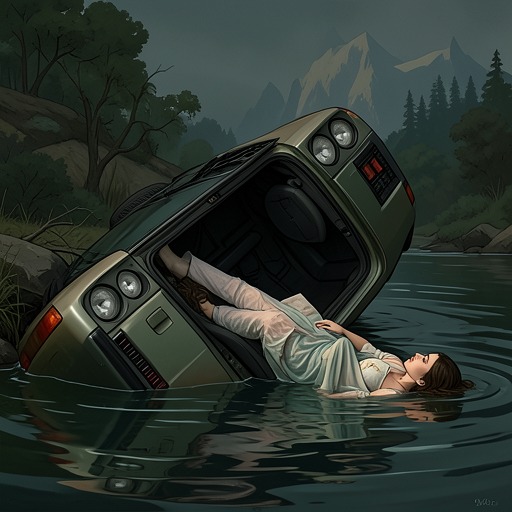
After the Toyota leaves the road and sinks, Kelly cannot see clearly or draw enough breath to scream. She imagines the Senator has escaped and will return for her, then calls out, “I’m here. I’m here. Here.” The words answer the immediate problem of her location: the Senator must find her in the water and reach the trapped passenger compartment. At the same time, the call gives Kelly something to do while she waits, a repeated action set against the car’s descent and her inability to free herself.
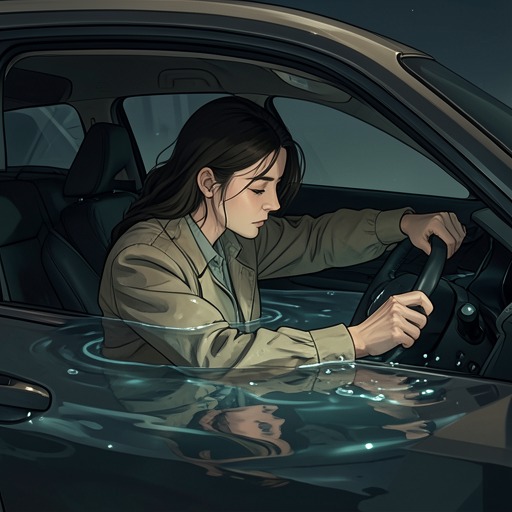
The phrase acquires urgency as she hears movement above. Kelly can hear the Senator in the shallows, diving and swimming, and understands that she must guide him toward her. She speaks loudly, her throat raw, repeating the message until it becomes an emphatic “I’M HERE.” She is not screaming or sobbing at this point; she is trying to control her fear and conserve the air available in the darkness. The volume and repetition make her voice a beacon, while the deliberate effort behind it shows her fighting not to become paralyzed by terror.
Repetition as Survival
The call recurs as the physical space around Kelly becomes harder to comprehend. Upside down inside the wreck, with her right leg caught in twisted metal and her body cramped against the car’s interior, she cannot reliably name the place where she is trapped. She pushes her face toward a diminishing pocket of air and strains to hold her head above the water. In this setting, “Here” is more than a direction: it asserts a point of awareness in an environment that is dark, disorienting, and steadily filling with foul water.
Her refrain persists through changes in the Senator’s apparent distance and the water’s rise. At one moment she believes he is close enough to hear; at another she senses him far away and fears he has been offended by her. When she cannot speak without water entering her mouth, she shakes her head, spits it out, and resumes calling for help. The repeated words register the bodily cost of communication: speaking requires effort, and even the air she reaches for can drift away from her.
The Rescuer and the Plea
“I’m here” addresses the Senator, but its meaning is shaped by the uncertainty of their relationship in the emergency. Kelly remembers their drive, his hard kiss, and his terrified movements as the car went into the water. She believes he may have kicked her while trying to escape, but interprets this as blind panic rather than a conscious decision to abandon her. She holds on to faith that he is attempting to reach her, and her call gives that hope a concrete task: he must locate her and open the door.
The phrase’s intimacy also recalls the preceding encounter on the beach. During the kisses, Kelly experiences the surge of desire as belonging to the man rather than to herself, and feels the familiar anxiety that having made him want her will leave her unable to refuse him. In the submerged car, that uneasy intimacy becomes an urgent dependence: the same man whose desire and actions have shaped the encounter is now the person she needs to hear her. The narrative does not make the call a declaration of romance or consent; it presents it as a plea for help under conditions in which Kelly’s body and movement are constrained.
Voice, Recognition, and Meaning
The refrain is repeatedly interrupted and renewed as Kelly’s consciousness moves through fear, memory, and determination. She insists that she will not give in to pain, remembers being praised as brave when her eye was bandaged, and imagines that she can save herself once freed. These thoughts do not remove the danger: her leg remains trapped, her breath is limited, and the air pocket is shrinking. Instead, they accompany the call as ways of maintaining resolve while rescue remains uncertain.
When Kelly hears her name called from above, the sound ripples through the black water. Her own “Here, I’m here. Here” answers that recognition and keeps the exchange alive across the barrier of the wreck. The brief words therefore carry both directions of the search: they tell the rescuer where Kelly is, and confirm that Kelly can still hear and answer. Their force comes from that double function, not from any assurance that help will arrive in time.
Across the episode, the phrase’s plainness contrasts with the increasingly alien world around it: the capsized car, the rising water, the distorted sense of space, and the uncertain passage of time. Kelly’s repeated call does not defeat those conditions, but it gives her a persistent voice within them. “I’m here” is at once an effort to be found and an effort to remain present—an appeal whose repetition makes survival audible even as the possibility of rescue narrows.