Kelly Kelleher
Black Water (Joyce Carol Oates Edition)Kelly Kelleher is the name by which Elizabeth Anne Kelleher is known to her friends, a highly accomplished student, a writer on national politics, and a volunteer teacher whose life is marked by both purposeful effort and vulnerability. She is twenty-six years and eight months old when the rented Toyota carrying her and The Senator plunges into black water. Trapped in the wreck, she tries to understand and escape it, but the car fills around her; the imagined rescue that briefly returns her to the surface gives way to the final fact of her death.
Identity and Background
Kelly’s baptismal name is Elizabeth Anne Kelleher, and that full name appears both on her undergraduate work and on the masthead of Citizens’ Inquiry, a biweekly publication of the Citizens’ Inquiry Foundation. Her friends call her Kelly. These names locate her in distinct spheres: Elizabeth Anne on the record, Kelly among friends, and a public-facing writer engaged with the political life she studies.
At Brown University, Kelly graduated summa cum laude with a bachelor’s degree in American Studies. Her ninety-page senior honors thesis focused on The Senator and examined his three Senate campaigns, his career in the Senate, his influence in the Democratic Party, and the possibility of his nomination as his party’s presidential candidate. Its subtitle was “Jeffersonian Idealism and ‘New Deal’ Pragmatism: Liberal Strategies in Crisis.” She received an A and nearly a page of handwritten praise from her advisor. Her work thus combines close attention to an individual politician with larger questions about political traditions and crisis.
That academic record stands beside practical service. Twice a week, on Tuesdays and Thursdays, Kelly drove her secondhand Mazda from her condominium behind Beacon Hill in Boston to Roxbury. At a poorly ventilated community services center, she taught adult students who could not read, working through primer texts in classes scheduled from 7:00 to 8:30 p.m. When asked how much progress the students were making, she answered, “Some!” The brief reply conveys both her enthusiasm and the modest, ongoing nature of the work.
Kelly had volunteered with the National Literacy Foundation of America for only a few months. She brought zeal to the classes, but her experience was not uncomplicated: she recognized a priggish self-righteousness and a Caucasian condescension in herself, alongside a visceral fear of being harmed in the streets around the center, on the debris-strewn expressway, and in Roxbury. By midsummer she had not told her parents about the work and rarely mentioned it to friends. The contrast between her commitment and her apprehension makes her public-mindedness neither effortless nor self-congratulatory.
Desire, Agency, and Relationships
Before the crash, Kelly and The Senator walk through the dunes, with wind whipping her hair and surf beating nearby. His fingers grip her bare shoulders; her response is shy but eager. She thinks that the encounter cannot be happening even as she senses that something is about to happen and cannot be stopped. The scene holds anticipation and apprehension together rather than presenting desire as a simple, settled choice.
Kelly’s experience of kissing is shaped by an imbalance between what she feels and what she perceives in the other person. Since girlhood, she has often experienced a man’s desire rather than her own as the force that arrives first: a quick, galvanizing shock. When The Senator kisses and gropes her on a beach where other people are present, she feels the jolt of his desire, then a familiar wave of anxiety and guilt. Her fear is that by making him want her she has made refusal impossible. The distinction between his desire and her own is central to how she understands the encounter and its pressure on her agency.
A remembered relationship with G----- offers another instance of physical intimacy complicated by harm. Kelly recalls that he sometimes hurt her while making love, unconsciously. Near their breakup, he tells her that he does not want to hurt her and hopes she knows it; she says that she does. She recognizes that she no longer has the power to hurt him in return, even as the old closeness persists in his insistence that they had been more than lovers and in her memory of their easy conversations. The recollection makes tenderness, injury, and unequal power part of the same emotional history.
Kelly’s response to The Senator’s hand also registers a history of how men use touch. As he smiles and grips her hand just perceptibly too hard, the pressure recalls men who seem to need a small, involuntary sign of pain—the startled look or contracted pupil. The narration connects this gesture to the unconscious hurt she remembers from G-----. Neither recollection makes the different relationships identical; together, they show how Kelly reads even a seemingly friendly touch through bodily knowledge accumulated over time.
The Crash and the Trapped Body
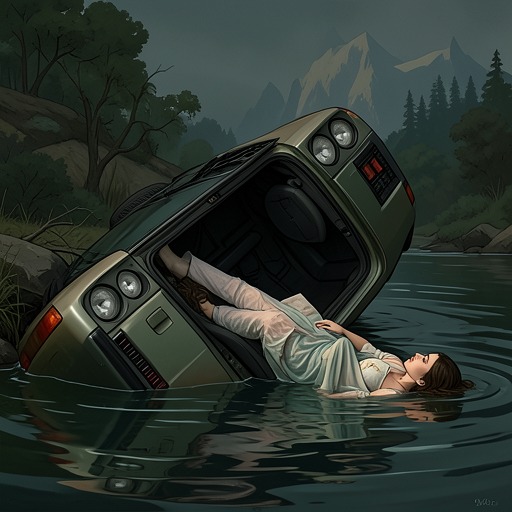
The accident transforms Kelly from passenger into a person struggling to orient herself in a space she cannot see. The road has no warning of the narrow wooden bridge or the dangerous curve before it. The Toyota hits a guardrail rusted almost to lacework and flies into water that appears at first as though it might be shallow. Kelly is twenty-six years and eight months old, too astonished and disbelieving to scream as the car strikes the surface. The apparent possibility of floating across to the far bank vanishes as black, foul-smelling water surges over the hood and cracked windshield.
Her body is caught amid the consequences of the impact. She cannot initially tell what is holding her: safety belts, the buckled passenger door, part of the roof, or her own position in a car turned onto its side. Her forehead has struck something; her right leg is pinned and her kneecap crushed, though she does not feel pain. The Senator’s body is thrown against her as he struggles for air. His startled cry is audible, but in the darkness Kelly cannot make a stable picture of where either of them is or which way is up.
The car’s remaining air becomes a temporary resource, not a promise of safety. Kelly reasons that even if bubbles remain inside the submerged vehicle, water will seep through its many holes and cracks and rise until it reaches her mouth, throat, and lungs. She has heard of accident victims surviving submerged cars for as long as five hours and imagines that patience might bring rescue. At the same time, she understands that the water must continue to rise. Her mind holds hope and a brutally practical forecast in parallel.
Kelly tries to turn that reasoning into action. She gropes for the steering wheel and uses it as a point of orientation, hoping to reach the driver’s door. Because The Senator managed to free himself using the wheel as a lever, she imagines that the wheel might help her too. She cannot know whether the door will open: it may have been forced open in the collision and then shut by the current. The car shifts under pressure from the water, and she loses time and consciousness in fragments, waking in terror as a rush of water crosses her face and neck. What she can feel, hear, and smell becomes more dependable than what she can see.
In a pocket of dwindling air beyond the passenger seat, Kelly lifts her head and tries to keep her mouth above the water. The place is difficult to name: roughly beneath the glove compartment, in the space where her knees and feet had been before the car overturned. As the water rises, she loses not only a clear sense of location but the words and logic that would let her describe it. She still senses that she must not lose the air, even when “air” and the surrounding space are no longer fully available to her as concepts. The narrowing of language tracks the narrowing of her physical margin for survival.
Rescue, Memory, and Death
Kelly tries to sustain herself through expectation and faith. She imagines that The Senator will come to her from the only direction available, remembers a promise, and tells herself she will not give in to pain. She believes that she is a strong swimmer and calls on the identity of a brave child praised by her family when her eye was bandaged. The appeal to that earlier self gives her a model of courage, but it cannot free her from the car’s damaged metal or make her body safe.
Her account of The Senator’s escape is not a confident, external reconstruction. She understands that he kicked her while trying to get free, and interprets his action as blind panic rather than a deliberate decision to harm her. She remembers who he is only after the struggle has begun. That distinction reveals Kelly’s capacity to extend understanding to him even while she remains trapped and fighting for her life; it does not change the physical fact that he got out and she did not.
As consciousness falters, Kelly bargains with the imagined rescue team. She is willing to trade her right leg, or both legs, and says she will sign a release and not sue if only they will act. She even thinks of Artie Kelleher, whom the family teases as litigious, and imagines explaining the circumstances and taking responsibility herself. These thoughts convert rescue into a negotiation in which she offers what she can; their urgency also shows how little control she actually possesses.
The narrative finally gives Kelly a vision of rescue. She sees The Senator diving toward the car, searching the cracked windshield, then opening the door that had trapped her. In the vision he takes her wrists and hauls her upward. She slips free and swims toward the surface herself, using the Australian crawl she learned at school. Seeing the moon, she understands that she is alive; she also sees her parents waiting among tall grasses, their faces aged and grief-stricken. For a moment, the imagined return to air, family, and her own swimming strength gathers the force of a reprieve.
That reprieve is overturned by the ending. Kelly imagines herself as a little girl in white anklet socks, running to be lifted by her parents, while black water fills her lungs. The apparent arrival at the surface is therefore not a literal escape: the scene resolves with Kelly dying. The movement from the clear, practical calculations of a trapped adult to the childhood image of reunion makes the conclusion especially stark. Her intelligence, courage, memories, and willingness to bargain remain active to the end, but none can reverse the bodily and environmental conditions of the submerged car.
Narrative Significance
Kelly’s crisis is narrated through the changing limits of her body and perception. At first she can identify the bridge, the guardrail, the passenger door, and the car’s likely route through the water; later she has to infer position by touch and remember the steering wheel as a tool. Eventually even the words for the space around her disappear. The shift is not merely from calm to panic: it is a progressive loss of the sensory and linguistic means by which she can make the wreck intelligible.
The novel also places Kelly’s careful study of political power beside her exposure to it. She has researched The Senator’s campaigns, career, party influence, and presidential prospects; in the dunes and the car, the relation between them becomes bodily and immediate. Her sense that male desire can make refusal difficult, her response to a hand squeezed too hard, and her later effort to understand The Senator’s panicked escape all complicate any simple account of her as either freely choosing or wholly without agency. The distinction between what Kelly desires, what another person wants, and what she fears may follow from refusing is part of the character’s defining tension.
The tension continues in the contrast between Kelly’s service and her limits. In Roxbury she makes a spirited effort to teach adults to read while acknowledging both her investment and her racialized fear; underwater she applies the same practical impulse to the problems of orientation, air, and escape. In both settings she tries to act within circumstances she cannot fully control. Her death does not turn those efforts into a successful rescue or erase their contradictions; it leaves the reader with the distance between purposeful action and the conditions that determine whether action can succeed.