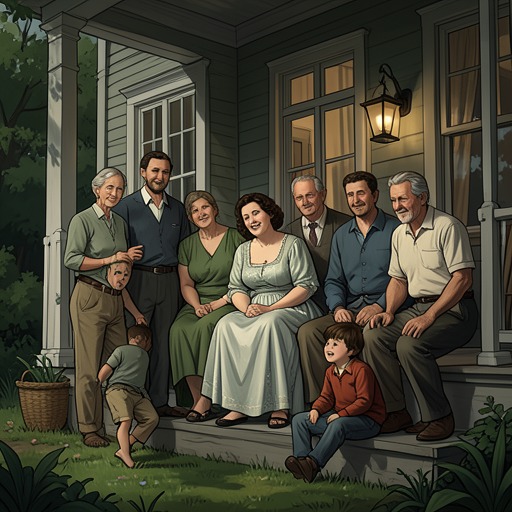
Kelly Kelleher and Grandpa Ross's grandparent-grandchild relationship
Black Water (Joyce Carol Oates Edition)Kelly Kelleher’s relationship with Grandpa Ross is marked by distinctive tenderness: he delighted in her as a child, knew her by a name different from the one used by her friends, and offered her a personal understanding of God near the end of his life. When Kelly later faces death, memories of his affection and his words become part of how she understands love, loss, and the lives she hopes to preserve.
A Grandfather’s Particular Affection
As a small child, Kelly ran across her grandmother’s prickly carpet in white anklet socks after kicking off her patent-leather shoes. Grandpa Ross swooped her up, lifting the laughing, kicking child above his head and playfully asking who she was. His arms trembled as he held her high; Kelly later overheard her mother and grandmother scolding him because of his blood pressure and warning that he might drop her. The memory holds both his exuberance and the adults’ concern for his safety.
Grandpa Ross’s affection was also expressed in the way he recognized her. Her friends knew her as “Kelly,” but he called her “Lizzie,” and she was his dearest grandchild among the several grandchildren for whom he had been a conduit into the world. The private name, set against her familiar one, conveys a bond with its own history and intimacy. Kelly remembered that he winked at her and that he loved her deeply.
His Advice Near the End of His Life
When Grandpa Ross was dying, his flesh had shriveled back from his bones, but his eyes remained alert and kind. He spoke to Kelly as if sharing a troubling secret, offering a compact statement of faith: “The way you make your life, the love you put into it—that’s God.” Rather than grounding belief in a religious institution, the advice locates the sacred in the life a person makes and the love she gives it.
The counsel has particular force because it comes from a grandfather who had shown his love through attentive, physical play and who remained lucid and loving as he approached death. Kelly carries his words into a later crisis; they connect the care she remembers receiving with the value she places on continuing to live and love.
Memory During Kelly’s Ordeal
Trapped in a submerged car, Kelly recalls Grandpa Ross while she is alone and uncertain whether help will return. The memory does not alter the immediate danger, but it gives her a remembered relationship to hold onto as she tries to understand her situation. His presence in recollection contrasts with her physical isolation: he had once lifted and delighted in her, but now she must endure without him beside her.
As Kelly imagines how her death would affect the family who loved her, she realizes that Grandpa Ross is already dead and therefore will be spared the news. The thought brings a moment of relief amid her fear. She also wonders whether there is any need to tell Grandma, showing how her concern turns outward even while she is struggling to survive. Her grandfather’s death is thus both an old loss and a fact that changes what she fears for the people she loves.
Love Remembered as a Source of Meaning
In another remembered family image, Kelly addresses Grandma, her mother, and her father with an expression of love. That recollection belongs to a wider circle of family attachment, while Grandpa Ross’s place within it remains singular: he gave her the name “Lizzie,” loved her openly, and offered the words that connect life-making with love. His influence is remembered not as an abstract doctrine but as care made personal.
The relationship also shapes the emotional measure of Kelly’s struggle. As she tries to stay alive, the possibility of pain to her family matters alongside her own survival; recalling that Grandpa Ross has already died briefly separates him from the suffering she fears her death would cause. His remembered affection cannot rescue her, but it remains a source of connection and meaning as she confronts isolation and danger.