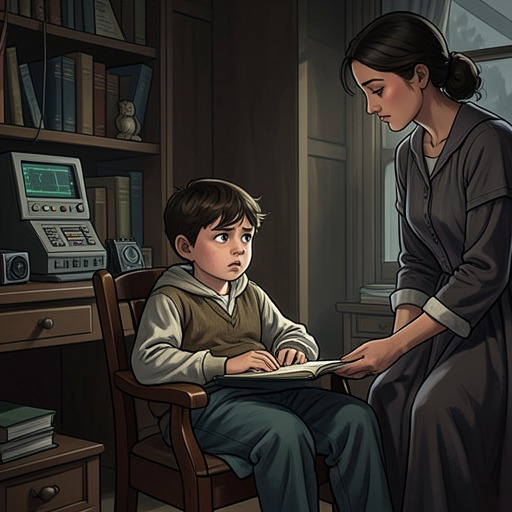
Kelly Kelleher's strabismus
Black Water (Joyce Carol Oates Edition)Kelly Kelleher’s strabismus is a congenital weakness in the muscles controlling her left eye, which made that eye wander and disrupted her vision during the first two years of her life. Her parents eventually chose surgery, and afterward the outward signs of the condition were gone. The episode is significant not only as a childhood medical history but as an early account of the pressure placed on Kelly’s body to appear normal: her parents’ love is inseparable from their fear of visible difference, while the novel’s later descriptions of her self-discipline make that ideal of correction recur beyond the childhood operation.
Condition and Early Experience
Kelly’s eyes are described in adulthood as gray rather than green, pebble-colored, large, and wide-spaced. She considers them attractive and ordinary, but is conscious that her lashes are pale, brittle, and thin enough to be scarcely visible without mascara, which she dislikes. The contrast between her present appraisal and the history of her eyes returns the reader to a childhood when their appearance and function caused her parents acute anxiety.
From birth, the muscles of Kelly’s left eye were weaker than those of her right. During her first two years, she did not see a single, stable image in the way the narration describes as normal; she registered two images, confused by overlapping details. The left-eye image could seem to float unmoored, and she instinctively relied on the stronger image from her right eye. As she focused on that eye, the left wandered further, sometimes appearing to look above or beyond the person in front of her while the right met that person’s gaze.
The account makes the experience concrete as well as medical. Artie Kelleher and Madelyn Kelleher repeatedly peered into their baby’s eyes, waggling fingers before her nose and asking questions during the first twenty-four months of her life. Their attempts to determine what she could see register their alarm, and sometimes impatience, alongside their concern. The narration calls the condition a defect while also showing how the family’s response gives that designation emotional and social weight.
Diagnosis, Family Conflict, and Surgery
The doctors did not offer a single course of treatment. One recommended exercises under a strict regimen; another advised an operation as soon as possible, warning that some children did not outgrow the condition and that the weaker eye might become permanently atrophied. Madelyn and Grandma Ross favored giving the exercises a chance. A young therapist, who wore eyeglasses herself, was optimistic about correcting Kelly’s problem, but weeks and months passed without reassurance that the exercises were working.
Artie’s reaction reveals how tightly he connects Kelly’s physical condition to vulnerability and social acceptance. He loved his daughter and wanted to spare her hurt, yet he could scarcely bear to look at her sometimes. He argued that the exercises did not seem to be working and urged Madelyn to imagine Kelly starting school: other children might tease her or think she was a freak. Madelyn, whose voice and hands tremble as she tries to answer reasonably, bursts into tears and rejects the prospect of her daughter being treated that way. The disagreement is not a simple opposition between caring parents and a medical decision; both fear harm to Kelly, but they differ over whether to wait or act to forestall a future marked by stigma.
The family’s conflict also reflects a broader investment in bodily health and appearance. Artie’s distress is framed as part of a family emphasis on physical well-being, attractiveness, and normality, and he acknowledges that emphasis defensively. His booming business in the early 1960s contrasts with his frustration that he cannot control his private life at home. The contrast makes his alarm about Kelly’s eye more than a clinical concern: the condition unsettles a family ideal that seems to promise order and control over the body.
Eventually Artie takes a weekday morning off, and the older Kellehers drive Kelly from Gowanda Heights, a suburban village in Westchester County, to Beth Israel Hospital on East End Avenue. The operation corrects her “bad” eye. Recovery is swift, though not as painless as promised; from then on, the outward signs indicate that her eyes and the girl herself are normal. The outcome resolves the visible misalignment, but the language of correction and normality preserves the pressure that made the operation seem urgent in the first place.
Normality and the Later Body
The operation belongs to childhood, but the novel’s account of Kelly’s later life repeatedly presents bodily discipline as a way of pursuing control. Since her freshman year at Brown, she has starved herself to maintain rigorous control and lighten her menstrual periods; after her relationship with G-----, she also uses deprivation to punish herself for having loved someone more than he appeared to love her. In the year described, she is determined to become healthy, forces herself to eat regularly, regains eleven of the twenty pounds she had lost, and sleeps without sleeping pills or the single glass of red wine that had become a bedtime ritual during the three months G----- lived with her. The text calls this recovery of health and normality, echoing the language attached to the surgical correction of her eye while distinguishing a chosen effort at recovery from the childhood intervention made on her behalf.
Other details show how ordinary standards of appearance remain present in Kelly’s self-presentation. Before her trip with The Senator, she files and polishes her fingernails in a subdued pale pink-coral-bronze to match her lipstick. The detail does not establish a direct cause-and-effect link between the childhood condition and her adult grooming; rather, set beside the history of her eyes and her efforts to regulate weight, it contributes to a recurring portrait of a body observed, assessed, and managed.
Narrative Significance
Kelly’s eye history places the medical correction of a bodily difference inside a family’s intimate negotiations over care, risk, and social judgment. The treatment addresses a specific physical condition: her left-eye muscles are weaker, her vision is confused, and a doctor warns of possible atrophy. At the same time, the parents’ fear of teasing and their concern with attractiveness show that the meaning of the condition extends beyond its mechanics. The account holds those dimensions together instead of reducing the experience either to a medical problem or to a symbol detached from Kelly’s childhood.
The episode also establishes a tension that continues in the novel’s attention to Kelly’s body: outward normality can be achieved, but it does not make bodily judgment disappear. Her eyes come to look normal after surgery; later, she attempts to restore health through regular eating after years of self-punishment. These are different circumstances and actions, not equivalent treatments. Read together, however, they show how the language of normality accompanies both care for Kelly and her own efforts to control her body, leaving the ideal itself open to scrutiny.