Madelyn Kelleher
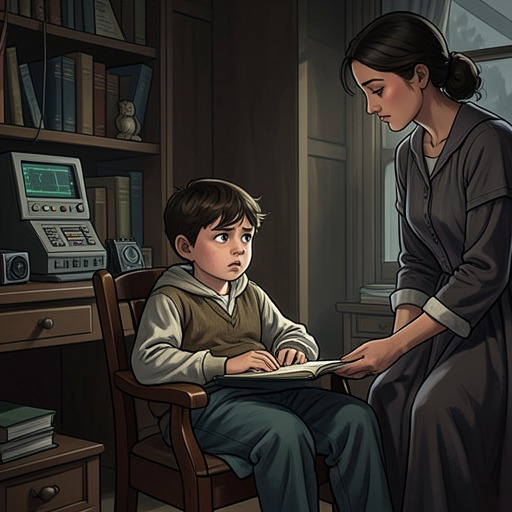
Black Water (Joyce Carol Oates Edition)Madelyn Kelleher, known to her daughter as Mommy, is Kelly Kelleher’s mother and one of the formative presences in Kelly’s memories. Her love is shown both in the family’s anxious response to Kelly’s childhood strabismus and, years later, in the comfort Kelly recalls while fighting for her life. Madelyn’s care is genuine, but it is shaped by fear of bodily difference and by the limits of what she can say about desire and adult relationships.
Family and the fear of difference
When Kelly was born with strabismus, an imbalance in the muscles of her eyes, Madelyn shared the distress of the family’s first two years of uncertainty. Kelly’s eyes did not register a single coordinated image; her weaker left eye wandered while she relied on the stronger right. Her parents repeatedly examined her eyes and tried to understand the problem. The narrative describes Madelyn and Artie Kelleher peering at their baby, moving fingers before her face, and trying to keep alarm and impatience out of their voices. Their concern came from love, but also from a strong emphasis on physical health, attractiveness, and being normal.
Doctors disagreed about whether to continue exercises or operate. Madelyn and Grandma Ross initially wanted to give the exercises a chance, supported by an optimistic therapist. As months passed without clear improvement, Artie pressed Madelyn to consider the future: he feared that children at school would tease Kelly as a freak. Madelyn tried to answer reasonably, but her hands and voice trembled; when he challenged her to imagine the consequences of waiting, she broke down and insisted that she did not want their daughter to suffer. The exchange shows her caught between hope for a less invasive course and the fear that delay might expose Kelly to lasting impairment or social cruelty.
Eventually Artie took a weekday morning off, and the Kellehers drove from Gowanda Heights to Beth Israel Hospital on East End Avenue. Surgery corrected Kelly’s eye. Her recovery was swift, though not painless, and outwardly she thereafter appeared normal. The operation resolves the immediate medical concern, but the account also makes visible the family’s assumption that bodily difference must be corrected to protect a child from suffering and exclusion.
A remembered lesson about love
Madelyn appears again in Kelly’s recollection of a conversation from when Kelly was sixteen and devastated after an awkward first sexual relationship with a boy who then avoided her. Kelly had been unable to sleep or eat and had said that she wanted to die, though she did not truly want to. Madelyn comforted her, reassuring her that she was a good girl and listening as she rejected the idea of taking birth-control pills. The memory is important not because it solves Kelly’s distress, but because it establishes her mother as someone who was present to comfort her at a moment of emotional crisis.
In that remembered conversation, Madelyn tries to explain that the intensity of young love does not last. She compares it with the fading of passion in her own marriage, admitting that she cannot remember when she and Artie last experienced that kind of closeness. She speaks quickly and with embarrassment, yet presses on with the difficult conversation. Kelly, later recalling it from inside the sinking car, cannot hear every word clearly in the present moment; memory supplies the mother who once held and consoled her. The episode reveals both a generational intimacy and a gap: Madelyn offers care and practical reassurance, while the subject of adult desire remains awkward and hard to articulate.
Motherhood in Kelly’s crisis
During the accident, Kelly’s recollections of Madelyn recur as the water rises around her. The present emergency and the earlier memory of maternal comfort overlap: Kelly imagines speaking to her mother and being reassured, even as she struggles to move and remain alive. The remembered conversation gives her a familiar emotional refuge, not a rescue from the physical danger.
A further memory brings Madelyn’s declaration of love into the crisis. She had told Kelly that, when the baby was handed to her in the hospital and she learned she had a daughter, she was happier than ever before and vowed that she would never let Kelly be hurt as she herself had been. She promised to give her life for her daughter. In the car, this protective vow returns alongside Kelly’s fear and her memory of being comforted. Its force lies in the contrast between a mother’s absolute promise and the limits of protection: Madelyn’s love shapes Kelly’s inner world, but cannot reach her in the wreck.
Characterization and significance
Madelyn is characterized through care expressed under pressure. Her trembling hands and tears during the debate over Kelly’s treatment show how parental love can coexist with uncertainty, while her efforts to comfort a heartbroken sixteen-year-old demonstrate a lasting closeness. Her recollection of marital passion also gives Kelly a rare, uneasy glimpse of her mother as a person with an intimate life beyond motherhood.
The novel’s use of Madelyn depends substantially on Kelly’s memory rather than on a separate account of Madelyn’s perspective. In the sinking car, past comfort is recalled at the point when Kelly most needs reassurance; the mother becomes emotionally present even while physically absent. That structure preserves the tenderness of Madelyn’s promises without suggesting that love can undo the accident. Her role is therefore both personal and thematic: she represents the care Kelly has received, as well as the painful distance between wanting to shield someone and being able to keep them safe.