Rented Toyota
Black Water (Joyce Carol Oates Edition)The Rented Toyota is the rented car in which The Senator and Kelly Kelleher leave a Fourth of July party and plunge from Old Ferry Road into Indian Creek. First a private space of easy conversation, flirtation, and hurried travel, it becomes a dark, submerged trap. Its collapse into the creek links the Senator’s driving and the neglected road’s hazards to Kelly’s fight for life, while the contrasting aftermath reveals how differently the two occupants escape the accident’s consequences.
Journey and Setting
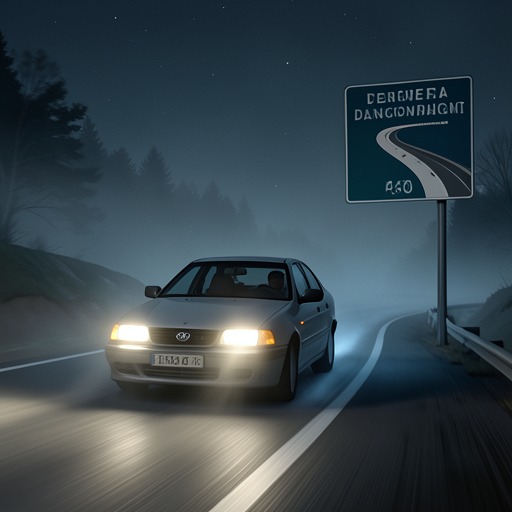
The Senator drives the Rented Toyota along an unpaved route on Grayling Island, Maine, as he and Kelly hurry toward the ferry at Brockden’s Landing. They have left the party at 17 Derry Road at about 7:55 p.m., aiming for the 8:20 crossing. The car is on the wrong road: Old Ferry Road, an obsolete, badly rutted route no longer marked by a sign, while a newer paved ferry road is in use. The mistake is understandable at dusk, but the old route is no longer maintained and should have been officially closed.
The journey’s casual intimacy sharpens the reversal. The two talk and laugh easily, like old friends; Kelly discreetly steadies the Senator’s hand so his vodka-and-tonic will not spill as he drives. He turns sharply onto the sandy road without signaling, ignoring an angered motorist’s horn. Kelly’s attraction to him has grown during the day: on a walk through the dunes, his hands on her bare shoulders and the surf’s pounding accompany her sense that something is about to happen and cannot be stopped. By the time they are in the car, the ride’s speed and excitement have become part of that momentum.
The road offers little warning of what lies ahead. At the apogee of a hairpin turn, the Toyota reaches a watercourse neither occupant knows is there. A narrow wooden bridge, its planks badly weathered, stands about thirty feet farther on, but there is no warning sign for either the bridge or the dangerous curve. The creek is Indian Creek, a fast-running stream that reaches eleven feet deep in some places and runs through marshland toward the Atlantic. The road, the missing signs, and the failing barrier make the car’s route more than a simple wrong turn: its danger has been left unmarked and uncorrected.
Impact and Submersion
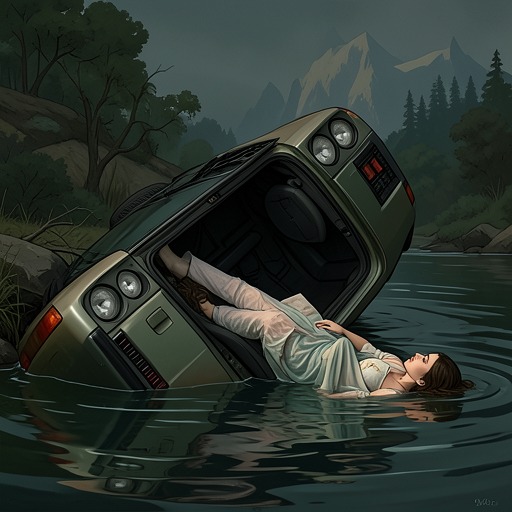
The accident arrives in a rush. The Toyota hits a sandy rut at more than forty miles per hour and begins to skid; the Senator brakes, but the car continues sideways with its own momentum. The guardrail appears from the shadows and breaks apart on impact. The vehicle jolts down a brief, steep embankment, rushes through tall reeds, and enters what may initially seem like a shallow pool. Instead, it sinks on its side into black, churning water. The account estimates a likely speed of about forty-five miles per hour from the skid marks and damage, and notes that a collision with the bridge railing might also have ended in a fall into the water. That alternative is speculation, not an observed event.
Inside the car, the crash abruptly remakes the occupants’ physical world. Water washes over the hood and cracked windshield; the passenger side is crushed inward, and Kelly’s head strikes the window. The Senator falls against her, their heads knock together, and the car’s changed orientation leaves the passenger door overhead. In the disordered seconds after impact, the Toyota is no longer transportation but an enclosure filling with water, with the outside world reduced to blackness, pressure, and the struggle to find a way out.
Kelly Trapped Inside
Kelly is not drunk. As the Toyota sinks, she is stunned, unable at first to draw enough breath to scream. She reaches for the Senator’s forearm, then his trousered leg and ankle, trying to hold onto him as he forces himself toward the door. His crepe-soled canvas shoe comes off in her hand. She cries out for help and begs him not to leave, but he escapes, and she is left in the car. The contrast is stark: the same vehicle that gives the Senator a route out becomes the space that confines Kelly.
Her efforts to understand the danger continue even as her body weakens. She recognizes that air remains in the submerged Toyota, but that water will seep through its cracks and raise the level by degrees. She cannot tell how far below the surface the car is; she can reason only that it is entirely submerged and that the air will not last. Water, black muck, and choking spasms make that calculation bodily and immediate. The car’s broken windshield, once evidence of impact, also evokes the many fissures through which the water is entering.
The ending refuses a simple separation between the car’s sinking and Kelly’s fate. The narration shows her dying as black water fills her lungs, then returns to her last possible effort: she strains upward, grips what she understands as a means of saving herself, and clings to a remaining bubble of air. In a vision of rescue, she embraces Buffy St. John and promises to explain the accident as no one’s fault. She even bargains that rescuers may amputate one or both of her legs if that will save her. The Toyota’s dwindling air is thus not merely a mechanical detail; it measures the shrinking space in which Kelly can still imagine survival.
Escape and Aftermath
The Senator gets out of the submerged Toyota and reaches shore, where he vomits the filthy water. He does not return to the car. After lying exhausted, he eventually gets up and limps away with one shoe on and one off, bruised and covered in muck. He makes his way to the highway and calls Ray Annick from a telephone booth at Post Beer & Wine. In the call, he says the girl is dead, then claims that she was drunk, became emotional, and grabbed the wheel. He anticipates that he could be accused of manslaughter. These are the Senator’s statements during his panic, not an established account of Kelly’s actions; the earlier scene describes her trying to steady his hand rather than grabbing the wheel.
The car’s wreck and Kelly’s entrapment are also set against the Senator’s concern for his own future. After escaping, he fears discovery and imagines the accident ending his political ambitions. Kelly, meanwhile, cannot know that he has reached a phone or called for help. Her consciousness continues to return to the moment before the Toyota left the road, as though the crash has not yet happened. That temporal dislocation makes the vehicle’s journey recur in her awareness: the black car is at once the approaching danger and the place from which her mind struggles to escape.
Narrative and Significance
The Rented Toyota concentrates several kinds of risk in one object. The Senator’s hurried driving and alcohol are part of the circumstances, but so are Old Ferry Road’s disrepair, its lack of signs, and the guardrail that gives way. The account identifies individual choices without making the roadside infrastructure disappear behind the drama of a single crash. The car carries both occupants into the hazard, yet their positions inside it are unequal: the Senator forces his way out, while Kelly is left with the water and the diminishing air.
The narration’s repeated return to the Toyota’s descent also changes how the journey is understood. Its early movement—turns taken at speed, an abrupt turn onto a sandy road, and the exhilaration of the ride—gives way to a sequence of bodily constraints: the tilted cabin, the door overhead, the broken glass, the waterline rising. The vehicle is at once a rental, a site of intimacy, and a lethal enclosure. Its transformation makes the accident’s physical reality inseparable from the story’s larger contrast between Kelly’s struggle to live and the Senator’s flight, self-justification, and fear of exposure.