The Senator
Black Water (Joyce Carol Oates Edition)The Senator is a leading Democratic politician whose public appeal and presidential ambition meet their starkest test in a marshland car crash: he escapes the sinking Toyota, leaving Kelly Kelleher behind, then calls Ray Annick to report that she is dead. The episode links his instinct for political survival to a more intimate failure of responsibility, while the novel’s shifting chronology sets his version of events against Kelly’s bodily struggle to live.
Political Identity and Public Presence
In 1988, The Senator had been among the three leading candidates for the Democratic presidential nomination. He withdrew for political prudence and released his delegates to his old friend, the Massachusetts governor. The governor, Dukakis, in turn asked him to join the Democratic ticket as running mate; he politely declined. His ambition remained oriented toward a future election: though no longer young, he was not old, and he was eleven years younger than George Bush.
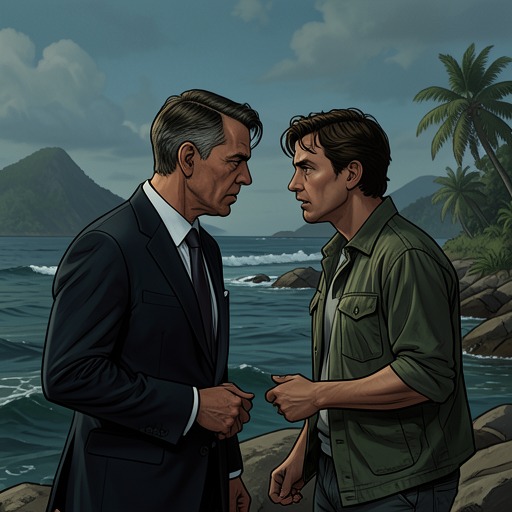
That career calculation has a public face. When The Senator arrives at Buffy St. John’s gathering on Grayling Island, guests pass the news among themselves in excitement. He appears youthful and ardent, more vivid in person than on television. At six feet four inches and perhaps 215 pounds, he has the scale of a former athlete and a wary, springy poise; even in scuffed beige canvas shoes, he seems ready to move. The physical confidence that makes him compelling in a room will later become a blunt advantage in the submerged car, where strength helps him get free.
His conversational manner also carries the assurance of a man used to setting the pace. During the drive, he teases Kelly about being too young to be a Beatles person, then announces the turn before sharply steering the Toyota. A motorist behind them sounds the horn, but The Senator pays no heed—not, the narration suggests, from deliberate hauteur, but because ignoring it is characteristic of him. His brisk confidence, effective as social performance, does not amount to knowledge of the road ahead.
The Drive and the Crash
The Senator and Kelly leave the party at 17 Derry Road at about 7:55 p.m., aiming for the 8:20 ferry at Brockden’s Landing. They have enough time if they drive fast and take the correct route. Instead, he turns onto Old Ferry Road, a badly rutted track whose sign has been absent for years. A newly paved Ferry Road has replaced it, and the old turn lies three-quarters of a mile beyond the right one. The mistake is described as understandable at dusk, but the road itself is no longer maintained by Grayling Township and should officially have been closed.
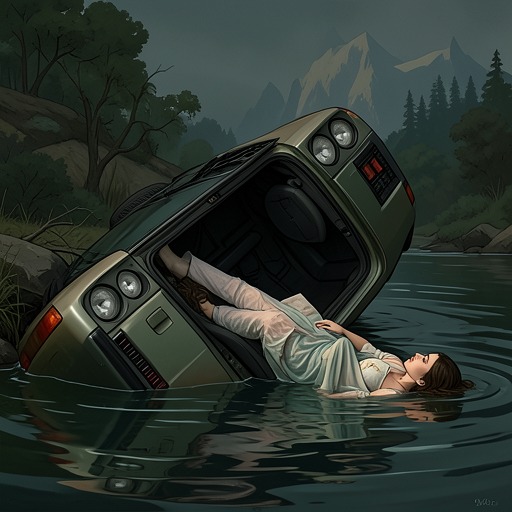
The danger is not simply a wrong turn. About thirty feet before the water lies a narrow wooden bridge with badly weathered planks, and neither the bridge nor the preceding hairpin curve is marked by a warning sign. At around 8:15, with no witness present, the Toyota leaves the road and plunges into water that neither occupant knew was there. The stream is Indian Creek: in places eleven feet deep and about twenty feet wide, running northeast toward a tidal pool and the Atlantic. The narrative also notes that, had the car not lost control on the curve, it might have struck the bridge railing and fallen into the water anyway; that alternative is presented as speculation, not certainty.
The crash follows a moment of intimacy. On a dune walk, with wind in Kelly’s hair and surf beating nearby, The Senator grips her bare shoulders; she feels shy and eager while thinking that something is about to happen and cannot be stopped. Later, on the beach, his kisses and groping register for her as the force of his desire rather than the expression of her own. She experiences desire as an electric shock, then anxiety and guilt: the familiar feeling that having made a man want her means she can no longer refuse him. The political figure who seemed so assured in company is, close up, flushed and sweating, with bloodshot eyes and the appearance of being out of condition.
In the car, Kelly experiences the skid as a sudden loss of control: the Toyota hits a sandy rut, slides sideways, breaks through a guardrail, and descends into black water. The vehicle sinks on its side. The Senator falls against her, and their heads knock as both struggle in shock and terror. He fumbles with his safety belt, forces himself out through a door made difficult to open by the water and the car’s changed position, and gets clear by sheer strength. Kelly clutches at his forearm and trouser leg, then at his ankle and shoe, begging him to wait and help her. His crepe-soled canvas shoe comes off in her hand; he leaves her behind in the car.
Escape, Survival, and the Call to Ray Annick
Kelly understands that The Senator has kicked her in blind panic, not through a considered decision to kill her, and she tries to preserve that distinction even as it cannot undo what he has done. The car’s plunge has turned a fast drive beneath a bright moon into a struggle for breath; the moment before, his kiss had been hard on her mouth, and now he is forcing himself through the submerged door while she is left behind. She tells herself that he did not know what he was doing. Her faith in that explanation coexists with the physical fact of his escape and her abandonment.
The Senator reaches shore, vomits the filthy water, and cannot bring himself to return to the car. After an uncertain stretch of time—perhaps half an hour, perhaps an hour—he gets up and limps back through the marsh toward the highway, wearing one shoe. He is bruised, soaked in black muck, and terrified that a passing motorist might see or recognize him. His thoughts turn rapidly from the accident to exposure, political ruin, and the possibility that he may never be nominated or elected president. He vows to remain sober for the rest of his life, but the vow arises inside a frantic plea for divine favor and deliverance from public disgrace.
At a telephone booth in the Post Beer & Wine parking lot, he calls the residence of St. John on Derry Road. A woman answers amid the party noise, and The Senator asks for Ray Annick, initially using the name Gerald Ferguson. When Ray comes to the phone, The Senator admits that it is he and says there has been an accident. He then tells Ray, in a faltering and desperate voice, that the girl is dead. Ray’s shock is immediate, but he refuses to discuss the matter over the phone and asks where The Senator is so that he can come get him.
The Senator’s account quickly shifts from disclosure to self-protection. He claims that Kelly was drunk, became emotional, grabbed the wheel, and caused the car to swerve; he anticipates that others will call it manslaughter and pursue him. The scene does not establish that Kelly grabbed the wheel. Instead, it places his explanation beside the earlier account of the skid and the unmarked, disused road, exposing how urgently he tries to reshape the crash into a defense against legal and political consequences. The phone call confirms his belief that Kelly is dead, but the novel’s intercut chronology leaves that belief radically out of step with Kelly’s still-unfolding fight inside the submerged car.
Relationships, Responsibility, and Narrative Contrast
The crash carries an intimate encounter into a crisis of unequal physical power. Before the car leaves the road, The Senator has held Kelly by the shoulders and kissed and groped her on a beach that is not deserted. Kelly registers the force as his desire, not hers, and then feels anxiety and guilt at the familiar thought that she has made him want her and can no longer refuse him. The narration places this response within a pattern reaching back to girlhood: being kissed has often meant feeling the male’s desire rather than recognizing her own. His political composure and commanding presence thus coexist with an encounter in which Kelly’s sense of choice is already troubled.
Underwater, that imbalance becomes literal. The Senator’s strength helps him wrench free of his belt and force open the door, while Kelly, trapped in the sinking car, grasps his arm and leg. She clutches his ankle and shoe as he struggles out; the crepe-soled shoe comes off in her hand, and he leaves her behind. Later, Kelly understands that he kicked her in blind panic rather than through a deliberate decision to kill her. This interpretation matters to her, but it does not change the action’s consequence: he escapes, and she remains trapped and fighting for breath.
The novel makes the gap between his actions and his account especially sharp in the call to Ray Annick. The Senator reports Kelly dead, then says she was drunk, became emotional, grabbed the wheel, and caused the car to swerve. The available account does not establish that she touched the wheel; instead, the crash occurs on an unmaintained road with an unmarked curve and bridge. His accusation therefore appears as an effort to assign blame before anyone can investigate, while his fear of a manslaughter charge turns immediately toward his own exposure and political future. Ray will not let him continue over the telephone: he demands to know where The Senator is and offers to come get him.
The timing of the call makes the contrast more than a dispute over responsibility. At 9:55 p.m., The Senator is already on shore, has reached a telephone, and believes Kelly is dead; Kelly, meanwhile, is still inside the car, bargaining with an imagined rescue team and willing to have one or both legs amputated if that will save her. She reasons that if she swallows the black water quickly enough, she may simply be drinking it and be all right. His conclusion that her life has ended is thus not knowledge of her fate but the limit of what he can see—and a measure of how completely his attention has turned from her survival to his own.
Narrative Role and Moral Contradictions
The Senator’s crisis is presented through a narrative that refuses to let his belief stand as the final account. While he is already on shore, convinced Kelly is dead and rehearsing the legal and political consequences, Kelly remains alive in the car. She bargains with an imagined rescue team, offering one or both legs if amputation would save her, and tries to reason that swallowing the water quickly might mean she is merely drinking it. The difference between his report and her continuing struggle makes the call to Ray Annick a point of dramatic irony: he speaks as if the outcome is settled, but the reader knows he cannot know that.
His self-description is equally unstable. During the escape, Kelly interprets his actions as blind panic rather than a deliberate attempt to kill her, and she has faith in that distinction. The narrative preserves the distinction without turning it into acquittal: panic may explain why he kicked her while trying to get free, but it does not erase that he escaped and left her trapped. His later claim that she caused the crash by grabbing the wheel is different again. The account supplies no confirmation of that accusation, while establishing a badly maintained road, a missing warning, and a skid; his version is presented as an attempt to anticipate blame, not as established fact.
The contrast also joins personal power to public ambition. Before the crash, The Senator’s stature, confidence, and practiced command of attention make him compelling; after it, he limps through the marsh in one shoe, fears recognition, and imagines the end of his political future. Yet the crisis does not dissolve his political reflex. Even as he reports Kelly dead, he describes her as drunk and emotionally responsible, and fears that he will be charged with manslaughter. The same man who once declined a vice-presidential place while looking toward another presidential election now measures catastrophe through the possibility of nomination, exposure, and disgrace.
The novel’s chronology gives Kelly’s body and The Senator’s public narrative unequal but simultaneous presence. His call converts uncertainty into an assertion of death; Kelly’s bargaining and effort to survive expose the limits of that assertion. The missing shoe, the black water, and his claim about the steering wheel leave the scene with material traces and disputed responsibility rather than a clean account of innocence or intent. His decisive significance lies in that unresolved divide: he is both a frightened survivor and a powerful man already attempting to shape what the accident will mean.