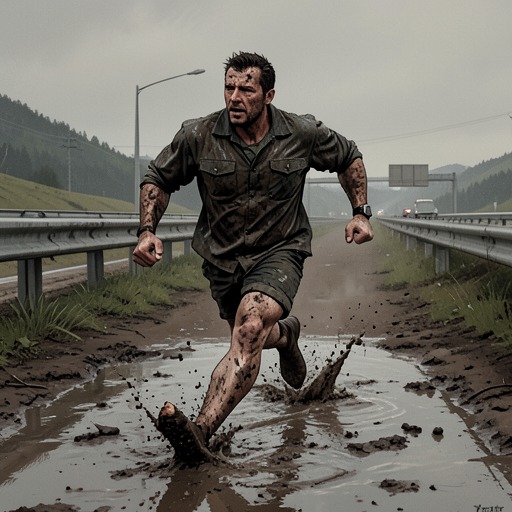
The Senator escapes the sinking car and leaves Kelly behind
Black Water (Joyce Carol Oates Edition)The Senator’s escape from the sinking car is the decisive abandonment at the center of Kelly Kelleher’s struggle to survive in Indian Creek. Trapped together in a car filling with black water, he forces his way out while Kelly clutches at him; she is left behind with his shoe in her hand, still pleading for help and believing he will return. His actions are first experienced through her confusion, then revisited through his flight and frantic call to Ray Annick, a shift that makes the difference between what Kelly hopes and what The Senator actually does impossible to miss.
The Crash and the Attempt to Escape
The Toyota has skidded off Old Ferry Road and plunged into the creek. The car sinks on its side, the water dark and churning around them. The Senator falls against Kelly as both struggle, stunned and terrified, to understand what is happening. Moaning, “Oh God. Oh God,” he fumbles with his safety belt, extricates himself from behind the broken steering wheel, and uses his strength to force open a door against the weight of the water and gravity. In the overturned car, the door is overhead; the familiar layout of the vehicle no longer tells them how to get out.
As The Senator pushes through the opening, Kelly grabs his muscular forearm, then his trousered leg and foot. His foot, still in a crepe-soled canvas shoe, strikes the side of her head. She catches at him again, tearing at him with her fingernails, but the shoe comes off in her hand and he gets away. The sequence is physical and specific: Kelly’s desperate grasp does not hold him, and the object she manages to keep is the shoe he leaves behind.
The road and the crash form part of the danger surrounding the escape, without making its precise cause a settled legal conclusion. The pair had left a party at about 7:55 p.m. to catch the 8:20 ferry, and the Toyota entered the water at approximately 8:15. They had taken Old Ferry Road, an unmaintained route with no sign marking it, rather than the newer paved road. The narrative also notes that there was no warning of the hairpin curve or the narrow, weathered bridge ahead. It speculates that even if the car had instead struck the bridge railing, the likely result could still have been a fall into the water. Those conditions establish a hazardous setting; they do not erase the separate fact of The Senator’s escape while Kelly remains trapped.
Kelly’s Experience of Being Left Behind
Kelly cannot see the situation clearly or know how long they have been struggling. After The Senator forces his way out, she continues to imagine that he has swum to shore to summon help, or that he is recovering on the bank so he can come back and dive for her. The possibility that he has abandoned her competes with the hope that he will return. For a time, she believes he will save her; she eventually remembers that the man with her is The Senator. In the darkness and panic, knowing his identity does not give her a way to reach him or to escape.
Her cries make the abandonment audible: “Don't leave me!—help me! Wait!” She has no name to call after him as the water enters her lungs. Later she repeats, “I'm here. I'm here. Here.” The words are both a call for rescue and an attempt to locate herself in a car whose position and exits have become disorienting. The account stresses her limited knowledge: she cannot tell whether he has left to get help, and she cannot know what is happening outside the submerged vehicle.
Kelly tries to preserve an explanation that makes his leaving bearable. She understands that he kicked or shoved her in blind panic and tells herself that he did not know what he was doing. The narrative describes that understanding as faith, not as evidence that he is coming back. In the car, hope is bound to the practical need to survive: she continues fighting even as the black water rises around her and she swallows it in small mouthfuls, reasoning that if she drinks it quickly enough she will be all right. Her earlier image of a shared struggle cannot settle what The Senator will do; his departure leaves her to fight alone.
From Flight to the Call for Help
The account later supplies an external view of what Kelly cannot witness. The Senator has escaped the car and reached shore, but the prospect of returning to the submerged vehicle overwhelms him. After an uncertain interval—perhaps half an hour, perhaps an hour—he rises and leaves on foot, limping with one shoe on and one shoe missing. He does not go back into the water to rescue Kelly. The shoe in Kelly’s hand and the one-shoed flight described later mark the same escape from opposite sides: for her, a remnant of the man who left; for him, part of the evidence of his panicked retreat.
He makes his way back along the marsh road toward the highway, covered in filthy black muck and afraid of being seen or recognized. The narrative presents his fear in terms that reach beyond the immediate accident: he imagines exposure, disgrace, and the possible end of his political ambitions. At the highway he crouches in the rushes, waits for traffic to clear, and runs to a telephone booth in the parking lot of Post Beer & Wine. His Rolex reads 9:55 p.m. By then, his focus is not on getting back to Kelly but on finding someone who can respond to the crisis he faces.
From the booth, he calls the residence of St. John on Derry Road and asks for Ray Annick, first using the name Gerald Ferguson. When Ray comes to the phone, The Senator admits that it is he and says there has been an accident. He then says the girl is dead. Ray reacts in shock but tells him not to explain over the phone, asks for his location, and offers to come get him. The Senator’s own account immediately shifts toward self-protection: he claims that Kelly was drunk, became emotional, and grabbed the wheel, and fears that he will be charged with manslaughter. These are his assertions in a panicked call, not an independent finding about how the crash occurred. The call reveals both that he has left Kelly behind and that, once on land, he turns to managing the consequences for himself.
The Meaning of the Abandonment
The contrast between Kelly’s and The Senator’s accounts gives the scene its moral and narrative force. From inside the car, the escape is incomplete knowledge: she clings, loses hold, and waits for the person who has gone. From the roadside and telephone booth, the same event becomes a sequence of choices and fears. The later account confirms that The Senator did not return, while his words to Ray show how quickly he frames the crisis around blame and his own possible prosecution. His panic explains the pressure under which he acts; it does not make Kelly’s abandonment disappear.
The scene also places bodily vulnerability and power in sharp contrast. Before the crash, The Senator’s fingers grip Kelly’s shoulders on the dunes, and he kisses her while she feels the force of his desire and the anxiety that she will be unable to refuse him. In the sinking car, his physical strength helps him force open the door; Kelly’s grasp on his arm and leg cannot keep him beside her. The episode does not reduce the crash to that earlier intimacy, but the change in what their bodies can do is consequential: the man who had exerted physical pressure on Kelly escapes using his strength, while she is left trying to hold on, breathe, and remain alive.
The setting likewise resists a simple account of accident as isolated misfortune. Old Ferry Road was no longer maintained and should, the narrative says, have been officially shut down. Its missing signs, dangerous curve, broken guardrail, and nearby bridge belong to a chain of public and individual risks. The Senator was headed toward the ferry but had taken a disused route; the text says this turn was an understandable mistake at dusk and separately gives a speculative alternative account of what might have happened at the bridge. The setting helps explain how the Toyota entered the water, while the escape and the failure to return remain distinct actions. The scene’s lasting reversal is that Kelly’s faith imagines rescue just as the reader learns that The Senator has chosen flight.