The Senator's intoxication
Black Water (Joyce Carol Oates Edition)The Senator’s intoxication is a steadily worsening condition that helps turn a rushed departure into a crash on Old Ferry Road, but the novel does not present alcohol as the only cause. He has continued drinking as the evening advances, drives erratically despite his technical skill, and takes an obsolete road in failing light. After the Toyota enters Indian Creek, his drinking gives way to terror and a rapid effort to manage the consequences. The contrast between the confidence of the drive and the panic after it exposes how impaired judgment, unsafe surroundings, and political self-preservation converge around Kelly Kelleher’s entrapment.
Drinking and Departure
At the Fourth of July party, The Senator’s drinking changes over the course of the evening. He begins with white wine, Perrier water, and low-calorie beer, then switches to stronger drinks with Ray Annick. By the final hour, he is less coherent and less fluent in repartee; his attention to Kelly Kelleher takes on a proprietary edge mixed with anxiety and indignation. The shift is visible both in what he drinks and in the change in his manner.
The missed schedule sharpens his impatience. The pair have already missed the 7:30 p.m. ferry, and he appears determined not to miss the 8:20. As they leave, he asks Kelly Kelleher to carry an additional vodka-and-tonic for him, alongside the drink he is already holding. She hesitates briefly, then agrees. By the time they are on the road, he has finished his drink and accepts the one she has carried for him. The alcohol is thus not a single prior indulgence but part of the journey itself, accompanied by pressure to make the ferry.
The Senator and Kelly Kelleher leave the party at 17 Derry Road at approximately 7:55 p.m., leaving twenty-five minutes to reach the ferry. The timing would be sufficient if they drove fast and chose the right route. He is impatient, watches the time, and drives as though the dwindling margin matters more than the conditions around them. Their plan and their drinking are entwined: haste narrows his attention just as the drinks are affecting his judgment.
Driving and the Wrong Road
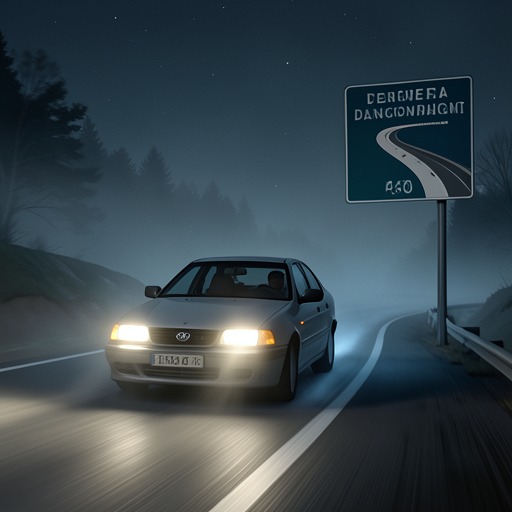
The Senator drives the rented Toyota with forceful, unstable rhythms: pressing hard on the accelerator, braking into turns, and accelerating again until the tires spin briefly in sandy soil. His vodka-and-tonic splashes over the rim of its plastic cup onto the seat and Kelly Kelleher’s summer dress. The car rocks over the rough ground, and his driving is described as aggressive. Yet the account makes a distinction between his impaired judgment and his ability to control the vehicle: he still handles the compact car with skill, almost instinctively, and Kelly initially feels protected by that apparent competence.
His route carries them onto Old Ferry Road, a badly rutted sandy track with no sign marking it. A new, paved Ferry Road has long replaced it, and the old turn lies three-quarters of a mile beyond the turn for the newer route. The wrong turn is described as understandable in the dusk and not dependent on alcohol alone; nonetheless, the road is no longer used or maintained by Grayling Township and should have been closed. Alcohol, haste, darkness, and a hazardous route form an interacting set of conditions rather than a simple, isolated explanation.
Kelly Kelleher notices their uncertainty and tells him that she thinks they are lost. He is not, strictly speaking, headed in the wrong general direction for Brockden's Landing, but he does not know that he has chosen the disused road. The distinction matters: the pair are moving toward their destination while becoming exposed to an increasingly dangerous route. His confidence in his driving and their apparent progress obscure the risk created by the unmaintained road.
Crash and Competing Causes
On the sandy road, the Toyota’s speed rises past forty miles per hour. It hits a rut and begins to skid; The Senator brakes, but the car continues sideways, breaks through the guardrail, and enters the rushes and water. The passenger-side door buckles inward, and the car sinks rather than floating. Kelly Kelleher is trapped inside, pinned and disoriented as black water rushes over the vehicle. The sequence turns the earlier signs of recklessness into immediate bodily danger.
The narrative complicates any claim that alcohol alone caused the crash. A later estimate places the car’s speed at about forty-five miles per hour, based on the skid marks and damage. It also speculates that, had the car not lost control on the hairpin curve, it might instead have collided with the railing of a narrow bridge ahead and fallen into the water with a similar result. This counterfactual does not absolve The Senator’s driving; it marks the limits of certainty about precisely how the disaster would otherwise have unfolded. The road itself is a crucial hazard, and the account keeps observed evidence, later speculation, and the driver’s later story distinct.
Indian Creek is a fast-running stream in marshland, as deep as eleven feet in some places and about twenty feet wide. It runs northeast toward a tidal pool connected to the Atlantic Ocean near Brockden's Landing. The setting makes the road’s neglect consequential: this is not merely a rough shortcut but a route beside water deep enough to swallow the car and trap its passenger.
After the Crash
After the collision, The Senator escapes the sinking Toyota and reaches shore, vomiting filthy water. The account presents him limping away in one shoe, injured, covered in muck, and terrified that a passing motorist might recognize or photograph him. He does not return to the car. His first journey after the crash is therefore not toward Kelly Kelleher but away from the scene, along the marsh road and toward the highway, where he finds a telephone booth.
His fear quickly gathers political and legal meanings. He imagines that the accident could endanger his party’s nomination and his prospects of becoming president; he also fears that the crash will be treated as manslaughter. He swears that he will remain sober for the rest of his life, a vow made amid panic and desperate appeals for divine favor. The scene shows intoxication’s aftermath not only as physical injury but as an abrupt confrontation with responsibility, public exposure, and the possibility of losing the future he has imagined for himself.
At the telephone, he first uses the name of his legal associate, Ferguson, when asking to speak with Ray Annick. Once Ray is on the line, he identifies himself as The Senator and says that there has been an accident and that the girl is dead. He then claims that Kelly Kelleher was drunk, became emotional, grabbed the wheel, and caused the car to swerve. That account conflicts with the narrative’s earlier description of The Senator driving aggressively and with the circumstances that place Kelly as his passenger, trapped in the wreck. His claim is not neutral evidence about the crash; it arrives while he is frightened of blame and trying to control what happens next.
Ray Annick stops him from explaining further over the telephone and asks where he is so he can come get him. The Senator gives his location. At 9:55 p.m., the digital numerals of his Rolex are still flashing, a precise marker of time amid his disordered flight from the scene. The call shows how quickly alcohol-related danger becomes a problem of political and legal containment: before the reader has a reliable account from the survivor, The Senator is already framing the event in terms of accusation and consequence.
Narrative Contrast and Significance
The novel places Kelly Kelleher’s increasingly limited perception beside The Senator’s externally focused panic. In the submerged car, she tries to orient herself through touch and calculation, but the darkness, injury, and rising water erode her ability to name her surroundings. She searches for a way out, tries to use the steering wheel as a lever, and eventually struggles to keep her mouth in a diminishing pocket of air. Meanwhile, The Senator reaches a telephone and speaks to Ray Annick. The same crash thus produces sharply unequal conditions: Kelly’s immediate struggle is for breath and escape; his is also a struggle over what the accident will mean for him.
That contrast gives the drinking episode its decisive significance. Intoxication does not stand alone as a diagnosis that explains every outcome: the narrative also identifies an obsolete road, an unmarked turn, pressure to make a ferry, and uncertainty about the crash’s precise mechanics. But The Senator’s drinking belongs to a broader pattern of haste and impaired attention, and his continued drinking before the drive makes his later claim about Kelly Kelleher especially suspect. The episode links private conduct to public power: a senator who fears political ruin can begin shaping a story even as the passenger he leaves behind is still fighting to survive.