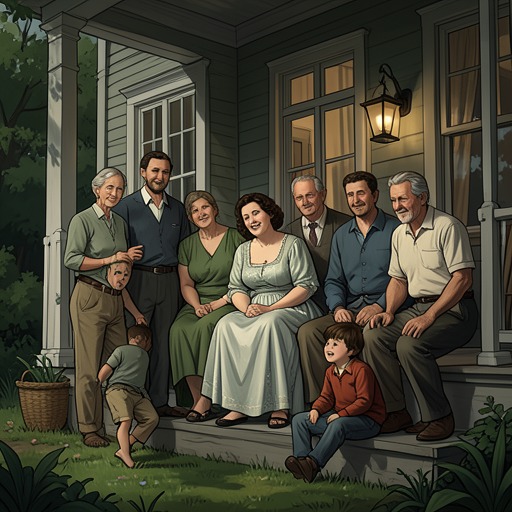
The mother-daughter relationship between Kelly Kelleher and Madelyn Kelleher
Black Water (Joyce Carol Oates Edition)Kelly Kelleher’s relationship with her mother, Madelyn Kelleher, is marked by protective love that can feel like both shelter and constraint. Madelyn’s care begins in Kelly’s infancy, when the family confronts a medical condition, and returns in the memories and imagined conversations Kelly experiences during the crisis in the submerged car. Their exchanges show a daughter struggling to claim independence and a mother whose fear of her being hurt is inseparable from love.
Early Care and the Eye Operation
When Kelly was born with strabismus, an imbalance in her eye muscles caused the images seen by her two eyes to overlap unpredictably. The condition worried both parents, but Madelyn and Kelly’s grandmother initially favored prescribed exercises and hoped that therapy would help. As weeks and months passed without clear improvement, Artie Kelleher argued that surgery should be considered before Kelly began school, fearing that other children would ridicule her. Madelyn tried to answer him calmly, but her trembling voice and hands gave way to tears when he pressed the point.
The disagreement centered on how to protect Kelly: whether to wait and continue exercises or act before the condition could affect her vision and expose her to social cruelty. The evidence portrays Madelyn as deeply involved in the effort to help her daughter, not as indifferent to the risks. Eventually, she and Artie took Kelly from Gowanda Heights to Beth Israel Hospital in New York City, where surgery corrected the eye. Kelly’s recovery was swift, though not entirely painless, and afterward her appearance seemed normal. That outcome closes this early episode of parental anxiety, while also showing how expectations of normality shaped the family’s understanding of care.
Advice, Privacy, and Independence
As an adult, Kelly continues to turn to her mother, but their closeness does not mean that Madelyn always knows what Kelly is doing or how she votes. Kelly is outraged by her parents’ support for a politician whose beliefs she condemns, and she asks Madelyn how she could vote for such a man. Madelyn takes her hand and calmly replies, “Kelly, dear, please: how do you presume to know how I vote?” Her answer preserves an important boundary: maternal intimacy does not give Kelly complete access to her mother’s private convictions.
A remembered conversation from Kelly’s adolescence offers a different kind of boundary-setting. At sixteen, after a boy she had loved avoided her following their first sexual experience, Kelly was devastated and told her mother that she wanted to die. Madelyn tried to reassure her that this intense kind of love would not last, while Kelly could not bear the pain of rejection. She did not actually want to die, and her mother comforted her as she cried in her arms. The episode establishes a pattern that resurfaces later: Madelyn’s reassurance may not immediately meet the intensity of Kelly’s feelings, but her presence provides comfort when Kelly feels overwhelmed.
Protection and Friction
The mother-daughter bond also carries friction. Madelyn is distraught about the possibility that Kelly may be hurt, and Kelly feels guilty at seeing her mother’s distress. At the same time, that distress angers her: she wants her mother to stop worrying about her as if she were uniquely fragile, and compares Madelyn’s protectiveness with the way her friends’ mothers handle their daughters’ lives. Madelyn answers that she worries because she loves Kelly and does not want her to be hurt.
That exchange gives the relationship its central tension. Madelyn’s protective impulse is not presented as a lack of respect for Kelly, but it can make Kelly feel watched and limited. Kelly wants room to make choices and face the consequences herself; Madelyn wants to shield her from pain. Neither position erases the affection between them, but their different understandings of what love requires can turn care into conflict.
The Mother’s Voice During the Crash
During the crash and its aftermath, Kelly’s memories of her mother return amid confusion and fear. She remembers being the teenage girl who had cried in Madelyn’s arms and insists to herself that her mother is still there to comfort her. The remembered scene of maternal reassurance is woven into Kelly’s effort to make sense of what is happening, so the past relationship becomes a resource in the present crisis rather than merely background information.
Kelly also recalls Madelyn’s declaration that, when Kelly was born, she vowed never to let her daughter be hurt as she herself had been hurt, and would give her life for her. The vow clarifies the force of Madelyn’s protectiveness: it is rooted in a promise made at Kelly’s birth, not simply in a wish to control her. As the crisis continues, Kelly relents in an imagined conversation and asks her mother to take her home. The appeal returns the relationship to its most elemental form: a daughter seeking the safety of her mother, even after a life of asserting her own independence.
The novel does not establish whether Madelyn is physically present at the crash site or at the hospital during these moments. Kelly wonders about her parents’ young-looking faces and their possible location, but the scene leaves that uncertainty unresolved. What remains clear is the emotional presence of her mother: remembered comfort and the wish to go home persist as Kelly confronts the danger of the wreck.