
Cinema as Refuge and Life Script
BlondeThis thread traces how films first shelter Norma Jeane from abandonment, then provide the scripts through which she understands love, identity, and her own life.
increasing Bearing strength in each event
 decreasing
Bearing strength in each eventdecreasingThe Unfinished Film
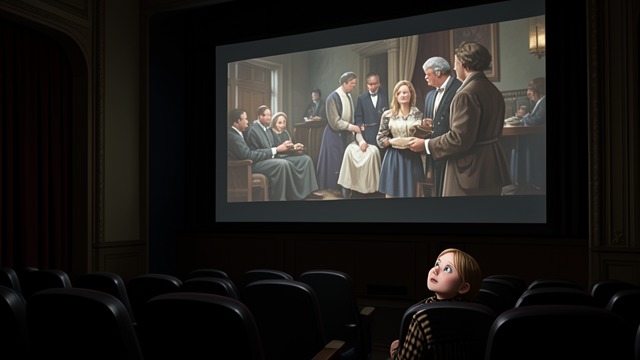
The Unfinished Film
A world inside the theater
As a small child, Norma Jeane returns with her mother to the Egyptian Theatre, where motion on the screen feels more comprehensible than the life outside it. Films give her an ordered world of images, music, entrances, and embraces at a time when family life is unstable and explanations are scarce.
A story without an ending
The imagined film always breaks off before its conclusion. That unfinished ending becomes a pattern: Norma Jeane can picture lovers finding one another, but cannot trust that the reunion will last. Cinema offers her a refuge, yet its promises remain suspended, waiting for a final scene that childhood never supplies.
The Screen as Witness

The Screen as Witness
Learning herself from images
Norma Jeane’s birthday visit with Gladys Mortensen introduces her to a photograph of the father she has never met. The revelation arrives like a scene in a film: a hidden identity is disclosed, but only through an image and a story supplied by someone else.
A self made from other people’s accounts
The child learns that photographs and other people’s words may seem more reliable than her own uncertain memory. Her imagined father, the promised return, and the cinema’s conventions all help her organize what she cannot verify. The screen and the photograph become substitutes for direct knowledge, while the child’s own identity remains dependent on being seen and named.
Replaying the Lost Ending
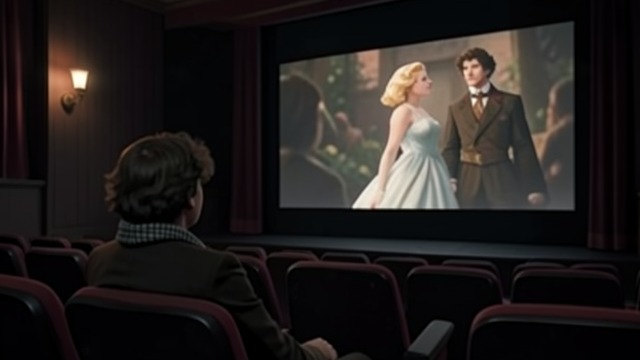
Replaying the Lost Ending
Returning to the dark theater
As an adult, Norma Jeane continues to revisit cinemas, sometimes in disguise, searching for the film she never managed to see through to its end. The habit is not simply escape: she uses the theater to suspend time and return to a childhood in which the screen promised an intelligible world.
Recognition without resolution
The imagined film changes with the actors and years, but its central figures remain recognizable: the Good Princess and the Mysterious Prince. Their recurring separations mirror her fear that love can vanish without warning. Repetition offers temporary reassurance, yet cannot provide the ending she seeks or settle whether the story is hers or merely one she has learned to perform.
The Screen Becomes Work

The Screen Becomes Work
From audience to image
The screen that once offered refuge becomes the site of Norma Jeane’s labor. At the Studio she is renamed, styled, photographed, and assigned small roles; the cinematic world that once seemed freely magical is now governed by contracts, executives, lighting, and the demands of publicity.
An identity shaped for viewing
As she learns how the camera frames her, Norma Jeane begins to distinguish the private person from the image designed to attract an audience. That distinction is never secure. She can experience herself as the woman in the mirror, the performer in the scene, or the figure others recognize, and cinema turns those selves into overlapping roles rather than a single stable identity.
The Audience Writes the Ending

The Audience Writes the Ending
A private life made public
With the success of Niagara and the publicity surrounding later films, the audience’s attention becomes part of the story. Strangers treat Marilyn Monroe as a character they already know, while the woman behind the image must live among interpretations she did not choose.
The image outlasts the person
The novel links cinema’s power to its danger: a recorded image can preserve a face while leaving the life behind it unread. The public may applaud, desire, or condemn the figure on screen without understanding the person who performed her. The myth promises permanence, but it also makes the performer increasingly difficult to distinguish from the role.
Early childhood, before her sixth birthday
June 1932, on Norma Jeane’s sixth birthday
Adulthood, during repeated visits to Los Angeles cinemas
1947–1950, from Studio debut to the success of Niagara
After Niagara and through the rise of Marilyn Monroe’s public fame
