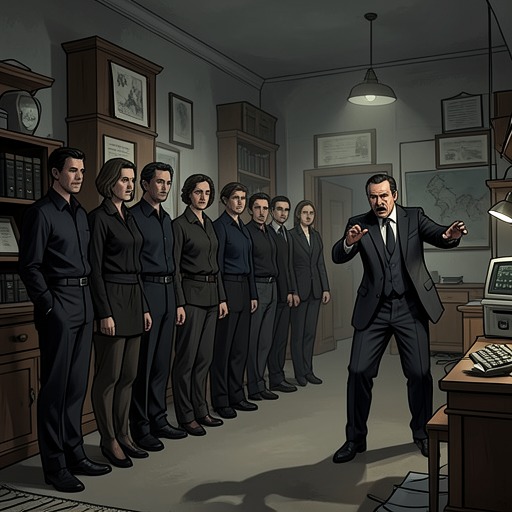
Armed ambush outside Warshawski’s apartment
Blood ShotThe armed ambush outside V. I. Warshawski’s apartment turns the threat against her into a concrete danger at home: two men with guns and lockpicks were caught at her door, but the reinforced entrance held. The police detained them, and Warshawski was asked to identify them as possible participants in an earlier attack. Her tentative recognition, undercut by a voice she did not recognize, made the lineup a lead rather than a resolution.
The Threat at the Apartment
After midnight, Warshawski returned to her building expecting to find the police activity she had imagined on the way home. Instead, the street showed no sign that officers had been there. She entered cautiously, keeping close to the lobby walls and moving sideways up the first half-flight of stairs. Mr. Contreras and Peppy came out to meet her. Mr. Contreras, in tears, said the police had taken two men away in a patrol wagon but had not told him where Warshawski was or what had happened.
The men had used a ruse to get Mr. Contreras out of the way, then waited at Warshawski’s door. He understood that they had come looking for her and regretted that he had not been able to help. His distress gives the attempted intrusion a second consequence: even before Warshawski knew what the men had carried, the attack had frightened the neighbor who had been left without answers.
A Door That Held
Warshawski’s apartment had been protected against another break-in after an earlier home invasion. This time, the steel-lined door could not be cut through, and the intruders could not get past the third dead bolt. The defenses prevented them from entering, but their failure to breach the apartment did not make the encounter harmless: the police later confirmed that the two men outside had both picklocks and guns.
After calming Mr. Contreras, Warshawski inspected the apartment with him and Peppy. Mr. Contreras stayed outside until he heard the last bolt slide home, then went downstairs to bed. His care reinforces the contrast at the center of the episode: the danger comes from armed strangers at the door, while the immediate protection comes from a neighbor who waits to make sure the locks are secured.
Arrest and Lineup
Warshawski could not get information that night from officers at the Central District Police Station. The following day, Bobby told her that police had picked up two men loitering by her door. They claimed they had gone upstairs for a smoke; their lockpicks and guns gave the police grounds to hold them temporarily on weapons charges. The state’s attorney had secured twenty-four hours, but a stronger charge depended on linking them to Wednesday’s attack on Warshawski. Bobby asked her to attend a lineup for that purpose.
The lineup tested a memory Warshawski herself regarded as fallible. She reflected that stress can distort a witness’s recollection of broad features, even as a gesture or other distinctive detail may remain vivid. With her hands in her pockets to hide their trembling, she watched six similar-looking men through a one-way window. She asked that they repeat words associated with the earlier attack, hoping to compare their voices with the voice she remembered.
A Tentative Identification
Warshawski focused on the second man from the left, whose secretive smile reminded her of the attacker’s apparent confidence that a serious charge would not stick. But resemblance was not enough. When the man spoke, his husky South Side twang did not match the emotionless voice she recalled. She therefore said she thought he was the man, while making clear that she did not recognize the voice and could not be certain.
The lineup produces no definitive identification in the available account. Its uncertainty matters: the men’s weapons and presence at the apartment establish a serious threat, but they do not by themselves prove that either man took part in the earlier assault. By presenting Warshawski’s competing visual and vocal impressions—and her explicit reservation—the episode keeps the investigation open rather than turning a pressured act of recognition into proof.