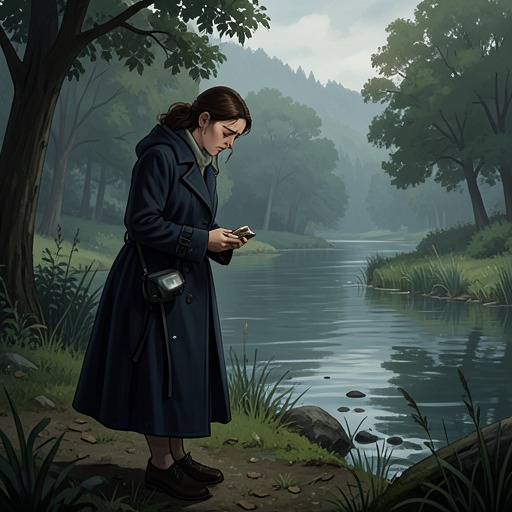
Caroline Djiak
Blood ShotCaroline Djiak is a community organizer whose search for her absent father brings private family history into collision with environmental activism, workplace injustice, and threats against people close to her. Her story is also a test of the long, sisterlike attachment between her and V. I. Warshawski: Caroline begins by trusting V. I. Warshawski to solve a mystery, then tries to make her stop when the investigation endangers the fragile security Caroline has built for her mother. In the end, she can accept the painful truth without allowing it to dictate the life she chooses.
Identity and Early Bond
When V. I. Warshawski returns to her former school for a reunion of the Lady Tigers, Caroline is waiting at the women’s locker-room entrance with a clipboard. The years have altered her copper pigtails into a halo of curls, but not her short stature, energy, or tactlessness. She briskly tells V. I. Warshawski that the other players arrived earlier, asks whether she brought her uniform, and reminds her that she was the tournament’s most valuable player. The scene establishes Caroline as both organizer and familiar instigator: she treats an old friend’s return as a task to manage, not an occasion for ceremony.
Caroline and Nancy Cleghorn have arranged the reunion because the Lady Tigers are again entering regional championships after a twenty-year interval. Their pregame gathering is meant to serve the team and bring publicity to the neighborhood and to the South Chicago Reawakening Project, where Caroline is deputy director and Nancy handles environmental affairs. Caroline’s public work and personal ties are already intertwined: the reunion is both a community event and an expression of friendships formed long before their current responsibilities.
That history helps explain why Caroline’s request carries unusual force. As a child, she followed V. I. Warshawski, adored her, and even tried basketball because V. I. Warshawski played. She once nearly drowned while following her into Lake Michigan. When V. I. Warshawski left for college, Caroline ran to meet her train on visits home. These memories make Caroline’s trust more than a convenient client relationship; they are the inheritance of years spent imagining V. I. Warshawski as a protective older sister.
Work, Activism, and the Search
After the reunion, Caroline asks V. I. Warshawski to work for her professionally as a detective. Her initial assignment is direct: find her father. V. I. Warshawski specializes in financial crime, not missing persons, and the man has been absent for more than a quarter century. She nevertheless struggles to refuse because Caroline’s childhood devotion remains vivid to her, and Caroline still looks at her with complete trust.
Caroline’s job at the South Chicago Reawakening Project is not background decoration. She is involved in an effort to establish a solvent-recycling plant in the neighborhood. The project has funding, a proposed site, specifications that have passed the environmental tests its organizers have considered, and prospective customers nearby, including Xerxes and Glow-Rite. Caroline presents the proposal as a way to create about a hundred jobs while reducing harmful material entering the ground. When the proposal is kept off the board’s agenda despite being filed on time, she recounts the procedural obstruction to V. I. Warshawski and Nancy Cleghorn. The project’s lawyer, Ron Kappelman, consults an attorney for the U.S. Environmental Protection Agency, who finds the submission in strong shape. Caroline’s frustration reflects the gap between the project’s stated readiness and its exclusion from consideration.
The search for Caroline’s father becomes entangled with V. I. Warshawski’s inquiries into Joey Pankowski and Steve Ferraro, former Xerxes workers. V. I. Warshawski initially considers whether one of them might be Caroline’s father and begins asking questions at the plant. After Nancy Cleghorn is killed, the investigation’s priorities shift: finding Nancy’s killer becomes more urgent, while the unexplained reactions of Xerxes personnel and a company doctor continue to trouble V. I. Warshawski. Caroline’s personal request has opened a line of inquiry that reaches beyond a family mystery into the conduct surrounding the workers and the plant.
Threats and Protective Secrecy
Caroline is already carrying information about danger when V. I. Warshawski visits a meeting at the project office to discuss John McGonnigal. Caroline breaks off her heated discussion with the group, flushes at the interruption, and later tells V. I. Warshawski that Nancy had called on Tuesday morning. Nancy said she had received threatening phone calls and believed someone was following her; Caroline understood the threats to concern the plant. The danger that hangs over the environmental campaign is thus disclosed first through Nancy’s confidence in Caroline, before Nancy’s death makes that warning part of a murder investigation.
Caroline also becomes a target of pressure intended to halt V. I. Warshawski’s questions. Someone calling from the Xerxes plant tells her that Joey Pankowski is her father and claims there is proof, then urges her to persuade the detective to leave the case. Caroline reports the call but does not accept its supposed evidence as a reason to trust the caller. Later, she explains a more immediate vulnerability: an unknown man has investigated the mortgage on the house she and her mother worked for years to buy. He threatens that the loan could be canceled unless Caroline stops V. I. Warshawski from pursuing the questions about her father, Pankowski, and Ferraro.
The mortgage threat clarifies Caroline’s apparent reversal. She had tried to call off the investigation not because the search had ceased to matter, but because the threat placed her mother’s home at risk. Louisa Djiak is seriously ill with kidney failure and is receiving dialysis; Caroline fears that a major upset could overwhelm her. Caroline has told her mother that Nancy is dead, but withholds the details of the search and the threats to spare her further distress. She also admits that, after Nancy’s murder, she told the police V. I. Warshawski knew why Nancy had been killed. Caroline meant for the police attention to keep watch over her and Louisa. Her actions reveal care expressed through concealment and intervention, even when those choices strain her trust with V. I. Warshawski.
Family Truth and Changing Perspective
Caroline’s fear that the investigation will damage her mother’s security coexists with growing doubt about the value of the search itself. She tells V. I. Warshawski that she wishes she had never asked her to look for her father and cannot see how discovering him would improve her life. Yet she also recognizes that the search has already changed it. When V. I. Warshawski eventually tells her that Joey Pankowski is not her father, Caroline immediately understands that the answer is no. The truth is Art Jurshak: Caroline’s parentage is connected to his abuse of Louisa Djiak, a painful history Caroline had not wanted to confront.
Caroline does not receive this revelation as a simple solution to an unanswered question. For years, she had imagined that V. I. Warshawski’s father, Tony Warshawski, might have been her own father, and pictured herself as part of V. I. Warshawski’s family. She believed that being like V. I. Warshawski, including doing the same kind of social-activism work, might make her more fully accepted as a sister. The reality of Art Jurshak’s identity brings shame and grief, but it also makes clear how much of Caroline’s imagined family life depended on an idealized alternative.
After Louisa Djiak dies, Caroline’s understanding of her mother changes. She recognizes how easily Louisa might have become angry or bitter, yet instead remembers her as a lively woman who loved life and was a good mother. Caroline also visits Art Jurshak Jr., whom she understands to be her half-brother. From him she learns how profoundly Art Jurshak failed as a father: he married to protect his political prospects, then kept his son at a distance and showed little interest in him. This knowledge alters Caroline’s comparison between the childhood she had and the one she once fantasized about. Being raised by Louisa alone, difficult as it could be, may have been better than growing up in Art Jurshak’s household.
Departure and Narrative Significance
For four months after learning the truth, Caroline stays away from V. I. Warshawski. She returns after Louisa’s death and apologizes for the insults she had directed at her, including her anger about V. I. Warshawski leaving the neighborhood. Caroline acknowledges that she had misunderstood the older woman’s example: V. I. Warshawski had not wanted Caroline to imitate her, but to choose what suited herself. Caroline’s reconciliation does not erase the conflict over the search. She accepts that knowing the truth is better than sustaining a more comforting invention, even though she had once asked for the investigation and later tried to stop it.
Caroline announces that she is leaving Chicago for Montana to study forestry. She had wanted a life in the country but had concealed the plan because she feared V. I. Warshawski would despise a choice that did not resemble her own activism. She has arranged for her mother’s relatives to buy the Houston Street house, providing money for the move, and plans to leave in two weeks. Her decision is a practical break with the neighborhood as well as a personal one: she does not have to remain in the role of V. I. Warshawski’s devoted imitator to belong to her.
Caroline’s arc turns on the difference between being protected and being permitted to choose. She tries to protect Louisa through secrecy, and she tries to protect the mortgage by asking V. I. Warshawski to stop. V. I. Warshawski’s persistence brings Caroline an answer she finds painful, but Caroline ultimately decides that a difficult truth is preferable to a fantasy that has silently governed her sense of family. The two women end not as blood sisters, but as chosen sisters: V. I. Warshawski embraces Caroline and affirms that their bond will last. Caroline’s departure therefore closes the search without closing the relationship; she leaves with a future not modeled on V. I. Warshawski’s, and with a sisterhood that no longer depends on becoming someone else.