Corporate concealment and intimidation
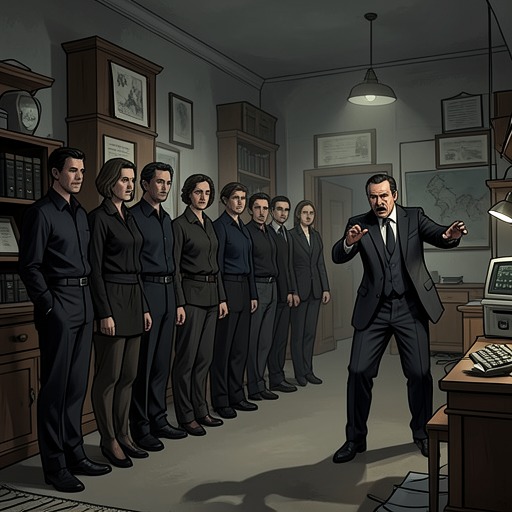
Blood ShotCorporate concealment and intimidation are linked strands in V. I. Warshawski’s investigation of the Xerxes plant. The evidence points to efforts to obscure the nature of Joey Pankowski and Steve Ferraro’s workers’ compensation case and to discourage renewed scrutiny, but it does not establish who ordered the threats. That uncertainty matters: pressure appears across several relationships, while responsibility remains something Warshawski must investigate rather than assume.
Concealment around the workers’ case
Warshawski initially came to the Xerxes inquiry for a personal reason. Caroline Djiak had hired her to discover the identity of Caroline’s father; Pankowski seemed a possible candidate, and the search led Warshawski to look for people at the plant who knew him. Caroline then dismissed her. Warshawski continued investigating, however, because people were lying about what had happened between Pankowski, Ferraro, and Xerxes. A contact at the U.S. Department of Labor had also told her that Frederick Manheim once represented the workers. Her inquiry had thus shifted from a family question toward the history of a workplace dispute and the efforts to keep that history unclear.
Warshawski’s suspicion is sharpened by the difference between the case’s apparent scale and the way it was described to her. She questions why Gustav Humboldt had characterized the suit as sabotage when, as she understood it, Pankowski and Ferraro sought workers’ compensation. That discrepancy suggests concealment, but does not by itself explain its source. The investigation also turns up Jurshak’s insurance report, which Nancy Cleghorn had found, and Warshawski considers whether it contains damaging information. She does not yet know what it proves. The report’s connection to Humboldt’s company makes it a lead, not a settled account of a scheme.
Pressure surrounding the appeal
Manheim tells Warshawski that he received a threatening phone call after the workers’ case, while an appeal was under consideration. The caller did not name the case; the warning referred generally to the dangers of using the appellate system. Manheim did not report it to the state’s attorney. Instead, the call angered him, and he pushed in every way he could to build an appeal, but found no viable path forward. His account complicates any simple picture of intimidation as an effective command: the threat unsettled him, yet his response was to try harder to pursue the case.
The financial stakes offer one possible explanation for the sensitivity of the dispute. Manheim observes that a successful precedent could expose the plant to claims by workers who had become ill or died. Warshawski considers the scale hypothetically: if a thousand people had worked there over ten years and each claim reached a quarter of a million dollars, the total would be enormous, even if Ajax paid. This is not a count of actual victims or claims, but it makes clear why reopening the matter could threaten the company’s interests. At the same time, Warshawski reasons that if Humboldt’s legal position were secure, threatening Manheim could backfire by giving a judge grounds to vacate the decree. She therefore doubts that the call straightforwardly represents a company strategy.
Intimidation reaches the investigation
The pressure is not confined to the earlier appeal. After Warshawski’s investigation becomes more visible, Caroline arrives frightened and tries to get her to stop. Caroline reports receiving a call from the Xerxes plant. The caller apologized for the expense of hiring Warshawski, claimed to have proof that Pankowski was Caroline’s father, and urged Caroline to persuade Warshawski to accept that claim and leave the case. Caroline says she did not need to see the purported evidence. The episode joins the original search for her father to the investigation of the workers’ case, using Caroline’s family uncertainty as a means of influencing the detective. Yet neither the caller’s identity nor the alleged proof is established in this encounter.
Warshawski also challenges the account Humboldt received about the suit. In a call with his secretary, Ms. Hollingsworth, she suggests that Curtis Chigwell may have misled him. Hollingsworth rejects the suggestion, citing Chigwell’s fifty years as a reliable associate, but agrees grudgingly to relay Warshawski’s concern. Warshawski’s point is specific: someone had seriously misrepresented the nature of Pankowski and Ferraro’s suit to Humboldt. Her call makes concealment an internal question as well as an external one—whether Humboldt was directing the deception, or whether information was being managed before it reached him.
Uncertain responsibility and accumulating clues
Warshawski considers several possibilities rather than treating suspicion as proof. Perhaps someone connected with Ajax wanted to prevent the case from reopening; perhaps a junior employee, hoping to advance, applied pressure without authorization. She recognizes that a company culture with loose ethics could encourage subordinates to use intimidation, but this remains her hypothesis. The threatening call to Manheim, the warning conveyed to Caroline, and the misleading description of the suit do not yet form a proven chain of command.
Other developments increase her concern without resolving that chain. Warshawski recalls that after she sent Murray Ryerson to speak with Chigwell, Chigwell attempted suicide twelve hours later. She reasons that Humboldt must have known what was being concealed about Pankowski and Ferraro, since he had approached her and tried to persuade her to accept a false account. This is her inference from his conduct, not independent confirmation of exactly what he knew. Jurshak’s insurance report, Nancy’s discovery of it, and the unexplained pressure around the appeal remain separate pieces of an investigation still in motion.
Significance
The pattern makes intimidation visible through ordinary channels: a phone call that never names its target, an appeal discouraged without an explicit order, a claimed piece of evidence used to redirect Caroline, and a company account of a lawsuit that Warshawski believes is false. Each act is suggestive, but the gaps between them prevent a premature conclusion about who is responsible. The tension between what can be documented and what can only be inferred gives the concept its investigative force. Concealment does not merely hide the workers’ experience; it also makes the search for responsibility harder, while the threats encourage those with relevant knowledge to doubt whether speaking or continuing the inquiry is safe.