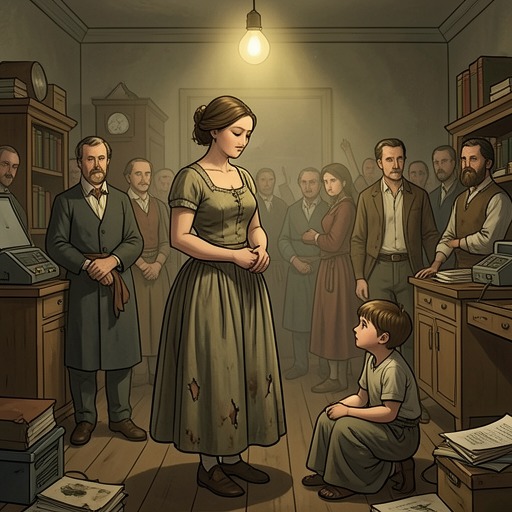
Ed Djiak
Blood ShotEd Djiak is Martha Djiak’s husband and a forceful presence in the household shared with Louisa and Caroline. He presents himself as a man wronged by Louisa’s pregnancy and by the neighborhood’s response to it, but his anger and violence undermine that account. When Victoria Warshawski confronts the family about how Louisa became pregnant, Ed’s response helps reveal the abuse and concealment behind the family’s version of events.
Identity and Place in the Household
Ed is described as tall and unusually long-limbed, with an elongated face and dangling fingers. The narration contrasts his appearance with the short, square good looks that Caroline and Louisa share with Martha. This physical description places him sharply apart from the women of his family, while his behavior makes the household feel organized around his temper and expectations.
In the first visit, Martha tries to manage the encounter before Ed enters. She tells Victoria to present herself as someone who has come to visit Louisa, rather than raise the subject that brought her there. When Ed arrives, Martha greets him brightly and introduces the visitor. The contrast is telling: Martha is working to keep the meeting ordinary, while Ed immediately turns it into a test of Victoria’s loyalty to the neighborhood she left.
Ed associates Victoria with the University of Chicago and treats her education and departure as evidence that she has become too good for her old neighborhood. He arrives with groceries—apples and pork chops, but no beans—and Martha puts them away before offering coffee. He rejects coffee in favor of beer. These domestic details establish a familiar household routine, but they do not soften the imbalance of the exchange: Ed sets the tone, and Martha adjusts around him.
Louisa and the Family’s Account of the Past
When Victoria mentions having visited Louisa and expresses sympathy for her condition, Ed responds by framing the family as having suffered because of Louisa. He presents her pregnancy as an injury done to him, and claims that she used his name and remained in the neighborhood with her baby instead of leaving to join the sisters, as the family had arranged. He also invokes the neighbors’ whispers over the ensuing twenty-five years. His account makes Louisa responsible not only for becoming pregnant but for the public shame her continued presence supposedly brought upon him.
That blame is not a passing complaint. Ed says that the family has suffered long enough and that Louisa should now suffer in turn. His language turns a daughter’s hardship into a debt owed to her parents, while refusing to consider what she herself endured. Victoria challenges the premise by asking what Louisa did to make him suffer. Ed does not answer that question with any account of harm; instead, he attacks Louisa’s character and condemns the fact that she stayed.
The later confrontation gives this history a different meaning. Victoria returns to the Djiak home at night and says she wants to discuss the man who got Louisa pregnant. She identifies him as Art Jurshak, Martha’s brother. Ed initially rejects Victoria’s right to raise the subject, then acknowledges Martha’s maiden name, Jurshak. When Victoria states that Art got Louisa pregnant, Martha says that he had promised not to do it again. Her response suggests that the pregnancy was part of a pattern of abuse, rather than the isolated scandal Ed had made it out to be. It also exposes how the family’s silence protected the man responsible while leaving Louisa to carry the blame.
Conflict with Victoria
In their first encounter, Victoria’s questions provoke Ed into anger. He turns from his complaint about Louisa to condemn Victoria and her mother, Gabriella Warshawski, for having defended Louisa. When Victoria challenges his hostility toward the women in his family, Ed strikes her and orders her to leave. Victoria stands her ground, makes clear that insults against her mother are unacceptable, and warns him not to repeat them. Ed eventually turns away, and Victoria leaves after thanking Martha for the coffee.
The second visit intensifies the conflict because Victoria has come to name Art and force the hidden history into the open. As Martha begins to confirm what happened, Ed orders her to stop speaking. He then shoves past Victoria and slaps Martha. Victoria immediately intervenes, striking Ed before he can continue toward her. She blocks his charge with a chair; he falls into the table, bringing down the small black-and-white television and beer in the resulting commotion. The scene converts the household’s suppressed history into an immediate confrontation: Martha’s account is interrupted by violence, and Victoria answers that violence by protecting her.
Characterization and Narrative Role
Ed repeatedly casts himself as the injured party. Louisa, in his telling, caused the family’s suffering; Victoria’s education makes her a snob; Martha’s attempts to speak are treated as disobedience. These shifts of blame allow him to avoid the central question of what happened to Louisa. The details revealed later reverse that emphasis. Art, Martha’s brother, is identified as the man who impregnated Louisa, and Martha’s words suggest that he had promised not to repeat his conduct. Ed’s forceful defense of silence therefore serves to protect the family’s concealment, not to establish the truth of his grievance.
His repeated resort to intimidation also gives the two visits a clear pattern. In the first, he uses insult and physical aggression to drive Victoria from the house; in the second, he turns on Martha when she begins to confirm the past. The parallel makes his anger more than a reaction to one provocative guest. It is a means of controlling who may speak and what may be said. Yet his control is not complete: Victoria persists, Martha begins to disclose what she knows, and Ed’s own reaction helps expose the violence underlying the family’s silence.
The available episodes do not establish a later change in Ed or what becomes of him. They do show the limits of his account of the family’s history. He insists that Louisa is the source of the Djiaks’ suffering, while the revelation about Art and Martha’s testimony point toward a different source of harm—and toward the cost of leaving Louisa to bear the family’s shame alone.