Ellen Cleghorn
Blood ShotEllen Cleghorn, also known as Mrs. Cleghorn, is Nancy Cleghorn’s mother and one of the people left to face the intimate aftermath of Nancy’s murder. At the funeral and in the family home, her grief is visible but does not prevent her from helping V. I. Warshawski. When she finds Nancy’s house ransacked, she calls V. and later helps her search for the papers the intruders may have been seeking. That practical cooperation brings a private loss into the investigation without turning Ellen herself into a detective.
Identity and Family Context
Ellen appears as Mrs. Cleghorn, a mother whose relationship to Nancy is established through the funeral and the family home. At Mount of Olives Methodist, she greets V. with tremulous warmth and invites her to come to the house after the service, where they can have coffee and talk. Her welcome is a small act of connection amid a crowded, unsettled family gathering: Nancy’s four brothers serve as ushers, while their children jostle and whisper in the front pews near the casket.
Ellen also invites V. to sit with her, though V. gently declines. The refusal is not a rejection of Ellen; V. wants to see who has come to the funeral and does not want to become a buffer between Ellen and the unruly grandchildren. The exchange establishes a difference in their positions. Ellen is surrounded by family, yet her daughter’s death has made the gathering strained; V. is an old acquaintance who can offer attention while remaining alert to the murder investigation.
Grief at the Funeral and Home
After the service, Ellen’s invitation becomes a quieter conversation at the house on Muskegon. A handful of mourners are there when V. arrives with Sergeant McGonnigal. Ellen’s makeup is streaked with dried tears, but she greets V. warmly and accepts the sergeant politely. Her hospitality persists even as grief is plainly visible; she is still attending to those who come to the door while the house fills with the consequences of Nancy’s death.
Ellen says the day is calmer because the children have been taken elsewhere. She also mentions the possibility of moving to Oregon when she retires, a remark that connects the immediate commotion of family life to an imagined future elsewhere. V. responds by teasing her about making such a drastic move to avoid grandmotherhood. The exchange briefly restores their familiar ease, but it does not erase Ellen’s loss or the vulnerability beneath her composure.
The Ransacked House
Ellen becomes an important source of information when she goes to Nancy’s house in South Chicago to collect her financial records and discovers that the place has been ransacked. She calls V. in distress. The furniture has been pulled apart and papers scattered; this is not merely disorder but a thorough search of a house where Nancy had been able to fix up only a couple of rooms. Ellen recognizes the destruction as the sort of damage V. would understand, and her report immediately makes the search relevant to the murder investigation.
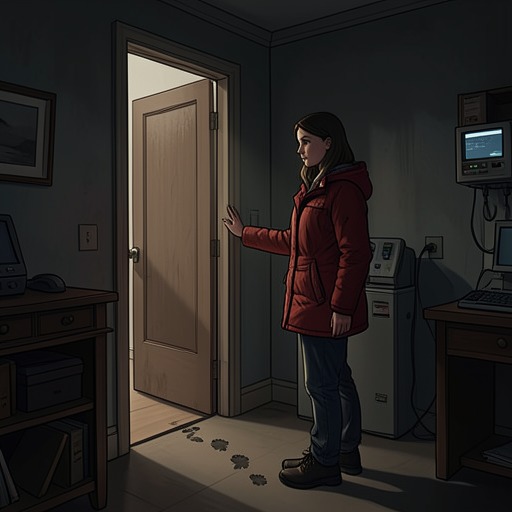
Too nervous to remain at the house, Ellen waits outside her own home for V. The Cleghorn house looks remote and bedraggled in the gray mist, and even the turret that had been Nancy’s bedroom seems to droop. Ellen’s normally pleasant, round face is gaunt and strained. She gives V. a tremulous smile and climbs into her car, explaining that she is shaking so badly she does not know how she got home. Her fear is grounded in a specific discovery: someone has torn through her murdered daughter’s belongings, and she cannot face the place alone.
Helping V. Search for Nancy’s Papers
Ellen nevertheless stays involved. At first V. offers to take the house keys and spare her another visit, but Ellen accompanies her. Later, over coffee and leftover cake, she asks what the intruders were looking for. V. reasons that they wanted something small and flat, probably papers, and notes that bricks have been pried up in more than one fireplace. Ellen says Nancy might have visited her while she was at work, though she does not know whether Nancy left anything there, and offers to let V. look through the old bedroom.
That offer gives V. a route back into Nancy’s private space and her remaining records. While sorting through the files, V. finds a photocopied 1963 letter concerning Jurshak & Parma’s fiduciary role for Humboldt Chemical’s Xerxes plant, attached to an actuarial study about insurance losses. The document appears ordinary to V. in isolation, and its significance is not something Ellen explains. Her contribution is different: by reporting the break-in, accompanying V. despite her fear, and opening the old bedroom to inspection, she helps preserve access to the material that may clarify why Nancy was killed.
Narrative Role
Ellen’s importance lies in the way the investigation passes through a bereaved family’s ordinary spaces. The funeral, the coffee, the old bedroom, and the damaged house are not incidental settings; they show what Nancy’s death has done to those closest to her and where the search for answers must continue. Ellen is neither shown uncovering the killers nor interpreting the evidence. Instead, she reports what has happened, shares what she knows about the house, and permits V. to search.
Her combination of hospitality and fear gives this assistance its weight. She welcomes V. when the family gathering is difficult, then calls her when Nancy’s home has been violated. The ransacking makes Ellen’s loss newly immediate: the intruders have disturbed not only a crime scene but the remains of her daughter’s life. By trusting V. enough to return with her and open Nancy’s bedroom, Ellen helps turn grief into a limited, concrete act of cooperation, even while the investigation remains beyond her control.