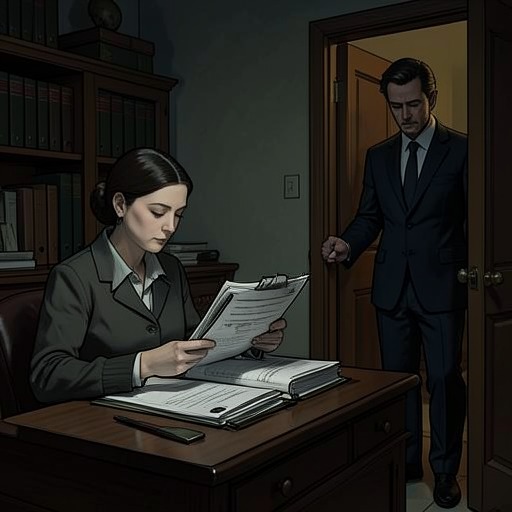
Frederick Manheim
Blood ShotFrederick Manheim is a South Side attorney whose unassuming practice first appears as part of a failed workers’ compensation case, then becomes a possible base for a much larger challenge to Humboldt Chemical. The contrast is central to his role: he is neither an established specialist with a large legal operation nor a figure untouched by intimidation, but a locally rooted lawyer who ultimately decides that the opportunity to pursue the Xerxes workers’ claims outweighs the safety of remaining within his familiar practice.
Background and Practice
Manheim’s office sits among the small storefronts crowding Ninety-fifth Street, between a beauty parlor and a florist. His name, Frederick Manheim, Attorney-at-Law, is printed on the plate glass in black-and-gold lettering intended to look discreet and old-fashioned. The front room, repurposed as a reception area, has vinyl chairs, a desk with a typewriter and an African violet, and old copies of Sports Illustrated. Behind it, a few pieces of wallboard divide off a tiny office and bathroom from space once used for shop inventory. The setting makes his scale visible before his legal history does: this is a neighborhood practice, not a firm equipped for a large corporate fight.
Manheim describes himself as a decent lawyer but not an ambitious one. He grew up on the South Side and likes working there, helping local businesses with leasing problems and employment issues. His connection to the neighborhood is also practical: Joey Pankowski’s sister owns the flower shop next door, and she recommended him to the two workers after he had done good work for her. They chose him because of that local trust, although their case would demand more specialized resources than his modest office could readily provide.
The Pankowski and Ferraro Case
Joey Pankowski and Steve Ferraro had sued Humboldt Chemical not for wrongful dismissal but to establish that their illnesses were job-related and eligible for workers’ compensation. The case went to trial, and Humboldt prevailed. The two men later died, while the lawyer did not seem eager to continue with an appeal. When V. I. Warshawski visits Manheim, he initially appears troubled at the mention of his former clients; he says he remembers everything connected with them and knows the case by heart even after time has passed.
His account places the defeat within both professional limits and personal responsibility. Manheim had handled compensation claims before, but he recognizes that he might have sent Pankowski and Ferraro to someone else. He took the case because it offered a change from his usual work and because he believed he could manage it. Their loss weighs on him in part because he wanted the men to win, and because a successful precedent could have exposed Humboldt to claims from other employees who had become ill or died at the plant. The case therefore stood not only for two clients’ claims but for the possibility of wider liability.
Threat and the Blocked Appeal
Manheim reveals that, after the trial and while an appeal was under consideration, he received a threatening phone call. The caller did not name the case, instead making a generic reference to the dangers of using the appellate system. Manheim says the call made him angry, and that he pushed in every way he could to build an appeal; he also says he could find no viable path forward. The threat thus did not simply silence him, but it formed part of the conditions under which the appeal stalled. The available account does not identify the caller or establish who was responsible.
That history helps explain why Warshawski approaches him again cautiously. After learning that Humboldt may have known about the toxic effects of Xerxine as early as 1955, she asks whether he would be prepared to organize and manage action for hundreds of former Xerxes employees, and perhaps current ones too. She makes the scale and cost explicit: the work could occupy the next decade, require researchers, associates, and paralegals, and attract larger firms seeking contingency fees. This would be a transformation of his practice, not simply another neighborhood case.
Taking on the Xerxes Claims
Manheim does not accept on the spot. He responds to Warshawski’s proposal with caution, recalling the earlier threat and asking whether she is joking about the material. Once she makes clear that she is serious, he weighs the choice against the life he already has. He says he cannot see how he could live with himself if he had a chance to win the case and passed it up merely to preserve a quiet practice. He asks when he can receive the documents and agrees to come to Lotty Herschel’s address that evening.
At the meeting, Manheim fills legal pads with notes and asks questions about the plant and its employees while listening to the others’ advice. Even after committing himself, he sets conditions for responsible action: he will not rush, wants to double-check the data, locate the laboratory that conducted the blood work, and consult an environmental-law specialist. Warshawski warns him that Gustav Humboldt may act while the evidence is being checked, including possibly putting pressure on the laboratory. Manheim considers the risk and still refuses to back out, asking only for Warshawski’s moral support from time to time.
Narrative Role
Manheim’s trajectory turns on a distinction between caution and retreat. His earlier case ended without an appeal, and a threatening call remains part of that history; the new opportunity does not erase either fact. Instead, he responds by insisting on verification and specialist advice while accepting a much larger professional burden. His small storefront, the flower shop that connected him to his first clients, and the prospect of building a team around the Xerxes claims all mark the distance between the practice he has chosen and the work now before him. The story leaves him at the threshold of that undertaking: committed to proceed, but intent on establishing the evidence carefully before acting.