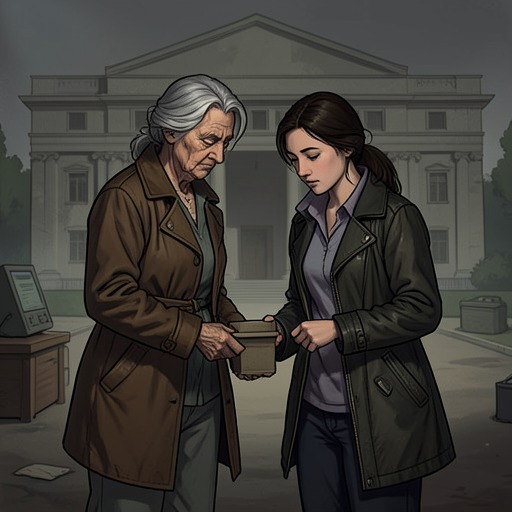
Gabriella Warshawski
Blood ShotGabriella Warshawski is a forceful presence in the memories and moral choices of her daughter, V. I. Warshawski, though she has been dead for years when the novel revisits their South Side past. An immigrant who once felt helpless in a strange country, she raises her daughter to have options and stands beside Louisa Djiak when the neighborhood turns against her. Gabriella’s compassion is not passive: it takes the form of unconventional choices, public defiance, and an expectation that her daughter will act responsibly even when doing so is difficult.
Identity and Background
Gabriella’s early life is described through her daughter’s account of her arrival in a strange country. She could not speak the language, and singing was the only thing she could do; she nearly died. That experience shaped a determination that V. I. would never be as helpless and frightened as she had been. V. I. later explains this inheritance to Mrs. Chigwell not as a matter of personal toughness alone, but as the consequence of having a mother who resolved to give her daughter more security and possibility than she herself had known.
The neighborhood remembered Gabriella through a mixture of affection and disapproval. The women on the block respected her after her death, in part because they recognized the shared labor of scraping, saving, and stretching money to feed and shelter a family. Yet her own choices had often unsettled them. She took V. I. to the opera rather than buying her a new winter coat, did not have her baptized, and refused to send her to the sisters at St. Wenceslaus for schooling. The neighbors’ objections became serious enough that they sent the school’s principal to confront her. These recollections show Gabriella living by her own judgment, even where the community treated its conventions as obligations.
Education and Independence
Gabriella’s ambition for V. I. was unusually broad by the standards of their block. She insisted that her daughter attend college and chose the University of Chicago, which she had decided was the best choice when V. I. was only two. The decision carried her daughter away from the South Side on a scholarship. V. I. remembers leaving both frightened and excited, while the neighbors called the university Red University. The distance that followed was real: after leaving, V. I. says she never truly went home again. Gabriella’s insistence on education thus enabled a life beyond the neighborhood, even as that life brought estrangement from the place and people of her childhood.
Her hopes for her daughter also exceeded a single approved path. V. I. recalls that Gabriella might have wanted her to become a concert singer or a high-priced lawyer. The contrast between those possibilities and the way V. I. actually lives amuses her, but it also suggests the scale of her mother’s hopes. Gabriella had once possessed only a voice in a country whose language she could not speak; for her daughter, she could imagine education, professional standing, and a future chosen rather than imposed.
Defense of Louisa Djiak
Gabriella’s independence became most visible in her defense of Louisa Djiak. When Louisa became pregnant outside marriage, her parents expelled her, and neighbors gathered at her house to throw eggs and shout insults. Gabriella came out onto the front stoop and faced them. V. I. remembers the scene as an act of courage: her mother challenged people who claimed Christian respectability while publicly humiliating a vulnerable young woman. Louisa, recalling the same episode years later, describes Gabriella as the only person who stood up for her when the righteous women came to her door.
That support endured beyond the public confrontation. Louisa tells V. I. that Gabriella would have given her last shirt to a beggar, and recalls that she helped when Louisa was very sick. Louisa sees her own assistance to Gabriella in return as a chance to repay what she had received. Her account makes their bond reciprocal without diminishing the original imbalance: at a moment when Louisa was rejected by her own parents and community, Gabriella offered her protection and continued regard. Even after Louisa’s parents eventually accepted that Caroline Djiak was alive, they did not forgive either mother or daughter. Gabriella’s support therefore did not depend on the neighborhood’s eventual approval.
The Mother’s Continuing Influence
Gabriella’s memory gives V. I. a standard of responsibility that she sometimes resents. When Caroline Djiak entangles her in another problem, V. I. remembers her mother’s expectation that she, unlike Louisa, should be rational. The recollection arrives while V. I. is angry with Caroline, with herself for being drawn in, and with Gabriella for having befriended Louisa in the first place. Yet rather than abandon Caroline’s troubles and go home, V. I. drives toward Nancy Cleghorn’s childhood house, partly from guilt over not having been there when Nancy called. Gabriella’s legacy is not simple obedience; it is a demanding habit of taking responsibility even when irritation offers an easier exit.
The novel also makes Gabriella present through V. I.’s memories of childhood and loss. While struggling to move toward the road after being left in the marsh, V. I. counts her efforts and recalls her fifteenth birthday, two days after Gabriella died in Tony Warshawski’s arms. In that moment of exhaustion, she imagines her mother waiting with open arms, her soprano joined with V. I.’s contralto. The memory does not undo the separation. Instead, it reveals how deeply Gabriella’s voice and protection remain part of her daughter’s inner life.
Narrative Role and Significance
Gabriella’s character is assembled through other people’s recollections: the neighbors’ grudging respect, Louisa’s gratitude, and V. I.’s changing memories. Together they complicate any simple picture of a universally admired mother. The same woman who unsettled her neighbors by rejecting their rules becomes, in Louisa’s account, the person who alone defended her; the mother who sent V. I. toward a world beyond the block also remains a source of obligation that follows her there.
Her influence links private family history to the community’s judgments about women’s lives. The neighborhood’s treatment of Louisa shows the cost of enforcing respectability, while Gabriella’s choices demonstrate that care can mean openly opposing that enforcement. Her insistence on education and her defense of Louisa arise from the same refusal to let other people decide the limits of a woman’s future. For V. I., that inheritance is both sustaining and burdensome: her mother’s example offers a model of courage, but also leaves her with the expectation that she must keep acting responsibly amid other people’s crises.