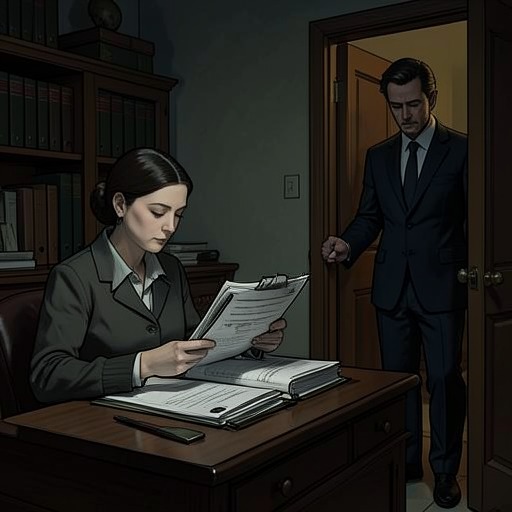
Gustav Humboldt
Blood ShotGustav Humboldt, the chairman and chief shareholder of Humboldt Chemical, is the powerful executive whose account of the Xerxes plant’s past first redirects V. I. Warshawski’s investigation and then proves to be part of its obstruction. He presents himself as a genial benefactor, but his later offer of shares in exchange for medical records, together with threats against Warshawski and Lotty Herschel, exposes the coercive force behind that cultivated manner. The conflict around him connects suspected occupational illness to corporate decisions about information, insurance, and liability.
Identity and Corporate Background
Warshawski consults Who’s Who in Chicago Commerce before meeting Humboldt and learns that he was born in Bremerhaven in 1904, emigrated in 1930, and became chairman and chief shareholder of a company founded in 1937. By 1986, Humboldt Chemical reported sales of eight billion dollars and assets of ten billion, with plants in forty countries. Its headquarters were in Chicago. The scale of the enterprise makes the South Chicago plant seem, at first, a small part of a far-flung business; Humboldt’s personal attention to it shows that it carries a particular significance for him.
Humboldt links the company’s growth to research conducted during World War II. He says Xerxine, a chemical in the 1,2-dichloroethane group, was one of the company’s major discoveries and the last product to which he personally devoted time. The Xerxes plant opened in South Chicago in 1949. Its name came from Xerxine, and the plant’s crown logo, set against a purple background, was designed by Humboldt’s wife, an artist. He describes the site as the beginning of Humboldt Chemical’s international expansion and says that, although he no longer manages daily operations, his employees know he remains concerned about it.
His influence also extends beyond his own company. Humboldt joined the board of Ironworkers Savings & Loan in the 1940s, when he began doing business in the area, and remained a director as his chemical company grew into a global enterprise. He was one of thirteen people on the board and, according to a bank source, had missed only eight meetings in fifteen years. The detail gives a concrete measure of his continuing presence in local institutions, even while the scale of his principal business reaches far beyond the neighborhood.
First Meeting with Warshawski
Humboldt arranges a confidential appointment through his secretary and receives Warshawski at the Roanoke Building. At their meeting, he appears considerably younger than his stated age of eighty-four and greets her with practiced courtesy. Their initial exchange is marked by mutual appraisal: he praises her independence, while she remains alert to the possibility that he expects something from her. He says that their interests intersect in South Chicago, then quickly turns her questions about Xerxes into an account of an old dispute.
Humboldt claims that Joey Pankowski and Steve Ferraro, together with two other employees, attempted to sabotage the plant by altering a mixture. In his version, the change produced unstable vapor and residue that blocked pipes, forcing three shutdowns in 1979. He says the company spent a year investigating, fired the men, and then faced a wrongful-dismissal lawsuit. He presents this episode as a corporate nightmare and suggests that his staff assumed Warshawski’s inquiries came from a lawyer seeking to reopen the case. Claiming to have taken a risk by telling her the story, he asks her not to turn the meeting into an accusation that he tried to influence her.
Warshawski explains that her inquiry is personal: Caroline Djiak wants to discover the identity of her father, and the late Louisa Djiak had not wanted to disclose it. Humboldt disapproves of Caroline’s wish to disregard her mother’s wishes, but says he will ask Curtis Chigwell, the plant doctor, whether Louisa had spoken to him. He promises that his secretary will pass along what he learns. This first offer of help gives Humboldt the appearance of a discreet intermediary, and allows him to make his company’s history seem separate from Warshawski’s private investigation.
A Disputed Account and the Insurance Trail
Information from Jonathan Michaels contradicts Humboldt’s description of the lawsuit. Pankowski and Ferraro had sued over workers’ compensation, attempting to show that illness had made them leave their jobs and that their illnesses were work-related. They lost at trial, and both later died. Michaels reports no evidence of sabotage in the case he reviewed. The difference is not minor: Humboldt has transformed a claim about illness and compensation into an accusation that the workers damaged the plant.
That contradiction changes how Warshawski reads his earlier cooperation. She wonders why he would attach a sabotage charge to two men seeking compensation, and whether his intervention was intended to discourage further inquiry. Her suspicion grows as she traces an insurance report associated with Art Jurshak and Mariners Rest Life Assurance Company. She considers Humboldt too well informed to have been unaware of the matter and connects the report to possible concealment of illness and mortality at Xerxes. These remain investigative conclusions at this stage, but they make his initial account look less like a candid explanation than a way of controlling what the dispute means.
The legal history supplies a further reason the company could resist the workers’ claims. Warshawski later explains that Humboldt had successfully defended the case with arguments that the men smoked and drank heavily, making it difficult to establish Xerxine as the cause of their illnesses, and that their exposure predated general knowledge of the chemical’s toxicity. She then sees how Jurshak’s insurance report might fit a broader effort to conceal the plant’s health record from the insurer and secure favorable terms. In that reading, the case is no longer simply about two unsuccessful claims: medical evidence, employment history, and insurance information may all have been made to work against workers seeking compensation.
Pressure, Bargaining, and Exposure
Humboldt’s authority appears not only in his position at Humboldt Chemical but also in his personal command of local relationships. When Warshawski returns to confront him, she cites his pressure on Caroline to fire her and challenges the propriety of Art Jurshak handling life and health insurance while associating with Steve Dresberg. She acknowledges privately that she does not yet understand every implication of the report that prompted her accusation. Even so, her references to Pankowski and Ferraro test whether Humboldt will address the discrepancies in his story. He does not supply the explanation she is seeking.
Later, Humboldt asks Warshawski to visit him again, this time saying that someone is present whom she would regret not meeting. When she arrives, he turns the conversation to Chigwell’s notes on Xerxes employees, claiming that the doctor kept them without his knowledge. Humboldt wants the notes. In return, he offers two thousand preferred shares of Humboldt Chemical. At the quoted closing price, Warshawski calculates the package’s value at two hundred thousand dollars. She refuses: the records have already gone to an attorney and medical specialists, and she tells him that money matters less to her than the consequences of the evidence.
The proposed exchange is accompanied by pressure directed at Warshawski’s closest ally. Humboldt raises the possibility that Lotty Herschel could lose her medical license, presenting her professional practice as a point of leverage. Warshawski responds with a direct warning that any harm to Herschel would bring a swift response. When Humboldt reframes his concern as being about the doctor’s practice rather than her physical safety, the threat remains unmistakable: he means to make the consequences of refusal personal. His language about Chigwell’s limited ability also helps explain why he values records gathered by a plant doctor but seeks access to them through a physician of Herschel’s standing.
Warshawski answers his bargaining with the prospect of public and legal consequences. She points to the Herald-Star’s investigation of Humboldt’s connection to Steve Dresberg and argues that Xerxine claims could overwhelm the company. Her estimate of half a billion dollars in potential claims is a forecast, not a settled judgment, but it makes clear why the medical records matter to both sides. Humboldt responds with an insult, a threat to ruin her professional prospects, and a glass hurled into a bookcase. The carefully controlled host has become openly furious when persuasion and money fail.
Characterization and Narrative Role
Humboldt’s characterization turns on the distance between his polished presentation and the consequences Warshawski associates with his company. At their first meeting, he is courteous, amused by her independence, and willing to discuss his own history. He also describes himself as an old-fashioned man concerned about family respect and speaks as if he is offering a personal favor. Later, that paternal manner appears alongside threats to Warshawski’s work and Herschel’s license. His courtesy is not simply a contrast to his anger; it helps him frame influence as generosity until the target refuses to comply.
Warshawski repeatedly figures Humboldt as a shark, an image that registers both his scale and the danger of confronting him without knowing the full extent of his reach. The metaphor changes force as the investigation advances. At first he is a distant executive whose attention might provide access to information. After the lawsuit discrepancy emerges, his apparent openness becomes another reason for suspicion. By the final confrontation, he is no longer merely a formidable local magnate: he is the person Warshawski holds responsible for a corporate system that, in her view, concealed workers’ exposure and left the company facing extensive claims.
The evidence establishes Humboldt’s attempts to control the account of the workers’ case and to obtain Chigwell’s notes, but the exchange with Warshawski does not itself adjudicate the company’s eventual legal responsibility. The novel’s immediate reversal is instead ethical and dramatic. The executive who claimed to be helping a private inquiry tries to purchase the records that could support a public reckoning; when refused, he falls back on threats. His power remains formidable, but the evidence he sought to contain has passed beyond his control.