Hinsdale
Blood ShotHinsdale is the western suburban setting of V. I. Warshawski’s repeated efforts to reach retired physician Curtis Chigwell, whose knowledge of Xerxes plant workers and their medical records may help her investigation. The town’s quiet, well-kept appearance contrasts with the polluted industrial landscape that drives her inquiries, while the Chigwells’ home becomes a place where guarded resistance gradually gives way to information and a more personal exchange.
Setting and Character
About twenty miles west of the Loop, Hinsdale is described as an old town of tall oaks and gracious homes, gradually being absorbed by urban sprawl. It is not presented as the trendiest suburb in the region; instead, its established self-assurance gives it a genteel character. Warshawski prepares for her first visit with that atmosphere in mind, choosing a black dress with a full skirt and gold buttons and carrying a leather portfolio.
The suburb’s quiet cleanliness makes a strong impression on Warshawski after her time in South Chicago. Even in a season when the trees are bare and the grass is brown, yards are raked and tidied for spring. That orderly surface sharpens her comparison with the sludge around the Xerxes plant: in Hinsdale, she can imagine the ground returning to life, while the industrial site presents a more difficult question of how life could be restored. The contrast gives the town significance beyond its role as an address. It sets two environments beside one another and makes the consequences of pollution harder to dismiss as abstract.
The Chigwell Home and Early Visits
Warshawski learns from Max Loewenthal that Chigwell has retired and lives in Hinsdale. His house stands on an older street near the town center: a two-story neo-Georgian building with gleaming white wood siding, yellow shutters, a screened porch facing the street, and older trees and bushes around it. Warshawski follows flagstones through shrubs to the entrance. The carefully maintained house and its setting reinforce the impression of stability that distinguishes this visit from her work in the industrial district.
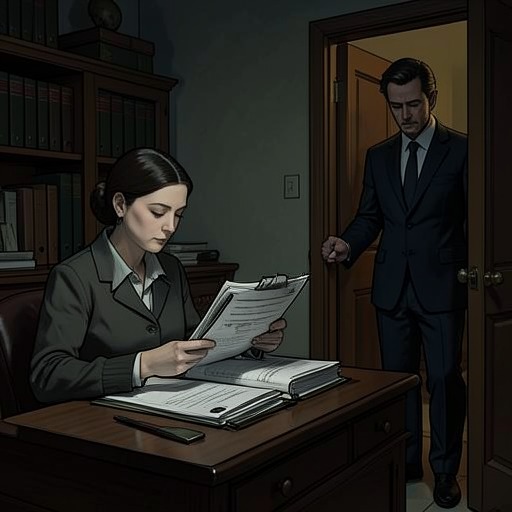
At the door she meets Chigwell’s sister, Clio, who corrects Warshawski’s assumption that she is Mrs. Chigwell. Clio is wary of an unannounced investigator and says her brother was not expecting anyone. Warshawski identifies herself as a lawyer and private investigator and explains that she is looking into people who worked at the Xerxes plant in South Chicago. She also says she was retained in connection with a lawsuit whose settlement left money to Joey Pankowski’s estate. Chigwell does not take her offered hand, and Warshawski sits while he remains standing, his rigid posture resembling his sister’s.
The house remains difficult to enter in a figurative sense as well as a literal one. Clio is the point of contact, but she cannot make her brother cooperate. After Warshawski phones again to ask whether Gustav Humboldt has recently called, Clio is surprised by the question, goes to consult Curtis, and reports that he will not speak to the investigator. Warshawski later returns to Hinsdale in the evening, hoping a different approach might succeed; Clio again tells her that Curtis will not talk. These visits establish the siblings’ reserve and the limits of Warshawski’s access to the doctor.
Information, Crisis, and Renewed Contact
Hinsdale’s role in the investigation changes when Humboldt’s secretary tells Warshawski that Humboldt spoke with Chigwell about Louisa Djiak and that Joey Pankowski was probably Louisa’s father. The report links the retired doctor to a matter central to Warshawski’s inquiry, but it does not itself establish what Chigwell told Humboldt or how he reached that conclusion. When Warshawski calls the Chigwells, Clio remains guarded and Curtis declines to speak.
Warshawski later hears from Max that Chigwell has tried to kill himself. Clio found him when she went to the garage for gardening tools. The news changes the circumstances of Warshawski’s next contact: her visits are no longer simply attempts to question a reluctant doctor. In a later visit, Clio thanks her for making the trip, although her face and manner remain stern. Warshawski has come to recognize that Clio’s gruffness need not mean she wants the visitor gone. Clio offers tea, and the exchange marks a modest but consequential easing of the relationship.
Clio cannot explain why blood tests began at the Xerxes plant. She remembers, however, that Curtis was greatly occupied with the testing because specimens had to be sent to a laboratory and kept in separate records. Employees were assigned numbers, so Curtis maintained notebooks that tracked the results by name instead. The detail clarifies both the practical difficulty of identifying individual workers in the company’s system and the particular value of the doctor’s records. Clio’s recollection supplies information even though Curtis himself has remained inaccessible.
Repeated Journeys and Narrative Significance
The investigation brings Warshawski back to Hinsdale more than once. After a long, fruitless week, she drives there to ask Clio again about the blood work and the notebooks. Clio is painting her dinghy in the garage when Warshawski arrives, and she invites the investigator in for tea. The visit yields no explanation for why the testing began, but it confirms the way specimens and employee numbers were handled and why Curtis kept his own records. The conversation also turns to Clio’s wish to visit Florence. She has long wanted to travel there but has not persuaded Curtis to go abroad; Warshawski urges her not to spend the rest of her life waiting for that agreement. Clio calls her brave, a personal response that sits alongside the practical exchange of information.
Later, while trying to work out who might be involved in Louisa’s medical care, Warshawski reasons that the doctor connected to the scheme may be Chigwell and makes another trip west. At the Xerxes plant, Curtis and Clio are caught in the crossfire. Afterward, state police arrange a car to take the siblings home; Clio refuses an offer to go to hospital for observation and insists on returning to her own house. Warshawski gives the police an account that Curtis had been lured to the plant with a story about a half-dead employee, and that Clio would not let him go alone. The account is presented as a version intended to cover what happened, not as a verified explanation of the siblings’ presence.
Across these episodes, Hinsdale is both a geographic counterpoint to South Chicago and the setting of a slow change in access. Its maintained homes and quiet streets cannot answer the questions raised by the Xerxes plant, but the Chigwell home holds the records and memories that connect the industrial workplace to individual employees. Clio’s gradual willingness to receive Warshawski, share what she remembers, and talk about her own unrealized journey makes the suburban setting part of the investigation’s human dimension as well as its pursuit of evidence.