Horace Chigwell’s diaries and medical records
Blood ShotHorace Chigwell’s diaries and medical records are twelve old leather-bound volumes that transform a family keepsake into a decades-long record of workers’ health at Humboldt Chemical’s Xerxes plant. Preserved by Curtis Chigwell’s wife after Curtis tried to destroy his copies, they contain evidence that makes individual illness legible as a pattern across the workforce—and gives the investigation a documentary basis stronger than memory or accusation alone.
Physical Form and Changing Use
The volumes were originally personal diaries belonging to Horace Chigwell, a physician. Each was bound in green leather and marked with his name and medical title in gold. Curtis Chigwell used the books to hold data about employees at the Xerxes plant, making the family’s inherited journals serve a purpose far removed from private reflection. Their substantial physical presence matters: this was not a single report or a short-lived file, but a set of twelve books covering twenty-eight years.
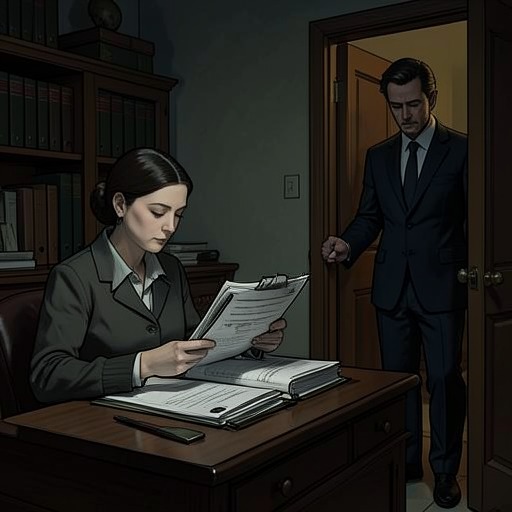
The records’ survival depended on a division between Curtis’s copies and the originals. Over the years, his wife typed his notes for him, but quietly retained the original notebooks without telling him. She kept them in part because they were her father’s diaries and she considered discarding them an indignity; at the same time, she concealed their continued existence because she expected Curtis to be angry that she had kept them for their sentimental connection to her father. The archive thus persisted through a private act of preservation that Curtis did not know about.
The Medical Record Inside the Diaries
The entries comprise an inventory of Xerxes employees’ medical histories, including blood-work information. The surviving records cover approximately five hundred workers from 1955 through 1982. They track changes in measures including creatine, blood urea nitrogen, bilirubin, hematocrit, hemoglobin, and white blood count. The technical shorthand can be difficult for a lay reader to interpret, but its accumulation over time is central: repeated measurements allow the investigators to compare developing health problems with employees’ years at the plant, rather than treating each diagnosis as an isolated case.
The diaries also give the archive a specific human scale. Louisa Djiak does not appear in the 1962 list, the year she began working at Humboldt Chemical, but is recorded in 1963 as a seventeen-year-old white woman living on Houston Street. Her emergency contact is Gabriella Warshawski. The entry contains no information about Louisa’s baby or the child’s father; that silence does not establish what the physician knew, but it marks what the written record itself can and cannot prove. The same entry’s medical shorthand offers a snapshot of a young worker’s recorded health, while later records supply a longer history.
From Hidden Notebooks to Evidence
Curtis’s effort to dispose of the notes first exposed how consequential he believed them to be. His wife found him trying to burn the notebooks in a waste can and took them away, judging that destroying the records would mean turning away from the facts. She hid them among her boating books, a choice that proved vulnerable because boating was her great interest and the hiding place was one Curtis might think to search. When the copies later disappeared from the house, she could tell the investigators that only those copies were gone: the originals had remained in her possession.
The contents connect the plant’s chemical history with the changing understanding of occupational exposure. Xerxine is described as a chlorinated-hydrocarbon solvent whose vapors could harm the liver, kidneys, and central nervous system. When Humboldt began manufacturing it in the 1950s, the hazards were not yet understood as they later would be. As attention to environmental and workplace health grew in the 1960s and 1970s, Xerxes installed air scrubbers and better-sealed pipes; by the late 1970s, the reported concentration had been brought to the federal standard of fifty parts per million. The diaries span the period before and after those changes, preserving the distinction between workers’ earlier exposure and the later regulated conditions.
Patterns, Limits, and Significance
A specialist’s review of the records identifies blood histories for Louisa from 1963 to 1982 and Steve Ferraro from 1957 to 1982. The changes in their blood values, and in those of other employees, are described as consistent with renal, liver, and bone-marrow dysfunction. Louisa’s records indicate noticeable renal damage by 1967 and severe damage by 1969; she began experiencing diffuse symptoms around 1979, although she did not then seek medical care. Ferraro’s medical history ends with his death from aplastic anemia in 1983. These findings are also checked against clinical information: Louisa’s physician confirmed that she was diagnosed with chronic renal failure in 1984, which later progressed to an acute stage.
The notebooks do not erase the complications that had weakened an earlier workers’ compensation case. Ferraro and Joey Pankowski had smoked; Pankowski drank heavily; both had lived in South Chicago, where polluted air offered another possible explanation for illness. Humboldt had argued that Xerxine could not be isolated as the cause and that the plant had operated according to the medical knowledge available at the time. The records’ importance lies in the kind of evidence they add: longitudinal measurements across hundreds of employees, read alongside diagnoses and the history of exposure. Their findings are presented as consistent with Xerxine exposure, not as a simple answer detached from competing causes.
As an object, the diaries hold together two forms of time: the personal past embodied in Horace Chigwell’s named volumes and the accumulated working lives entered into them. Their movement from private heirloom to medical archive, then from threatened copies to preserved originals and expert review, gives the investigation a material record of what individual testimony could not show on its own. They make the plant’s history readable through the bodies of its employees, while their gaps and technical limits keep that evidence from becoming more conclusive than the record supports.