Intimidation targeting investigators and associated people
Blood ShotIntimidation targeting investigators and associated people is a recurring pressure tactic around the South Chicago inquiry: a threatening call discourages a lawyer from pursuing an appeal, a caller warns V. I. Warshawski away from the neighborhood, Caroline Djiak is told to end the investigation, and men later ambush and abandon Warshawski in a marsh. The threats do not establish who is behind them. Their force lies instead in their progression—from insinuation and private warning to bodily danger—and in the uncertainty that makes each target weigh what can be proved against what may happen next.
Pressure on the workers’ compensation appeal
A lawyer discussing the Xerxes workers’ case describes receiving a threatening phone call after the verdict, while an appeal was under consideration. The caller did not name the case; the warning referred generically to the dangers of using the appellate system. Because the threat was nonspecific, the lawyer did not take it to the state’s attorney. He says the call made him angry and led him to push and prod for an appeal, but he could find no viable way to bring one. His account exposes intimidation as pressure that can work without an explicit order or a clearly identifiable source: the warning leaves him with no useful allegation to report, while the absence of a legal route prevents his anger from becoming an effective challenge.
The conversation also places that pressure against the possible consequences of a successful workers’ claim. The lawyer recognizes that a precedent could invite large settlements from people who had been sick or died at the plant, and that the company might see the plant go under. The call is not proven to have come from the company or anyone acting for it, but its timing and its reference to appellate procedure make the threat part of a wider atmosphere in which the workers’ pursuit of redress carries risks beyond the courtroom. When the lawyer says the caller never contacted him again, that silence does not resolve the matter; it leaves the warning hanging over the failed appeal.
Threats aimed at Warshawski and Caroline Djiak
Warshawski receives a more direct warning in a cold, unfamiliar man’s voice. He tells her she should butt out of South Chicago because she no longer lives there and has no business there. When she challenges him, he invokes her swimming ability and warns that no swimmer could float through a swamp. He refuses to say whether he is calling on Art Jurshak’s or Steve Dresberg’s behalf, insisting that the source does not matter if she wants to stay alive. The message tries to turn Warshawski’s return to South Chicago into a trespass and to make the landscape itself sound like an instrument of disposal. The threat names neither a verifiable sponsor nor a specific act, but its language makes the danger unmistakable.
Caroline’s warning arrives through a different channel. Someone calling from the Xerxes plant says they are sorry she has spent money hiring Warshawski, claims to have proof that Joey Pankowski is Caroline’s father, and tells her to persuade Warshawski to leave the case. Caroline initially presents the caller’s claim about Pankowski as the point of the call. Warshawski presses her to disclose the omitted danger, and Caroline finally admits that the caller threatened to hurt Warshawski if she did not stop looking. Caroline’s earlier insistence that she would not be frightened does not remove the coercion; it conceals its most consequential detail. The episode shows intimidation working through a person close to the investigator, mixing a claim about family identity with a demand that the inquiry end.
From warning to physical attack
The danger becomes physical when three men in black slickers, apparently without fishing gear, watch Warshawski approach a harbor seawall and stand up to form a casual barrier between her and the road. A lone jogger passes behind them, absorbed in his earphones and unaware of the encounter. That ordinary passage sharpens the isolation of the scene: the men do not need to announce their purpose for Warshawski to recognize that her route is blocked and that no witness is attending to them.
After the attack, Warshawski keeps herself limp as she is pulled from a car and carried like a discarded carpet. She hears that one of the men wants to check whether she is moving; another orders him to leave her as she is, warning that someone might see them or remember a face. The men’s language treats her as an object to be dumped, while the practical concern about recognition reveals their awareness of exposure. They carry her through dead grasses into a marsh, where she notices the rank smell of decaying vegetation mixed with chemicals draining into the water. The polluted setting makes the threat against an investigator physically contiguous with the industrial landscape under scrutiny, without identifying who ordered the attack. Her effort to stay limp is a survival response, not evidence that the danger has passed.
Identification and the limits of proof
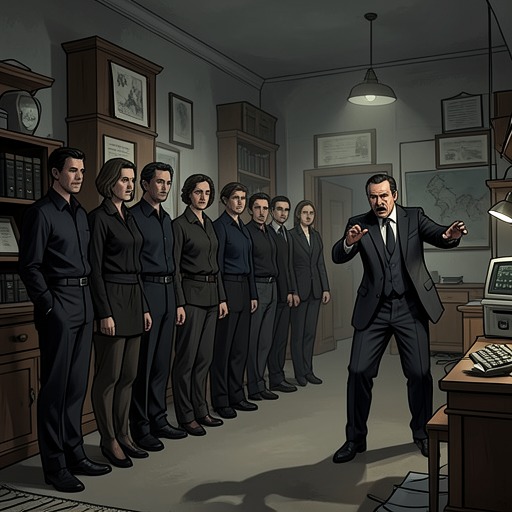
Afterward, Bobby explains that the police can make a case against two men for loitering in a private building and carrying concealed, unregistered weapons, but those charges may not keep them off the street for long. A stronger case would require supporting an attempted-murder charge. Warshawski therefore has to distinguish what she remembers from what she can confidently identify. She reflects that stress can distort eyewitness memory, yet can also preserve a gesture or other detail with unusual force. The lineup is presented not as a simple revelation but as a test under conditions where certainty is difficult.
Warshawski asks the men to repeat phrases she remembers hearing during the attack, including the instruction to dump her at the spot. She watches the second man from the left and notices a secretive smile, but when he speaks, his husky voice and South Side twang do not match the cold, emotionless voice she remembers from the warning at the lagoon’s edge. She identifies the second man only tentatively and says she cannot be absolutely certain. That mismatch matters: the lineup offers a possible visual recognition, not confirmation that the man made the earlier call or that the two episodes share a single source. Intimidation has made the investigation more dangerous, but it has not made responsibility easier to prove.