Jurshak Ward Office
Blood ShotJurshak Ward Office is a neighborhood political headquarters in Chicago’s East Side, where public favors, local political authority, and an adjoining insurance business occupy one small piece of Avenue M. V. I. Warshawski visits it more than once while investigating Nancy Cleghorn’s death. The office first offers a place to seek old ward records and locate Art Jurshak’s son; later, its connection to Jurshak & Parma helps frame a much larger question about insurance at Humboldt Chemical’s Xerxes plant.
Setting and local role
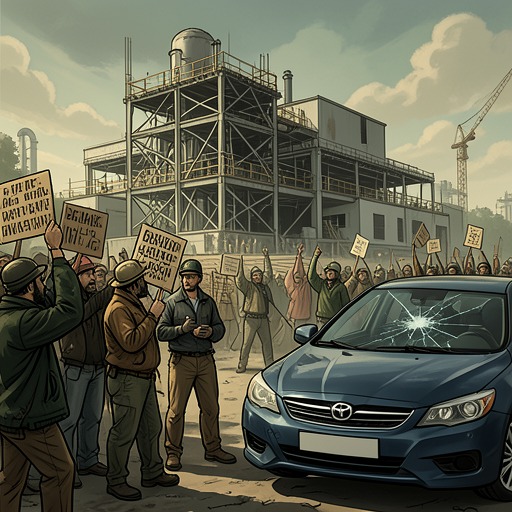
The ward office occupies a tidy brick two-flat on Avenue M. A large sign on the building’s exposed north wall identifies Art Jurshak as alderman and the ward committeeman as Freddy Parma; the sign has remained unchanged since Warshawski’s childhood. Next door, a storefront houses the insurance agency that had given Art Jurshak his entry into the community. The close physical arrangement makes the political office and insurance business neighbors, not merely names that happen to recur in the same investigation.
The office is part of the ordinary machinery of neighborhood life. Residents may come seeking help with parking tickets or a way onto the city payroll, and local police officers are frequent visitors. Its first-floor room, with men at ease among its furnishings, conveys a place where political access is habitual. Warshawski remembers having come there with her father, whose police beat was elsewhere. The office thus carries both the familiarity of an established local institution and the weight of a network whose reach extends beyond its doors.
Warshawski’s visits
Warshawski first goes to the building while looking for Pankowski and Ferraro. Neither man appears in the phone book, so she considers whether old ward voter-registration records might help locate them. Inside the first-floor office, three older men are gathered: one reads the sports pages while smoking a cigar, and two others talk. Their appearance and unhurried familiarity with the room suggest to Warshawski that they belong to an older generation of the ward’s political life. The available evidence does not show her finding the records; the visit instead establishes the office as a place to pursue local connections.
She returns while seeking Art Jurshak’s son. On this afternoon, the office is busy: patrol officers are leaving, favor-seekers fill the room, and two men who may be patronage workers play checkers by the window. When Warshawski asks for Young Art, the bald man who had spoken during her earlier visit says he is not there. She waits in an uncomfortable yellow wooden chair, reads the Sun-Times, leaves her card, goes out for a meatball sandwich and a beer, then comes back. The small routines of waiting make the office’s access to the person she seeks conditional: she has to fit her inquiry around its everyday traffic and the uncertain arrival of Young Art.
When he finally appears, Young Art asks whether his father has left anything for him. The question, and his visible hope for an answer from the older men, places his personal dependence inside the office’s political atmosphere. Warshawski introduces herself and identifies him as Art Jurshak’s son, recalling that she saw him at the Tenth Ward office the previous week. He takes her upstairs to a small office of his own. The suite bears his father’s name; a woman at the outer desk explains that the elder Art is away at a council meeting and is not expected back until Wednesday. A second inner office also carries the father’s name, while the door to the room Young Art uses is blank. The upstairs rooms make the family hierarchy visible in the very arrangement of the workplace.
Political decisions and insurance ties
The office matters beyond the search for Young Art because local political relationships surround a disputed community proposal. Nancy Cleghorn says the proposed recycling center was denied a hearing on the grounds that it lacked community backing, despite her claim that residents supported it. She reports that the zoning-board chair had heard from people opposed to it. Caroline Djiak attributes the decision to political ties, describing the chair as close to established Democratic politicians. This account does not establish that the ward office itself decided the proposal, but it places neighborhood political influence in the background of the conflict that Nancy was investigating.
A more specific business connection emerges when Warshawski reviews Nancy’s files. Among the papers is a photocopy of a 1963 letter to Mariners Rest Life Assurance Company stating that Jurshak & Parma had become fiduciaries for Humboldt Chemical’s Xerxes plant. An attached actuarial study compares Xerxes’s losses with those of similar companies in the area and requests the same rate consideration. The document is insurance business rather than environmental-proposal paperwork, and Warshawski initially cannot see why Nancy possessed it or how it might relate to her death. Its significance lies partly in that mismatch: a routine-looking, decades-old insurance record connects the Jurshak firm to the plant at the center of a separate inquiry.
The investigation later supplies another strand of the insurance picture at Ironworkers Savings & Loan. Warshawski learns that Gustav Humboldt has remained on its board since agreeing to join in the 1940s, despite the expansion of his company and his service on other corporate boards. That information comes from the bank, not the ward office. Read alongside the fiduciary letter and the insurance agency next door to the ward headquarters, however, it sharpens Warshawski’s suspicion that the Xerxes workforce’s insurance arrangements conceal a problem. The office is therefore a point of entry into a network of political and commercial relationships, rather than proof by itself of what that network has done.
Narrative significance
Jurshak Ward Office recurs as both a recognizable neighborhood institution and an investigative threshold. Its public-facing services, steady stream of visitors, and established political personnel give Warshawski a way to pursue local information; its rooms also expose the difference between the authority attached to the elder Art’s name and the tentative position of his son. The adjoining insurance agency and the later discovery of Jurshak & Parma’s fiduciary role extend the office’s significance beyond local patronage without collapsing separate institutions into one.
The office’s ordinary details—an old sign, a crowded ground-floor room, a newspaper on a desk, and a long wait for a visitor—sit beside questions of zoning, employment, and industrial insurance. That contrast makes the investigation’s larger difficulty concrete: consequential decisions are embedded in everyday relationships and records that may look routine until their connections are traced. Warshawski leaves the office without resolving those questions, but its recurring presence helps her follow the path from neighborhood politics toward the insurance concerns surrounding Xerxes.