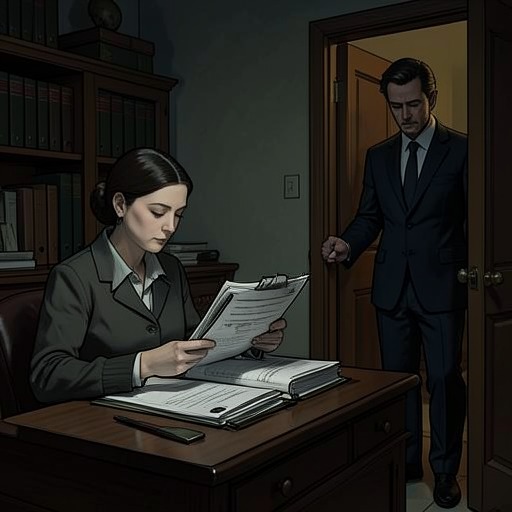
Lotty Herschel
Blood ShotLotty Herschel is a physician and clinic director whose unsparing care makes her one of Victoria Warshawski’s closest friends and chosen family. She treats Victoria’s injuries, helps her investigate medical records, and refuses to let independence become an excuse for disregarding the people who love her. That combination of professional competence and emotional candor becomes decisive when Victoria’s investigation places both women under pressure from Gustav Humboldt.
Identity and Medical Work
Lotty runs a clinic near the corner of Irving Park and Damen, and her work is not merely a backdrop to her friendship with Victoria. When Victoria cannot find Chigwell in a general directory, she calls Lotty, who is preparing to leave the clinic. Lotty asks whether Victoria knows the man’s first name or specialty, reasons that he may have worked in industrial medicine, and checks the directory she has to hand. Finding no listing there either, she points Victoria toward Max Loewenthal, the executive director of Beth Israel Hospital, as someone who might have a more complete directory. Her practical help is accompanied by a sharper question: why does Victoria let Caroline Djiak lead her into difficulties? Lotty sees the investigation as entangled with Victoria’s habit of allowing other people to set the terms of her involvement.
The novel also shows their friendship in quieter surroundings. When Victoria is frustrated by Nancy Cleghorn’s silence, Lotty is available for dinner. They share roast duck at the Gypsy and return to Lotty’s home, where Lotty beats Victoria at gin five times in succession. The scene offers companionship without pretending that their relationship is free of disagreement; Lotty can welcome Victoria and still challenge her choices.
Care After the Attack
After Victoria is found incapacitated at Dead Stick Pond, Lotty becomes central to the effort to get her medical care. Mr. Contreras insists that Victoria be taken to Lotty’s clinic rather than directly to a hospital, and when Lotty sees her, she summons an ambulance to take her to Beth Israel Hospital. Victoria has no memory of the journey. When she wakes in the hospital, Lotty examines her herself: she listens to her chest, checks her coordination and reflexes, and has her stand and walk. Her assessment is both clinical and personal. She recognizes how extraordinary it is that Victoria survived and can walk, but does not mistake survival for recovery.
Lotty explains that the hospital took X-rays and a CT scan after stabilizing Victoria on Wednesday. The scans show no broken bones, but her muscles are badly strained and need time and physical therapy to heal. Lotty approves outpatient therapy and offers to arrange for clothes to be brought from Victoria’s apartment. She has also recovered Victoria’s keys, which had been tied to the laces of her running shoes, and ordered the clothes Victoria arrived in discarded. Care here is concrete: examination, treatment, practical arrangements, and a warning against assuming that the body can keep absorbing danger without lasting cost.
That warning becomes a recurring point of conflict. Lotty tells Victoria that her body will repair itself more slowly with age and that neglecting it will make it less dependable. She has treated Victoria repeatedly over the preceding ten years, often after life-threatening situations, and asks why Victoria values herself so little. The force of the question comes from accumulated experience: Lotty is not responding to one isolated injury, but to a pattern that has repeatedly brought Victoria into danger and brought Lotty to her bedside.
Friendship, Independence, and Reconciliation
Their conflict becomes explicit after Victoria leaves Lotty’s home without telling her. Lotty says that Victoria asked for help and then disappeared, an act that is not independence but disregard for Lotty’s feelings. She is willing to remain Victoria’s doctor if that is all Victoria wants, but tells her that friendship requires more care than summoning Lotty only when she needs treatment. Her anger is rooted in attachment, not professional distance: she fears that Victoria will take a risk from which she will not return.
Victoria admits that she is frightened. Since her father told her that Gabriella Warshawski was dying and nothing could be done, she has associated depending on someone else with helplessness. Now she feels too frightened to solve her problems alone, yet asking for help makes her feel out of control. Lotty does not demand an instant change. As she sews tiny stitches into the hem of a black skirt, she proposes a compromise: Victoria need not give responses she cannot manage, but should tell Lotty when she is in that state rather than leaving her to become angry and afraid without explanation. Victoria agrees, and Lotty holds her, naming her the daughter of her heart. The reconciliation does not erase Victoria’s independence or fear; it gives their friendship a way to acknowledge both without turning silence into another injury.
Medical Records and the Threat from Humboldt
Lotty’s professional judgment also matters to the investigation of illness among workers at Humboldt Chemical’s Xerxes plant. She has Chigwell’s notebooks secured in Max’s safe at Beth Israel Hospital, explaining that they are too alarming to leave where anyone in the city could get hold of them. Before drawing conclusions from the records, she consults Dr. Christophersen, a nephrologist, to interpret them thoroughly. She brings Victoria photocopies summarizing the specialist’s findings, including the medical history of Louisa Djiak and Steve Ferraro and records for roughly five hundred other Xerxes employees. The records indicate patterns consistent with renal, liver, and bone marrow dysfunction. Lotty’s handling of the notebooks reflects a distinction between recognizing the evidence’s importance and claiming expertise she does not have: she seeks a specialist’s analysis and keeps the original records secure.
Humboldt later tries to turn the notebooks into leverage. He offers Victoria financial benefits and threatens Lotty’s medical license by arranging for Mrs. Portis to accuse her of sexually abusing Portis’s daughter, Amanda. Lotty had seen the child once, when she was eight and vomiting frequently; after Lotty suggested psychological problems, Mrs. Portis left angrily. When Victoria tells Lotty what Humboldt is proposing, Lotty understands that her license is part of the price he wants for access to the notebooks. She insists on speaking to him herself and refuses to submit, invoking the history of her parents’ deaths at the hands of Fascists as a reason she will not yield to intimidation in old age. Her answer rejects the bargain’s terms: neither professional reputation nor Victoria’s financial security will make the records Humboldt’s.
Consequences and Narrative Role
Lotty and Victoria spend the following days working with Victoria’s lawyer, Carter Freeman. Mrs. Portis eventually loses interest in bringing charges against Lotty, though the novel leaves open whether that change results from Freeman’s work, Anton’s, or the fear created by the scene at the Roanoke apartment building. Victoria’s mortgage remains uncertain for several weeks, until Freeman manages to settle that problem too; Victoria suspects he personally guaranteed it, but he avoids confirming her suspicion. Lotty’s conflict with Humboldt thus has consequences beyond the clinic: the attempted pressure threatens her license, while its resolution and the lawyer’s work help protect the women from the charges and financial crisis Humboldt has set in motion.
Lotty’s role in the novel rests on a repeated contrast. She helps Victoria act, but will not confuse help with taking over; she can tend an injured patient and also insist that the patient acknowledge the cost of reckless behavior. When Victoria cannot bear further involvement in the South Chicago case, Lotty’s presence does not magically resolve the investigation or remove Victoria’s fear. Instead, their reconciliation makes room for Victoria to admit what she cannot manage and for Lotty to remain close without pretending that the danger is harmless. Her medical care and emotional demands are parts of the same relationship: both insist that survival carries obligations to oneself and to the people who stay.