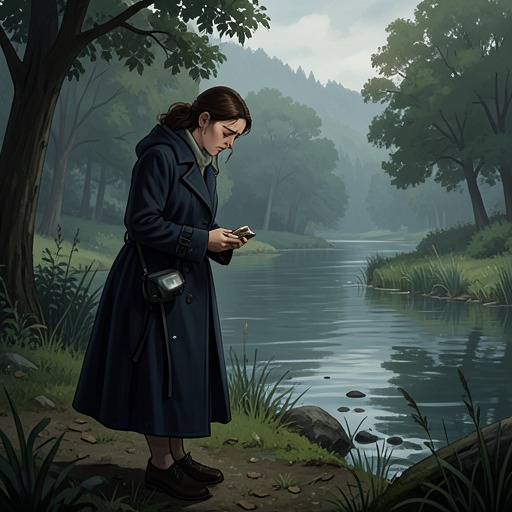
Louisa Djiak
Blood ShotLouisa Djiak is a former Xerxes plant worker, the mother of Caroline Djiak, and a longtime neighbor of V. I. Warshawski’s family. Her worsening illness is at once an intimate family crisis and evidence of a much larger corporate injury: records connect the damage to her health with prolonged exposure at the plant. Louisa’s own priorities remain close to home. She wants Caroline protected from a man she believes could ruin her life, even as she hopes her daughter will escape the hard life Louisa herself endured.
Identity and Background
Louisa first enters the story through Warshawski’s memories of the neighborhood and of Caroline’s childhood. When Louisa was pregnant with Caroline, she rented the house next to the Warshawski family. The families’ closeness endured beyond that period: Louisa remembers Gabriella Warshawski coming to her defense when people from St. Wenceslaus harassed her by throwing things at her windows. Gabriella’s support was not a distant kindness but a public stand against the judgment Louisa faced, and Louisa later described helping Gabriella during her final illness as a chance to repay what she had received.
The account of Louisa’s early adulthood also establishes a life shaped by work and limited choices. She recalls once having strong legs and going dancing after finishing work at midnight. Her memories include Steve Ferraro, who wanted to marry her, and Joey Pankowski, who did not. Looking back, she says she would make the same choices again because they gave her Caroline; for her daughter, however, she wanted a different future from a life spent working in South Chicago until an early old age. The contrast between accepting her own past and wanting Caroline to have more is central to Louisa’s idea of motherhood.
Illness and the Xerxes Records
Louisa’s decline has changed her daily life before Warshawski sees her again. Caroline warns that her mother is very sick and manages her care, including the regular trips for dialysis. Louisa has been unable to get around for months, after becoming disabled roughly a year earlier. Her kidney disease has progressed to acute failure, and other complications make her a poor candidate for a transplant. Though she is grateful that Caroline secures treatment, Louisa privately wishes to be allowed to die in peace and does not want that feeling to burden her daughter.
The later examination of Dr. Chigwell’s notebooks gives Louisa’s illness a history far longer than the period when she sought treatment. She began work at the Xerxes plant at seventeen. Her employee record appears in 1963, after a year at the plant, and identifies Gabriella Warshawski as the person to contact in an emergency. The notebooks contain no entry about Caroline’s birth or father, but they preserve medical data that help make Louisa’s workplace history legible. A specialist’s review traces blood records for Louisa from 1963 through 1982 and finds changes consistent with kidney, liver, and bone marrow dysfunction among her and roughly five hundred other Xerxes employees.
The specialist’s interpretation places signs of renal damage as early as 1967, with severe damage by 1969. Louisa began experiencing diffuse symptoms around 1979, including itching, fatigue, and headaches, but attributed them to the change of life and did not consult a physician. She first went to a doctor in 1984, at Caroline’s insistence; by then her kidney failure had advanced. The blood changes were consistent with exposure to Xerxine. What Louisa had experienced as a private illness thus becomes part of a documented pattern among plant workers, and the records make her case consequential to Warshawski’s investigation of Xerxes.
Motherhood and the Search for Caroline’s Father
Caroline hires Warshawski to find her father, but Louisa objects to the search. When Warshawski raises the question of why Caroline’s parents drove her away, Louisa recognizes that her daughter has enlisted the detective to uncover her parentage. Her anger comes from fear as well as secrecy: she believes the man who fathered Caroline tried to ruin her life, and she does not want Caroline near him. Louisa frames her opposition as protection, insisting that she has worked to give her daughter a different chance and will not watch that future put at risk.
That protective impulse conflicts with Caroline’s adulthood and right to make her own choices. Warshawski acknowledges Louisa’s care for her daughter while urging her to let Caroline decide whether to pursue the truth. The conflict also unsettles Louisa’s relationship with Warshawski, whom she knows through years of family connection. Louisa sees the detective’s loyalty to Caroline as an intrusion into a painful history; Warshawski sees the search as a legitimate request from an adult. Neither position erases the affection underneath their disagreement.
The paternity search draws Warshawski toward the histories of Joey Pankowski and Steve Ferraro, two men associated with Louisa’s past and with unsuccessful claims involving Xerxes. When Warshawski visits Louisa after learning about the men’s illness and suit, Louisa is genuinely surprised that they had been so sick or had sued the company. She recalls having seen them from time to time before they died, but says they had not told her about the case. Her recollection complicates the assumption that she knows the full story of either man and places her ordinary neighborhood memories beside the investigation’s emerging evidence of occupational harm.
Threat, Rescue, and the Investigation
Louisa becomes a direct target when an anonymous caller tells Caroline that she has been taken to Xerxes and sedated. The threat offers a stark choice: Warshawski can go to the plant alone and Louisa will be returned home, or police can accompany her and Louisa may be killed. The caller invokes the lagoons behind the plant and the danger of Xerxine, turning the toxic setting at the center of the investigation into a weapon of intimidation. The threat also makes clear why Louisa’s safety cannot be separated from the effort to expose what happened to Xerxes workers.
Warshawski goes to the plant, where Louisa is found alive. After the immediate danger, Louisa briefly mistakes Warshawski for Gabriella, saying that Gabriella would not have forgotten her in trouble. The moment joins Louisa’s present vulnerability to the earlier bond between the two families: in her disoriented state, it is Gabriella’s remembered loyalty that gives Warshawski’s presence meaning. Louisa’s rescue also prevents the evidence about her illness and the company from being silenced through the threat against her.
Death and Legacy
Louisa dies after the events at Xerxes. Caroline tells Warshawski of her death in an early-June phone call, and Warshawski attends the funeral at St. Wenceslaus. Caroline’s parents oversee the gathering afterward, but Warshawski does not go to the Houston Street house for the food. Caroline makes no effort to speak with her at the service, and their estrangement continues for a time.
Later, Caroline explains how her understanding of her mother changed. She had felt humiliated by the circumstances surrounding her parentage, but, after Louisa’s death, began to see what Louisa had endured and how remarkable it was that she remained a loving, lively mother rather than turning her anger against her child. That retrospective recognition completes the portrait built through Louisa’s choices: she cannot shield Caroline from every consequence of the past, but she gives her daughter a childhood and a bond not defined solely by the man who fathered her. Louisa’s story also gives the investigation its human measure. Her medical records expose a history shared by hundreds of workers, while her relationships reveal the individual care and loyalty that corporate records alone cannot contain.