Louisa Djiak rescued at the Xerxes plant
Blood ShotLouisa Djiak’s rescue at the Xerxes plant turns a coercive threat into a midnight armed confrontation. V. I. Warshawski and Clio Chigwell enter the hazardous factory to find Louisa sedated and trapped between men willing to use her as leverage; the rescue ends with Steve Dresberg and Art Jurshak shot, Clio wounded, and Louisa carried out alive for medical care.
The threat and the decision to act
The danger begins with a call that makes Louisa’s life the price of another person’s compliance. The caller says she has little time left and presents two outcomes: she might die at home, or disappear in the lagoons behind the Xerxes plant. Warshawski is told to go down and look at her; if police accompany her, the caller threatens that Louisa will be buried in Xerxine. The ultimatum makes the rescue a trap as well as an emergency: the threat is designed to isolate Warshawski and turn a search for Louisa into a risk to her life.
After the line goes dead, Warshawski reproaches herself for having concentrated on her own danger and on her closeness to Lotty Herschel, rather than recognizing Louisa’s peril. She also understands that, if both she and Louisa disappear, no one will be left to speak about the secret she had told Jurshak she knew. Rather than let self-recrimination cloud her judgment, she loads a second ammunition clip, puts it in her jacket pocket, and leaves Lotty a note. The sequence moves from shock to purposeful preparation without making the danger seem manageable.
The approach to the plant
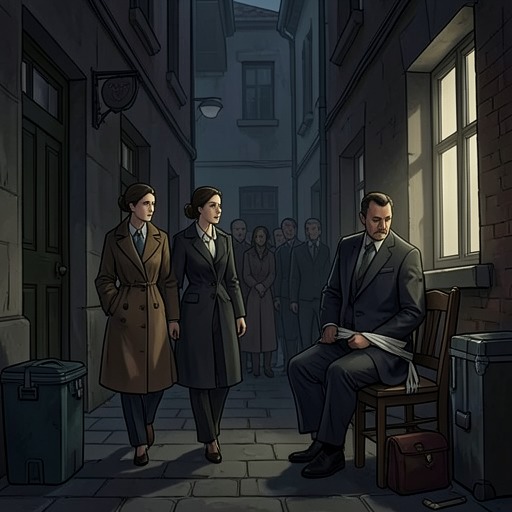
Close to midnight, Warshawski drives south at speed, watching for patrol cars as she navigates traffic and lights. She and Clio reach a neglected-looking industrial property, chosen in the hope that it has no night watchman or dog. The route into the plant is not a direct walk through a front entrance: they stop beside a cement barge and quietly lower an inflatable dinghy, using a blanket across the car hood and then on the ground to soften its descent. Clio holds a pencil flashlight, cuts ropes, carries the oars, and climbs down the iron rungs to the water; the two women row along the bank toward the loading bays.
The crossing places them inside an active industrial landscape before they reach Louisa. Warshawski uses the flashlight to avoid barges and read the company names painted beside steel ladders. At the plant, they pass through a door left ajar beside a closed sliding steel curtain. Pipes belch steam, cauldrons bubble beneath dull green safety lights, and a drop of liquid makes Warshawski fear that she has been exposed to a toxic dose of Xerxine. Clio keeps her attention forward, disregarding both the spitting machinery and obscene graffiti on the large no-smoking signs. The hazardous setting is not mere scenery: it makes the threat of a death in the lagoons, and the possibility of a toxic burial, part of the physical reality of the rescue.
Finding Louisa and facing the gunmen
In the far corner, Louisa lies on a stretcher. Curtis Chigwell stands on one side of her and Jurshak on the other; both men stare at the two women as they enter. Curtis recognizes Clio, who moves forward fiercely, while Warshawski holds her back from Jurshak’s reach. The discovery confirms that Louisa has not simply been threatened from a distance: she is physically present, sedated, and under the control of the men Warshawski has come to confront.
The confrontation escalates when Dresberg points a large gun at Louisa and orders Warshawski to come out, using the sick woman as his shield. Warshawski answers by challenging the idea that Louisa’s condition makes her expendable and warns that Dresberg must deal with her first. He swings and fires before Warshawski can duck; the bullet misses. Clio crouches beside Warshawski, then acts without waiting for safety to be assured: she darts around the protective vat and throws her keys at Dresberg’s face. He fires at the movement and hits Clio, but the distraction gives Warshawski the chance to get behind him and shoot him twice in the chest. Dresberg fires two more rounds before collapsing.
As Warshawski reaches for his gun arm, Jurshak moves toward the weapon, apparently hoping to wrest it away before she can take it. Warshawski shoots him in the chest. The rescue thus overturns the threat’s intended power: Louisa, initially the helpless leverage in the room, remains alive, while the men who controlled and endangered her are shot. Neither man is immediately confirmed dead.
Securing help and the immediate aftermath
Curtis has stood beside Louisa’s stretcher through the violence, his hands hanging at his sides and his head hunched into his coat. Warshawski slaps and repeatedly punches him, denouncing him as a traitor to his oath. Her rage is checked by Clio, who has staggered over with blood trailing from her wound. Clio agrees that Curtis has betrayed his responsibilities but urges Warshawski to leave him alone, noting that he is old and unlikely to change. Warshawski, exhausted and sickened by the plant and the violence, stops. Clio’s intervention prevents the confrontation from continuing against a man who is no longer the immediate armed threat.
The women do not treat the shooting as the end of the danger. Warshawski says they must get to a secure office and call the police because at least three more men remain outside; she and Clio cannot take on another group of attackers. Clio helps make Curtis show them the way, and Warshawski pushes Louisa’s stretcher. Louisa is still breathing, in short, shallow gasps. Inside Curtis’s old office, Warshawski moves her into a small examining room, locks the door, and shoves a heavy metal desk across it before pulling down the phone. The barricade and the call convert the rescue from a fight for immediate access into an attempt to keep the survivors alive until help arrives.
After Warshawski has called for assistance, shots are heard in the plant. She waits, then moves the desk and cautiously returns toward the factory; police fill the building several minutes later. The scene must then be accounted for: an alderman lies in his own blood beside Dresberg, while Louisa and the Chigwells are found at the plant. When Bobby Mallory arrives at three, Warshawski presses her worry about Louisa. He orders an ambulance from the fire department to take her to Help of Christians Hospital. Another ambulance has already taken Dresberg and Jurshak to County Hospital, both still alive and with their futures uncertain. Clio is also wounded, but refuses the police suggestion that she go to a hospital for observation and insists on returning home.
Significance of the rescue
The event’s reversal is stark but incomplete. Warshawski and Clio reach Louisa before the threats against her can be carried out, and the shallow breaths on the stretcher become the basis for urgent medical treatment rather than a burial in the lagoons. Yet the rescue does not establish Louisa’s eventual recovery, and it does not end in simple justice: the two armed men are transported alive, their outcomes unresolved, while Clio leaves with a bullet wound. The secured office, the delayed arrival of the police, and the ambulances mark how much of the outcome depends on holding on until assistance can reach the plant.
The factory’s steam, bubbling cauldrons, and feared Xerxine exposure bind immediate bodily danger to the industrial setting in which Louisa is found. The scene makes the threatened disappearance more than a remote menace: the plant’s landscape offers the means to hide a victim and the conditions that make exposure itself frightening. At the same time, the rescue depends on cooperation rather than on Warshawski acting alone. Clio’s rowing, her intervention with the keys, and her restraint of Warshawski after the shooting are all decisive. Louisa is saved through a dangerous joint effort, but the plant and the wider threat remain beyond the brief interval secured by the locked office and the arrival of the police.