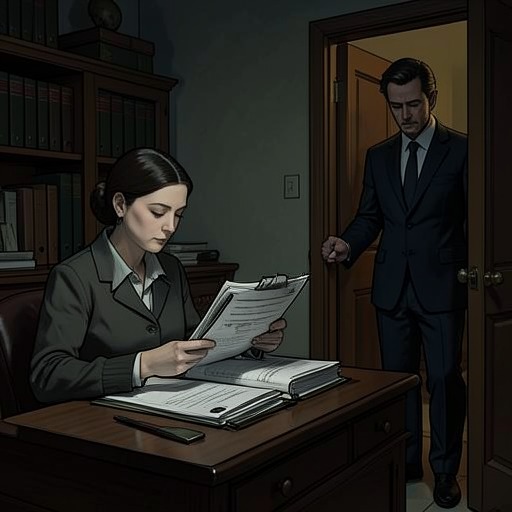
Medical notes stolen from Curtis Chigwell’s home
Blood ShotThe theft from Florence Chigwell’s home is a break-in with an uncertain culprit and a carefully limited target: Curtis Chigwell’s medical notes. Its importance lies in the difference between the missing copies and the originals Florence has secretly preserved. Because she connects Curtis’s records to his unexplained involvement at the Xerxes plant, the intrusion becomes a new lead for V. I. Warshawski rather than simply a domestic crime.
Background and Discovery
Before the break-in, Florence had already seen Curtis try to destroy his notebooks. On Monday evening, she smelled smoke, entered his study, and found him burning the records in a leather waste can. The can itself began to burn and gave off a terrible odor. Florence understood the attempt as evidence that whatever troubled Curtis had something to do with the notebooks, and she objected to his destroying records rather than confronting the facts they contained.
She took the notebooks and hid them behind her boating books. The hiding place was vulnerable precisely because boating was her great love: Curtis would have had reason to look there. Florence thought he might have felt humiliated when she caught him or frightened that he could not eliminate what he considered a guilty secret. The next afternoon, he tried to kill himself. She rushed him to hospital on Tuesday; he was released on Wednesday and said he would stay with friends. The sequence leaves the attempted destruction, the medical crisis, and the later intrusion closely connected, without establishing that they had the same immediate cause.
On Friday, Florence returned from her regular volunteer work with elderly women at the hospital and realized that her home had been broken into. She had not called the police: almost at once, she suspected Curtis, or someone he had let inside, because an outsider unfamiliar with the house would have been more likely to make a disturbance. Her account makes the break-in an act of access as well as entry; whoever was responsible may have known the household or gained entry through someone who did.
What Was Taken
The missing property was not a set of valuables. Florence said that nothing of that kind was gone; Curtis’s medical notebooks were the specific loss she reported. She believed the records could explain what he had been involved in at the Xerxes plant and why he had not wanted to tell Warshawski. The theft therefore directs attention toward the contents of the notes and their connection to the plant, even though the scene does not reveal who took them or what the thief intended to do with them.
The apparent loss proves incomplete. Curtis’s missing notebooks were only his copies. Florence had typed up his notes over the years and kept the original notebooks without telling him. Their pages contained data he had entered in their father’s old leather diaries, custom-bound for him in London. Florence had kept those volumes partly because discarding them seemed like a desecration and partly because she did not want Curtis to know that she was preserving them in memory of their father. The theft thus exposes a concealed reserve of evidence: the copies are gone, but the originals have not been lost.
Consequences for the Investigation
Florence approached Warshawski because she regarded her as a more suitable person to consult than the police. She knew Warshawski had recently endured a terrible ordeal and was still in pain, but considered the records important enough to ask for her help. At the time of the call, Warshawski was sore between the shoulders and trying to recover; Florence noticed her discomfort, yet the link between the stolen papers and the Xerxes plant brought the investigation back into immediate focus.
When Florence explained that only the copies had been taken, Warshawski felt an instinctive surge of alertness and told her she would come to the house within the hour. The surviving originals change the meaning of the break-in: the intrusion has not erased the documentary trail, and Florence’s undisclosed act of preservation gives Warshawski a possible route into the truth Curtis had tried to suppress. The event ends not with an identification of the intruder, but with a decision to investigate the house and the records still hidden there.