Mr. Contreras
Blood ShotMr. Contreras, V. I. Warshawski’s elderly neighbor, is a steady presence of practical care in the midst of her investigation’s violence. He brings food when she has neglected to shop, listens when threats frighten her, and repeatedly acts when she is in danger. His concern is sometimes anxious and impulsive, but it is also consequential: with Peppy, he helps find and free Warshawski in the marsh, and later offers shelter to Art Jurshak Jr. His role makes neighborly kindness more than a comforting backdrop; it becomes a form of protection when official help is distant or uncertain.
Identity and Everyday Care
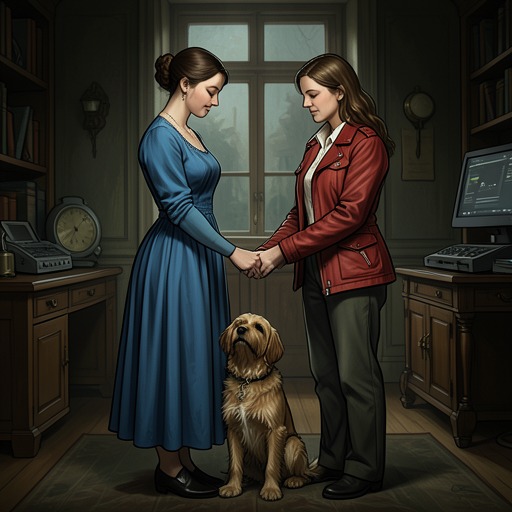
Mr. Contreras lives near Warshawski and is closely associated with Peppy, his dog, who accompanies him in his visits and efforts to help. Their home is a place Warshawski can turn to, but his care also crosses the threshold into hers. When she returns exhausted and subsisting on whiskey and peanut butter, he arrives with a laden TV tray bearing barbecue chicken and a large salad. He has noticed that she is home and has brought a proper meal rather than waiting for her to ask. His offer is solicitous without being demanding: he makes clear that he and Peppy can leave if Warshawski wants to be alone, while also insisting that she cannot live on what she has been drinking and eating.
That exchange establishes the character of his help. It is concrete, domestic, and attentive to the body: supper, laundry, a dog’s welcome, and the offer of a place to stay. He does not need to understand every part of the investigation to recognize that Warshawski is worn down. On another return, he meets her after the funeral of a friend and asks whether she has been drinking. He draws on his own experience, recalling that after his wife Clara died he avoided drinking at funerals because he remembered how much it had upset her. His concern is not abstract sympathy; it is shaped by grief and by a practical conviction that alcohol makes sorrow worse.
Care Under Threat
When Warshawski admits that a threat has unsettled her, Mr. Contreras hovers over her and offers a succession of ways to protect her: she could get out her gun, call the police, barricade the doors, or check into a hotel under an assumed name. She declines these measures, but his response shows how quickly concern becomes action in his mind. He even suggests that she call Murray Ryerson at the Herald-Star, despite his own fierce jealousy of Ryerson. The suggestion is a small but revealing concession: in that moment, the need for Warshawski to have help matters more than his rivalry with the person he recommends.
Peppy registers the tension too, dropping her bone and coming over with a bark. The two of them form a watchful presence around Warshawski, though they cannot eliminate the danger. Mr. Contreras offers her grappa when he has no other way to help; she refuses, reasoning that the threat has cleared her mind and that she does not want to fog it again. His care is persistent but not coercive. He offers what he can, while Warshawski retains the choice to accept or refuse it.
Finding Warshawski in the Marsh
Mr. Contreras’s most dramatic intervention begins when Warshawski has been abandoned in the marsh, bound and exposed to an attacking dog. From inside, she hears him calling to ask whether he has found her and whether she can hear him. The voice she first fears is the familiar voice of her neighbor, accompanied by Peppy. He works feverishly at the knots with the wrong tool, a pipe wrench, reproaching himself for not having brought a knife as he tries to free her.
Once her hands are loose, Mr. Contreras rubs circulation back into her arms. He is shocked to find her in her underwear and initially fears that she has been raped; Warshawski manages to explain that her assailants had intended to drown her. He supports her as she struggles back to the road. His account there explains how he found her: a young lawyer, Ron Kappelman, had said that Warshawski was due to meet him at nine and had been left waiting. Mr. Contreras also heard a companion say that they were going to dump her in the marsh. He made Kappelman drive him and Peppy to the area, using the map Warshawski had previously shown him to locate the place. Kappelman had waited by the car; when the group reached the road, he helped lift Warshawski over the fence and into the back seat, while Peppy pressed her body against her injured companion.
The rescue depends on Mr. Contreras’s attention to a fragment of overheard conversation and his refusal to treat Warshawski’s disappearance as someone else’s problem. His arrival does not make him a trained rescuer: he is clumsy with the knots and brings a wrench where a knife would have helped. But he persists, and his familiar voice and Peppy’s presence transform a moment of near-terror into the beginning of safety.
Protection, Trust, and Risk
Mr. Contreras’s loyalty also extends to people Warshawski asks him to protect. She brings him Art Jurshak Jr., explaining that his father may have had something to do with Nancy Cleghorn’s death and that the young man is in danger from his father’s associates. She asks Mr. Contreras to keep Art hidden until another arrangement can be made. He readily agrees, promises discretion, and says Peppy will keep the secret too. When Warshawski warns that Art may prove an unpleasant guest, Mr. Contreras remains willing to shelter him. The episode shows the reach of his trust: he accepts a difficult responsibility without requiring Warshawski to make it easy or convenient.
His instinct to help can also be exploited. On a later night, a caller tells him that Warshawski is in bad shape at her office. He bundles up Peppy, bullies a cab into taking them downtown, and breaks the office lock with his pipe wrench when he finds the door locked and the lights out. The call has drawn him away from home under false pretenses, and afterward he recognizes that it was a trick to get him and Peppy out of the way. Meanwhile, intruders have tried to break into Warshawski’s apartment. The steel-lined door installed after an earlier home invasion and its third dead bolt hold; the attackers cannot get through, and police take two men away. Mr. Contreras’s hurried response has exposed him to manipulation, but his devotion is not the cause of the danger: it is what the scheme seeks to divert.
Return to Ordinary Life
After that night, Mr. Contreras is tearful with relief when Warshawski returns. He has received no useful information from the police and has spent hours not knowing where she is. He tells her what happened, worries that he failed to help, and remains with her while she checks the apartment. At last he lets her spend the night alone, but leaves Peppy with her and waits downstairs until he hears the final bolt slide home. His care takes the form of staying until he can see that she is secure, then allowing her the privacy she asks for.
When Warshawski later leaves Lotty Herschel’s apartment and brings home the sheets and towels she has used, Mr. Contreras and Peppy greet her with exuberance. He takes the laundry and offers to wash it before breakfast. Believing the case nearly over and the two villains in hospital, he says he should not have worried so much. Warshawski answers that the outcome of a shooting depended on luck; she could as easily have been in intensive care as her opponent. His relief therefore sits beside a clear reminder of how close the danger came. Across meals, searches, shelter, and the return of clean laundry, Mr. Contreras gives Warshawski a dependable domestic ally without pretending that care can make violence harmless or guarantee its outcome.