Nancy Cleghorn
Blood ShotNancy Cleghorn is a South Chicago environmental advocate whose murder turns a stalled community project into an investigation of political influence, corporate insurance, and occupational illness. Long known to V. I. Warshawski as a childhood and basketball friend, Nancy is also an experienced organizer whose work at the South Chicago Reawakening Project (SCRAP) brings her close to the dispute over a proposed recycling center. Her killing makes her both the story’s personal loss and the link between that local conflict and a much older record of harm at the Xerxes plant.
Identity and Community Work
Nancy directs environmental affairs for SCRAP, where Caroline Djiak serves as deputy director. She is also described as the director of Health and Environmental Services, a role that involves tracking community health information. Her work places her between two connected concerns: the community’s effort to secure a recycling facility and the health consequences of industrial activity in South Chicago.
Nancy’s advocacy is practical as well as public-facing. When the Lady Tigers reach the regional championships for the first time in twenty years, she and Caroline organize a reunion of the old team for a pregame ceremony. The event is intended to support the current team, draw publicity to the neighborhood, and promote SCRAP. This work shows Nancy building community visibility through shared local history rather than treating environmental organizing as a separate concern.
She is also willing to challenge official explanations. After the zoning board refuses SCRAP’s recycling-center proposal a hearing, Nancy reports that the stated reason was a lack of community backing. She says she was prepared to present petitions, but the official insisted that opposition existed. Caroline connects the decision to the board chairman’s ties to the old Democratic political network. Nancy’s account helps V. I. Warshawski see the dispute as more than a technical permit problem: access to a hearing is being shaped by local political relationships.
Friendship with V. I. Warshawski
Nancy and V. I. Warshawski have known each other since childhood and stayed in touch through college. They played basketball together, and Nancy remains recognizable to her old friend years later. When the former teammates reunite, Nancy’s familiar manner quickly replaces the distance of time: she urges V. I. Warshawski to hurry because the ceremony is about to begin. Their reunion is warm but not sentimental; Nancy draws her friend back into an old shared world through action and teasing familiarity.
The friendship also has a history beyond the reunion. Ron Kappelman tells V. I. Warshawski that Nancy had said her friend helped keep her from going mad in high school. Nancy had spoken about V. I. Warshawski to other people, and she had recently discussed the basketball reunion with Ron. Their closeness is therefore not merely a memory held by the investigator; Nancy had continued to carry that friendship into her adult life.
Shortly before her death, Nancy tries to contact V. I. Warshawski. Her mother does not know what she wanted, but V. I. Warshawski recalls that their more recent conversations had concerned her work as a detective and what she might do in Nancy’s position. That unfinished contact gives the investigation a personal urgency: Nancy may have been seeking help, and V. I. Warshawski cannot learn what she meant to ask.
Investigating the Permit Dispute
After the zoning-board setback, Nancy and Ron divide their inquiry. Nancy agrees to look into the political angle and find out whether Art Jurshak is blocking the recycling center and why. Ron concentrates on legal options, including whether the permit might be obtained through the Sanitary District or with state and federal environmental agencies involved. Their division of labor makes Nancy’s search for information part of an organized campaign, not an isolated suspicion.
Her investigation leads her to Art Jurshak’s insurance office. Nancy and Art Jurshak Jr. return there late one night, and she searches the desk for documents bearing the names of companies connected to the recycling proposal. Among the papers she finds a 1963 letter stating that Jurshak & Parma had become fiduciaries for Humboldt Chemical’s Xerxes plant, accompanied by an actuarial study of the plant’s losses. Nancy recognizes that the material matters and takes a copy. The document’s apparent distance from the recycling question is precisely what makes it consequential: it points toward a relationship between the insurance agency and the industrial company that was not part of SCRAP’s public proposal.
Art Jurshak Jr. later explains that his father arrived while Nancy was copying the papers, accompanied by Steve Dresberg. Nancy fled, leaving the originals scattered. This episode establishes that people in Art Jurshak’s office knew she had found the records. It does not, by itself, establish who later killed her, but it gives the inquiry a concrete trail from her political investigation to Xerxes and its insurance arrangements.
Private Relationships and Public Stakes
Nancy’s personal life is also entangled with the political conflict. She and Art Jurshak Jr. met through a community project on which she represented SCRAP and he represented the alderman’s office. After initially keeping him at a distance, she began dating him and the relationship became an affair. They kept it secret because he believed his father would object to his involvement with a woman from SCRAP, an organization Art Jurshak regarded as a challenge to his authority in the ward.
The relationship helps explain why Art Jurshak Jr. was present during Nancy’s search of the insurance office, but it does not reduce her actions to his influence. Nancy is independently pursuing the companies connected to the proposed facility, and she recognizes the importance of the insurance papers herself. Her connection to the younger Art brings her into a political family’s private tensions; her work gives her a separate reason to examine what that family’s office holds.
Murder and the Missing Records
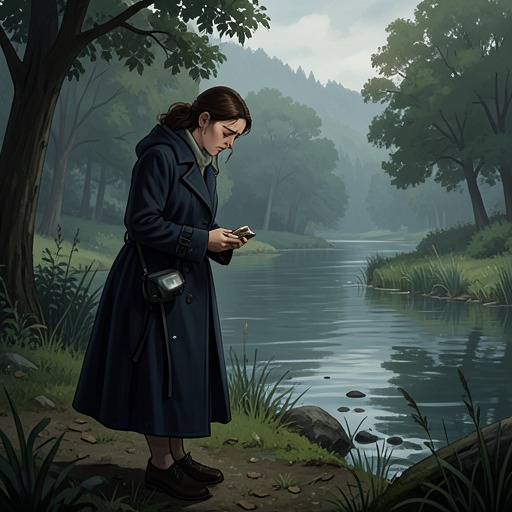
Two boys find Nancy at Dead Stick Pond, a remaining marsh in an industrial landscape polluted by PCBs. The medical examiner estimates that she died around six in the evening and was probably struck hours earlier. Police identify her as thirty-six and report that she had been pregnant at least once. The investigation also establishes that someone moved her to the pond in a green blanket, while another person apparently accompanied the carrier without helping. These findings establish that her death was deliberate, but the police initially have no clear suspect or motive.
The setting carries an environmental contrast central to Nancy’s work. Dead Stick Pond had once been a feeding and resting place for migratory birds; although the wetland survives, pollution has left little able to live there. Nancy’s death is discovered in a damaged environment that echoes the larger health questions she had been tracking. The landscape is not simply scenery for the crime: its condition gives physical context to the risks and losses investigated throughout the story.
After Nancy’s death, Ellen Cleghorn finds Nancy’s home ransacked, with furniture pulled apart and papers scattered. Later, Caroline tells V. I. Warshawski that Nancy’s health files have also disappeared from SCRAP. The police had taken the papers remaining in Nancy’s desk, but someone had removed the health files before they could be impounded. This missing material changes the direction of the inquiry. Nancy had been monitoring health statistics, and the absence of those records makes her work itself appear to be a target.
Significance to the Xerxes Investigation
The insurance document Nancy found becomes more meaningful when set beside the history of Xerxine production. Records examined later show blood histories for Louisa Djiak and Steve Ferraro, as well as approximately five hundred other Xerxes employees, covering 1955 to 1982. The documented changes are consistent with renal, liver, and bone marrow dysfunction; the broader investigation links those records to exposure to Xerxine. Nancy’s work monitoring health information could have given her reason to compare the community’s health evidence with the insurance company’s account of losses.
V. I. Warshawski concludes that Nancy would have understood the significance of the Xerxes loss experience in the 1963 letter and recognized that the insurance arrangement required scrutiny. That conclusion makes the missing SCRAP files and the ransacked house parts of a coherent pattern, though the precise path from Nancy’s discoveries to her murder remains an investigative question. The record does not supply a simple, public explanation at the moment her death is discovered; instead, each recovered document enlarges the stakes.
Nancy’s narrative role rests on the convergence of friendship, local activism, and evidence. Her reunion with V. I. Warshawski brings the investigator back into contact with a friend whose life has continued beyond their shared youth. Her organizing exposes the political barriers facing SCRAP, while her attention to health data and the insurance papers connects those barriers to the longer history of industrial exposure. Her death therefore does not close her work: it makes the missing files, the permit dispute, and the Xerxes records urgent questions that V. I. Warshawski must pursue.