SCRAP
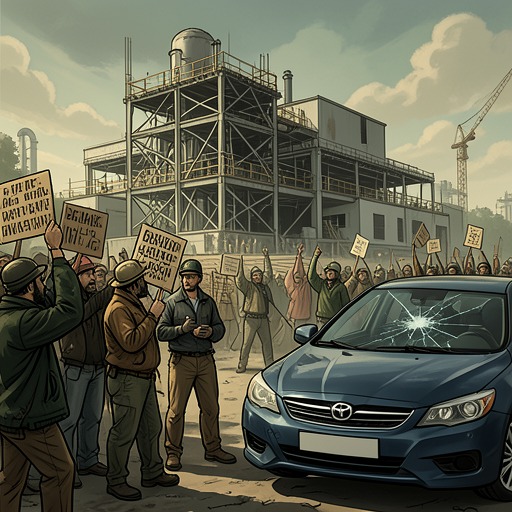
Blood ShotSCRAP, the South Chicago Reawakening Project, is a community environmental organization seeking to improve conditions in South Chicago through local advocacy and a proposed solvent-recycling plant. Its campaign promises jobs and a way to reduce industrial waste, but the effort runs into political obstruction and recalls earlier threats against its members. The organization’s practical work—building a proposal, seeking a hearing, and documenting environmental and health concerns—also becomes entangled with the murder of its director of environmental affairs, Nancy Cleghorn.
Identity and Organization
SCRAP operates from modest offices above a row of small shops. Its workspace, with scarred metal furniture, crowded papers, outdated electric typewriters, and empty offices along the corridor, reflects the limited resources of a poor not-for-profit agency. The setting contrasts with the scale of the industrial and political interests the group is trying to influence. SCRAP is not depicted as a large institution: its work depends on a small staff, community relationships, legal assistance, and the collection of information about local environmental conditions.
Caroline Djiak is the organization’s deputy director. Nancy Cleghorn directs environmental affairs and also has responsibility for health and environmental services, including tracking health statistics. The two work closely enough to plan public events and pursue the recycling proposal together, while SCRAP’s lawyer, Ron Kappelman, handles its legal strategy. Nancy is remembered by Kappelman as organized and clearheaded, someone who knew when to press a dispute and when to retreat. His assessment distinguishes her approach from Caroline’s more forceful leadership without diminishing her importance to the organization.
SCRAP’s public presence is part of its organizing. When the Lady Tigers reach the regional championships for the first time in twenty years, Nancy and Caroline arrange a reunion ceremony for the former team. The event is intended to publicize the neighborhood and SCRAP while supporting the current team. It places the organization within community life rather than limiting it to formal hearings and environmental paperwork.
The Recycling Proposal and Political Obstruction
SCRAP’s central campaign is a proposed solvent-recycling plant. Caroline explains that the group has funding and a site, and that its specifications have passed the environmental tests it has considered. Xerxes and Glow-Rite, nearby industrial users, could supply customers. The proposal is meant to provide about one hundred jobs in South Chicago while reducing the waste entering the ground. It joins an immediate economic promise to a longer-term environmental aim in a district marked by industrial decline and pollution.
The project’s technical preparation does not secure it a public hearing. Caroline and Kappelman arrive at a meeting believing their submission was filed on time and confirmed with the board secretary, only to discover that SCRAP is not on the agenda. After Kappelman challenges the omission, the zoning-board chairman, Martin O’Gara, returns with the explanation that legal problems prevent consideration that evening. An attorney from the U.S. Environmental Protection Agency later reviews the submission and considers it to be in good order. The discrepancy leaves SCRAP with a procedural obstacle that its own preparation has not resolved.
O’Gara subsequently says the proposal lacks community backing. Nancy disputes this, saying the group has petitions and regards the community as strongly supportive, but O’Gara claims to have heard from opponents. Caroline links the board’s decision-making environment to O’Gara’s ties with established Democratic ward politicians. Nancy worries that opposition from Art Jurshak could make a hearing nearly impossible, and considers whether SCRAP must find a way to engage him. The episode presents the permit process as more than a technical review: access to it appears vulnerable to local political relationships, while the organization’s evidence of public support is treated as insufficient.
The proposed recycling center is not described as an existing part of the operations of Steve Dresberg, a local figure in garbage disposal. Kappelman observes that Xerxes and Glow-Rite are currently putting their waste into their own lagoons and that SCRAP’s plan would recycle it. He nevertheless recognizes that a future expansion might affect Dresberg’s interests, while stressing that this connection does not establish his involvement in Nancy’s killing. The possibility of competing interests remains a line of inquiry, not a proved explanation for the obstruction or the murder.
Earlier Advocacy and Threats
SCRAP’s campaign follows an earlier fight over a proposed PCB incinerator associated with Dresberg. Caroline and Nancy testified that they had received death threats because of their opposition. Caroline recalls that the Sanitary District’s alleged favorable treatment of Dresberg’s proposal made their testimony seem ineffective, and that the group had been treated as too small to command attention. The earlier episode gives the organization’s later permit struggle a history: its members have already attempted to challenge industrial waste decisions and have faced intimidation in response.
When Nancy is murdered, Caroline tells V. I. Warshawski that Nancy had sought help from the State’s Attorney’s Office. She had not disclosed to Warshawski the earlier threats when first questioned, and Warshawski urges her to make an amended statement naming people who had threatened the group before. The revelation redirects attention from private grievances toward SCRAP’s public conflicts. It does not prove that the prior threats led to Nancy’s death, but it establishes a history that investigators had not initially been given.
Kappelman’s account complicates the connection between the murder and the recycling campaign. Two weeks before his conversation with Warshawski, Nancy had planned to investigate whether Jurshak was blocking the project and why, while Kappelman worked on the legal route to a permit through the Sanitary District and possibly state and federal environmental agencies. Nancy and Kappelman therefore divided the work between political investigation and regulatory strategy. He acknowledges that Caroline’s theory about the recycling dispute is possible, but says he does not know what Nancy believed about being followed or who was responsible.
Records, Health Work, and Aftermath
After the funeral, Nancy’s mother gives Warshawski the papers left in Nancy’s sky-blue Honda, asking that the work papers be returned to SCRAP. Among them is a 1963 letter stating that Jurshak & Parma had become fiduciaries for Humboldt Chemical’s Xerxes plant, accompanied by an actuarial study comparing Xerxes losses with those of similar companies and seeking comparable rate treatment. The document appears unrelated to the current recycling proposal, but its presence in Nancy’s papers suggests that her investigation had reached beyond the immediate permit dispute.
The significance of the old insurance material becomes clearer when Warshawski learns that Nancy tracked company health statistics. Caroline says that Nancy’s health files are missing: the police impounded papers from her desk, but someone had removed the health files before the police obtained them. The files had first been assumed to be at Nancy’s home. Their disappearance raises the possibility that information gathered through SCRAP’s health work mattered to whoever was interested in Nancy’s papers; it does not, by itself, identify who took them or why.
Warshawski’s subsequent inquiries connect the insurance issue to Humboldt Chemical and to the Xerxes plant’s workforce. At Ironworkers Savings & Loan, she finds Gustav Humboldt among thirteen directors and learns that he has remained on the board for decades despite the growth of his company. She suspects that a problem involving insurance for the Xerxes workforce is being kept from public view, though she cannot yet determine its relation to the workers’ lawsuits or deaths. Later, Caroline helps Warshawski seek information about the report Nancy carried. These developments expand the stakes of SCRAP’s work: its records and health investigations may bear on industrial risk as well as on the group’s immediate campaign for a recycling facility. The organization’s environmental advocacy thus links community employment, waste management, political access, and the difficult work of making workers’ health concerns visible.