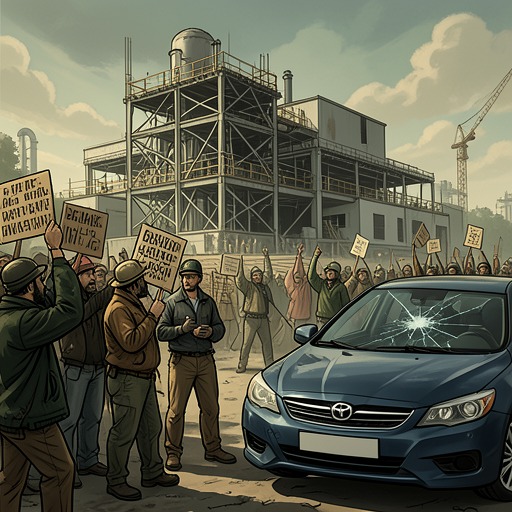
SCRAP recycling-center permit hearing and obstruction
Blood ShotThe SCRAP recycling-center permit hearing and obstruction turned a local environmental proposal into a test of who could claim to speak for the community—and who had the power to decide which proposals would be heard. The denial redirected Nancy Cleghorn’s work toward local political connections, while the investigation that followed exposed a separate, older insurance relationship linking Art Jurshak’s firm to Humboldt Chemical’s Xerxes plant. The narrative makes that connection consequential without proving that it explains either the obstruction or Nancy’s death.
Proposal and denial
SCRAP sought to establish a recycling center that would take industrial waste for recycling. At the time, Xerxes and Glow-Rite were dumping waste into their own lagoons; the proposed center was presented as an alternative to that disposal, not as an operation within garbage hauler and incinerator Steve Dresberg’s existing business.
The proposal met an obstacle before it could proceed to a hearing. Nancy told Caroline that O’Gara, the zoning-board chairman, had said proposals like theirs should not be made without community backing. Nancy answered that the community supported the plan and was ready to show copies of petitions, but O’Gara said he had heard from people who opposed it. The account leaves the disagreement unresolved: Nancy asserted broad support, while the official invoked unnamed opposition to justify refusing a hearing.
The refusal was not merely procedural for the organizers. Nancy and Caroline had been angered by the hearing’s outcome, and Nancy divided their next steps with a colleague: she would investigate the political angle, while he pursued legal options for obtaining a permit through the Metropolitan Sanitary District and possibly state and federal environmental agencies. The denied hearing thus redirected the campaign into parallel political and legal inquiries.
Political and industrial stakes
Caroline connected O’Gara’s decision to local political relationships, describing him as close to established Democratic politicians and identifying Jurshak as the reason she suspected a political tie-in. Nancy likewise set out to find whether and why Jurshak was blocking the proposal. The suspicion was a line of inquiry, not a demonstrated explanation for the denial.
The local setting gives that suspicion a material context. In East Side, the ward office remained in a brick two-flat on Avenue M. Its large exterior sign named Art Jurshak as alderman and Freddy Parma as ward committeeman; the storefront next door housed the insurance agency that had helped Jurshak establish himself in the community. The office was not an abstract political address: residents went there for help with matters such as parking tickets and access to city employment, and local police came and went. Its visible overlap of political service and insurance business helps explain why a connection between Jurshak and Xerxes warranted scrutiny, while not proving that the office caused the permit decision.
Dresberg offered another possible source of pressure, but the evidence remained equivocal. His garbage empire included hauling, incineration, storage containers, and landfills, and he was protective of perceived encroachments. A year earlier, he had threatened Caroline and Nancy when they opposed a noncompliant PCB incinerator. Yet the recycling center did not directly compete with those operations: it would recycle waste that Xerxes and Glow-Rite were then dumping into lagoons. Warshawski considered whether Dresberg might fear future expansion into his business or want SCRAP to use his trucks. His colleague judged such involvement possible, but not an obvious explanation for Nancy’s killing; if Dresberg wanted the hauling contract, he might simply have pressured SCRAP to use his trucks. The earlier threats made him relevant to the inquiry without establishing his responsibility for the obstruction or murder.
Documents and the widening inquiry
After Nancy’s death, Warshawski searched Nancy’s files for an explanation of Jurshak’s opposition. Among documents unrelated to routine SCRAP business, she found a photocopied letter dated 1963 and addressed to Mariners Rest Life Assurance Company. It stated that Jurshak & Parma had become fiduciaries for Humboldt Chemical’s Xerxes plant. An attached actuarial study said Xerxes’s losses were comparable to those of similar companies in the area and requested the same rate consideration.
At first, the document seemed ordinary rather than incriminating. Warshawski read the report three times, but it appeared to concern straightforward insurance business, and she could not see how it explained Nancy’s death. Its age and its lack of any obvious connection to Nancy’s environmental work made its presence in her files more puzzling, not less. The document supplied a verifiable business link, but no proof that the link caused the hearing’s denial or that Nancy had been killed for discovering it.
A later inquiry into Ironworkers Savings & Loan sharpened the insurance question. Of thirteen directors, Warshawski recognized only Gustav Humboldt. A bank officer said Humboldt had joined the board in the 1940s, when he began doing business in the area, and had remained a director even after his company became one of the world’s largest and he joined the boards of numerous Fortune 500 companies. He had missed only eight meetings in fifteen years. In the light of the Xerxes document, this information led Warshawski to suspect that Humboldt was determined to keep a problem involving insurance on the Xerxes workforce from coming to light. She still could not connect that issue to the workers’ lawsuit or the deaths of Ferraro and Pankowski, and she wondered whether Dr. Chigwell’s medical notebooks might clarify the actuarial data.
Consequences and significance
The permit obstruction establishes the political setting in which Nancy pursued her investigation: a claim of community support met an official assertion of unnamed opposition, while local political and commercial relationships offered several possible routes of influence. The evidence points in more than one direction. Jurshak’s position in local politics and his firm’s old fiduciary role at Xerxes invite investigation; Dresberg’s past threats make him a plausible subject of suspicion; neither connection, by itself, resolves the case.
The sequence also changes the scale of the inquiry. What begins as a dispute over whether SCRAP will receive a hearing opens onto the less visible question of how insurance, industrial losses, and the workforce at Xerxes were connected. The 1963 letter and Humboldt’s continuing bank directorship make the political and financial network legible, but they stop short of a conclusive answer. The hearing’s lasting narrative force lies in that combination of concrete institutional ties and unresolved causation: the proposal exposes the landscape of influence without identifying, on the evidence presented here, the hand that blocked it or the person who killed Nancy.