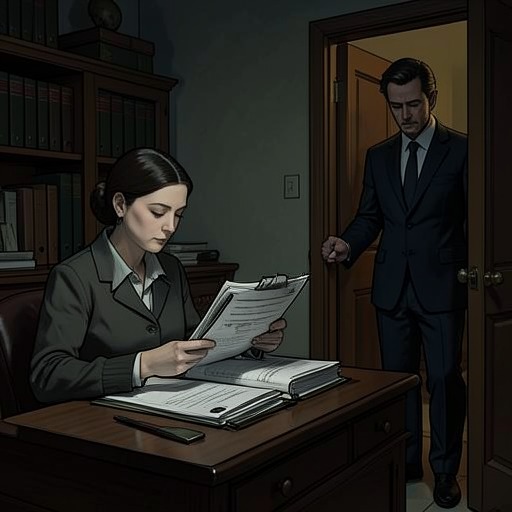
Steve Ferraro
Blood ShotSteve Ferraro is a deceased Xerxes plant worker whose story links Louisa Djiak’s past to the novel’s wider inquiry into occupational illness and corporate concealment. Remembered by Louisa as a man who wanted to marry her, he later becomes one of two workers whose unsuccessful compensation claim appears to settle the question of whether Xerxine caused their illnesses. Medical records change that understanding: Ferraro had worked at the plant for decades, his blood history showed changes consistent with toxic exposure, and he died of aplastic anemia in 1983.
Identity and Known Background
Ferraro’s life is reconstructed from other people’s memories and from records rather than presented directly. He worked at Humboldt Chemical’s Xerxes plant in South Chicago from 1959, remaining there until illness forced him to quit. The available account identifies him as an unmarried man and provides little personal history beyond his connection to Louisa and the circumstances of his illness. His importance comes partly from this fragmentary record: details that might have remained private become consequential when V. I. Warshawski tries to understand Louisa’s past and later examines what happened to Xerxes employees.
Louisa remembered Ferraro as one of two men from the old neighborhood and plant years who figured in her earlier life. She recalled that he wanted to marry her, while Joey Pankowski did not. Looking back, Louisa said she would have made the same choice because it gave her Caroline Djiak, but she wanted a different future for her daughter, one beyond work in South Chicago and premature hardship. Ferraro therefore belongs to a memory shaped both by affection and by the life Louisa built afterward; the account does not establish that the two married or that he became Caroline’s father.
A Search Through Incomplete Memories
V. I. Warshawski begins looking for Ferraro and Pankowski after deciding to respect Louisa’s reluctance to have her private history pursued while still responding to Caroline’s wish to learn about her origins. The search is necessarily uncertain. At Xerxes, Warshawski gives a clerk the two men’s names, but the clerk has worked at the plant for only two years and cannot identify employees from the early 1960s from memory. Warshawski’s attempt to find them through other records likewise yields traces rather than a living connection: old voter registrations show Ferraro registered through 1983 and Pankowski through 1985.
Ferraro’s mother supplies a separate, limited recollection. She tells Warshawski that her son died in 1984, had never married, and had once spoken of a girl at his workplace who already had a baby. She does not name the woman. Her account is consistent with Louisa’s memory that Ferraro wanted to marry her, but it does not confirm that the unnamed woman was Louisa. Warshawski considers the timing important: Ferraro’s wish to marry Louisa, baby and all, suggests that he knew her after Caroline’s birth, which would make him an unlikely candidate for Caroline’s biological father. The distinction between a remembered attachment and proof of parentage remains central to the search.
Illness and the Failed Claim
Warshawski learns that Ferraro and Pankowski brought a workers’ compensation case against Humboldt Chemical. They had left work because of illness and sought to show that their conditions were job-related. Jonathan Michaels reports that the case went to trial in Chicago, that Humboldt won, and that after both men died their lawyer did not pursue an appeal. Frederick Manheim, who represented them, later explains how the case developed: the men came to him in early 1983, seriously ill and under financial pressure, after learning that Xerxine might cause health problems.
Ferraro had worked at Xerxes since 1959; Pankowski had started in 1961. Both had quit about two years before approaching Manheim because they were too sick to continue. Manheim says he did not think they had been told that disability benefits might be available. He first approached the company, then filed suit when Humboldt would not negotiate. A successful claim after the men’s deaths could have meant indemnity payments for their families, but the effort failed before either man could see a recovery.
Humboldt’s defense turned on competing explanations and the limits of what was then known. Both men smoked, Pankowski drank heavily, and both had spent their lives in South Chicago, where poor air quality offered another possible explanation for illness. The company argued that the evidence could not establish Xerxine as the cause rather than those other factors. It also argued that the men’s exposure began before the chemical’s toxicity was known, when the plant was being operated according to prevailing medical knowledge. The court accepted a case that Manheim later regarded as a decisive loss; an appellate lawyer saw no viable basis to continue. The result explains the lawsuit’s failure, but not the full medical history concealed from its participants.
What the Medical Records Reveal
Later, a specialist reviews records from the notebooks of Dr. Chigwell, Xerxes’ company doctor. The material includes Ferraro’s blood history from 1957 to 1982 and records for approximately five hundred other Xerxes employees covering 1955 to 1982. An expert’s summary identifies changes in several blood measures as consistent with renal, liver, and bone marrow dysfunction. A further report on Ferraro concludes that he died of aplastic anemia in 1983 and that his blood-chemistry changes were consistent with Xerxine exposure.
These findings recast the compensation case. Ferraro’s and Pankowski’s claim had failed in part because Humboldt could point to smoking, drinking, polluted air, and the period before Xerxine’s toxicity was recognized. The later records, however, reveal a broader history of employee illness and provide evidence that the company’s chemical was consistent with the changes observed in Ferraro. The novel does not turn this evidence into a personal vindication Ferraro can witness: he is already dead. Instead, the gap between the failed lawsuit and the later medical interpretation makes the cost of delayed knowledge plain.
Narrative Role and Significance
Ferraro’s story advances on two connected tracks. In the family search, he is a possible figure from Louisa’s past, but the surviving memories cannot establish that he fathered Caroline. In the industrial investigation, he is a worker whose illness and death were once filtered through an unsuccessful legal claim, then illuminated by records kept over many years. Neither role gives him a fully recovered biography; together, they show how incomplete information can shape both intimate questions and public accountability.
His case also exposes the limits of a legal outcome as a measure of truth. The lawsuit ended with Humboldt prevailing, and its defenses appeared strong enough to prevent an appeal. Later blood records, covering decades of employment and hundreds of workers, disclose evidence that the litigation had not established. Ferraro remains present in the novel through that reversal: first as a name pursued for Caroline’s sake, then as a deceased claimant whose illness forms part of a much larger record of possible workplace harm.