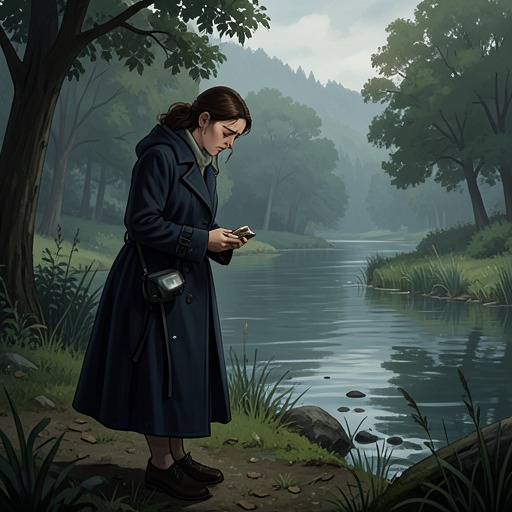
The killing of Nancy Cleghorn
Blood ShotThe killing of Nancy Cleghorn transforms a murder investigation into an inquiry about who benefits when evidence of industrial harm disappears. Nancy’s work monitoring health and environmental conditions at SCRAP had given her access to information that could connect Xerxes’s losses with a suspicious insurance arrangement. Her death is therefore more than a personal tragedy or a mystery of motive: it marks the point at which the concealment of records becomes part of the crime itself.
Background and the Missing Records
Nancy served as SCRAP’s director of Health and Environmental Services and tracked health statistics. That role made her a possible link between the conditions at Xerxes and the company’s insurance affairs. Warshawski initially considers several explanations for the killing, including a crime of passion and the possibility that Ron Kappelman arranged an ambush against her. Yet she cannot make those possibilities fit the wider investigation: the workers’ claims against the company, Gustav Humboldt, and Dr. Chigwell do not readily connect to Kappelman. The unresolved question is whether the murder belongs to the insurance inquiry and, if so, what Nancy had uncovered.
The disappearance of Nancy’s files sharpens that question. Caroline reports that the police impounded the material on Nancy’s desk, but someone had already cleared out her health files before officers received them. Caroline and her colleagues had assumed Nancy took those records home. Warshawski recognizes the consequence: if the killer removed the files, the investigation should have concentrated earlier on people connected with the companies rather than on aggrieved lovers. The loss is not simply an absence in the evidence; it suggests that Nancy’s professional records mattered to whoever wanted her silenced.
What Nancy May Have Discovered
Warshawski reconstructs a possible chain of knowledge from Nancy’s work. Because Nancy monitored Xerxes’s real loss experience as SCRAP’s environmental and health director, she would have understood the significance of a letter to Mariners Rest and the insurer’s rate structure. In Warshawski’s analysis, those documents showed that Art Jurshak was handling some kind of insurance scheme for the company. Nancy could therefore have recognized a connection between workplace harm and the financial arrangements surrounding it.
That reconstruction remains an inference rather than a fully settled account of exactly what Nancy saw or when she saw it. Warshawski considers whether the missing records were taken from Nancy’s office, or whether Nancy had them with her while preparing to confront Jurshak. She also notes that other material remained in Nancy’s car, which the person searching for evidence apparently did not inspect. The uneven removal of papers leaves a precise but incomplete trace: someone may have known which records mattered, while failing to find everything Nancy had kept.
Witnesses, Silence, and Competing Motives
The investigation also exposes a separate silence surrounding Nancy’s last encounters. A witness later admits that the people he was concerned about never knew he was present because he hid in his office with the lights off. Warshawski realizes that he knew Steve Dresberg had been there with his father. His concealment had left Nancy without help, and his withheld knowledge deprived the investigation of a lead. The episode does not resolve whether the central motive was the insurance papers or Nancy’s having seen Art with Dresberg; it makes both possibilities part of the same inquiry.
The witness’s explanation is bound up with loyalty and fear of family disgrace. He asks Warshawski to imagine discovering a parent’s wrongdoing and anticipates that disclosure would make his father regard him as a failure. He also believes his father would see him as siding with SCRAP and political opponents. His silence thus protects a family relationship and a political allegiance at the cost of useful evidence. Nancy’s death exposes how personal loyalties can obstruct accountability even when a witness understands that a serious event has occurred.
Consequences and Retrospective Identification
The killing’s consequences extend beyond the loss of Nancy’s records. It changes the field of suspicion: the environmental and health information she tracked directs attention toward Xerxes, its losses, and the insurance arrangements involving Jurshak. At the same time, the concealed encounter with Dresberg gives the case a second line of inquiry, one involving what Nancy witnessed and who knew she had seen it. The available evidence keeps these motives in tension rather than reducing them to a single uncomplicated explanation.
The book later gives Warshawski a stark basis for identifying Dresberg as the person who tried to kill Nancy: when he threatens Louisa and Warshawski at Xerxes, Warshawski confronts him with the accusation that he had tried to kill her by the same method he used on Nancy. The accusation comes during an immediate confrontation, not as a detached police finding, but it makes the earlier killing legible as part of a continuing pattern of violence against people who threaten powerful interests. Nancy’s murder accordingly joins two forms of harm in the novel: the slow, difficult-to-document damage associated with toxic working conditions and the direct violence used to keep evidence and witnesses from bringing that damage to light.