The murder of Nancy Cleghorn
Blood ShotThe murder of Nancy Cleghorn brings the personal cost of violence and the neglected landscape of industrial Chicago into the same frame. Found at Dead Stick Pond after being struck and left in the water, Nancy is at first known to V. I. Warshawski through a newspaper account and then through the sparse physical evidence at the scene. The details begin to reconstruct how she died, but not who wanted her dead or why.
Discovery in the marsh
The news reaches V. I. Warshawski the morning after Nancy’s death, while she is making coffee and skimming ChicagoBeat. The article explains why Nancy had not answered her phone the previous day: two boys had found her body around eight the previous evening. They had entered the posted area around Dead Stick Pond, hoping to see a muskrat they had encountered there before. At the water’s edge they stumbled over a discarded boot. In a place strewn with old footwear, and in the dark, it took them several minutes to realize that a body was attached.
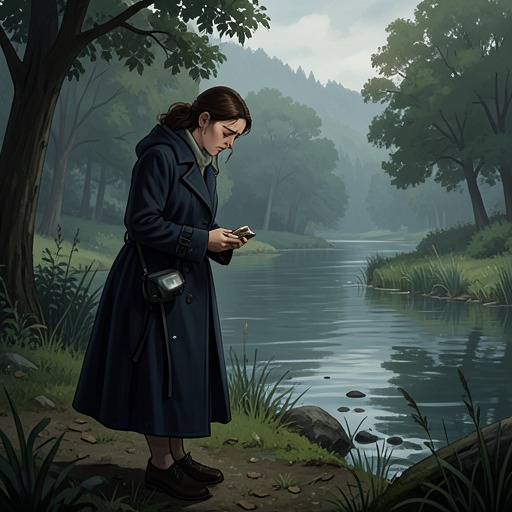
The discovery site is a remnant of marsh in the Calumet River overflow, once a feeding and resting ground for migratory birds. It has become a damaged wetland, contaminated with PCBs and ringed by the remains of mills. Birds and occasional mammals still appear there, but the pond’s history as habitat exists alongside signs of danger and neglect. On her later visit, Warshawski sees conflicting notices: one presents the area as a federal clean-water project, while another warns of hazardous waste. A low fence, intended to enclose the pond, has fallen in places. The boys’ route into the area is therefore not an isolated breach but an ordinary consequence of a boundary that is both posted and poorly maintained.
What the evidence establishes
The newspaper reports that Nancy was hit on the back of the head. The resulting internal injury would eventually have been fatal, but the account says she apparently drowned after her body was dumped in the pond. The distinction matters: the blow and the water are separate parts of the death, and the circumstances indicate that she did not simply fall into the marsh unaided. Still, the initial police account offers no identified suspect or known reason for killing her. It describes Nancy as respected and notes the recognition her SCRAP work had earned in an environmentally troubled community.
When Warshawski speaks with Bobby Mallory, he supplies a more detailed forensic reconstruction. Nancy died at about six in the evening; the medical examiner estimated that she was probably struck around four, based on the internal bleeding. She was thirty-six and had been pregnant at least once. Investigators also had details of her health history, including her eating habits and a right leg broken in adulthood. Those facts help identify and describe the victim, but do not establish a motive or point to a killer.
Other findings trace the movement of the body. A person wearing size-thirteen shoes, with a forty-inch stride, dragged Nancy in a green blanket to the south end of Dead Stick Pond. The blanket was a particular Sears brand sold in the United States between 1978, when production began, and 1984, when it ended. Bobby adds that another person, presumably a man, accompanied the carrier but did not help with the dragging or dumping. The evidence thus suggests at least two people were present during the disposal, while leaving open whether either was the person who struck Nancy. These measurements and the blanket narrow the physical account of the crime; they do not yet answer its central question.
The scene and its limits
Warshawski follows a track to the pond’s southern end, where the papers place Nancy’s death. Yellow police tape and large warning signs still mark the spot, but no patrol officer has been left to guard it. Rain has likely washed away whatever the evidence team did not collect. The killers appear to have parked near where Warshawski left her car and dragged Nancy along the path she has just walked, past the place where a fishing couple had been standing. Whether the couple was there at the relevant time, or whether the killers relied on the privacy of people living and fishing in the marsh, remains uncertain.
At the marked location, stones outline where Nancy’s body lay. Warshawski understands from the arrangement that she was removed from the blanket and landed on her right side, with her head partly in the water. The scene offers a physical sequence—transport, removal from the blanket, and exposure to the pond—but little that can identify the people responsible. Rain has erased traces, and the remaining litter of bottles, food wrappers, shoes, and coats makes Nancy’s abandoned body seem part of a broader landscape of discarded things. The fishing couple are still present when Warshawski returns along the path, but their gaunt German shepherd bares its teeth as she approaches. She turns back and leaves any questioning of the couple to the police.
Grief and the unanswered case
Before visiting the pond, Warshawski rereads the newspaper account six or seven times without finding anything new. She remembers a snappish thought from the night before, when she had wondered whether Nancy might have fallen under a train, and recognizes the irrational bodily guilt that follows: she knows her thought did not cause Nancy’s death, though that knowledge does not immediately quiet her response. She also reproaches herself for having gone to the lake rather than staying beside her phone, then rejects the idea that she should be perpetually available to friends and callers. The death makes the old friendship newly urgent, but cannot undo the ordinary distance and missed contact that preceded it.
Nancy had known Warshawski since they were six years old. Warshawski had continued to imagine them as young together, as if a shared childhood could protect both of them from aging and loss. The murder breaks that imagined protection. In the investigation’s early stage, the facts are unusually concrete—the approximate time of the blow, the route to the pond, the blanket, the stride and shoe size—while the motive and identities remain absent. The contrast between measurable traces and unanswered human questions shapes the event: Nancy’s death can be reconstructed in part, but neither forensic precision nor Warshawski’s personal connection immediately explains why she was killed.