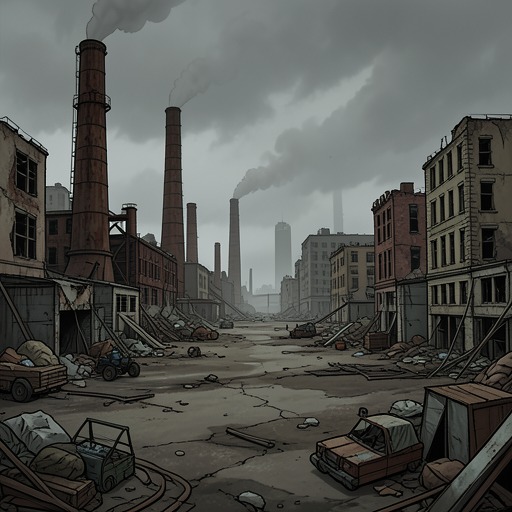
USX South Works
Blood ShotUSX South Works dominates the lakeside landscape south of Chicago’s wealthy shoreline, its weed-choked grounds and industrial structures marking the transition from beaches and high-rises to landfill and worn-out factories. The site evokes a vanished era of mass industrial employment, while its presence in the narrator’s return to South Chicago makes the region’s physical decline impossible to separate from its pollution and economic hardship.
Setting and Appearance
Seen from Route 41, the South Works occupies roughly a mile of land between the road and Lake Michigan. Beyond Seventy-ninth Street, the lake disappears from view behind the factory’s expansive grounds. Pylons, gantries, and towers rise in the smoke-hung February air, a stark industrial prospect in place of the high-rises and beaches farther north. The yards are choked with weeds, and the surrounding landscape has the character of landfill as much as a working industrial district.
The residential streets facing the plant register a different kind of decline. Nearby bungalows have missing siding, peeling paint, and cracked or sagging front steps, but their windows remain whole and their yards free of debris. The contrast places the steelworks within a neighborhood whose residents, despite poverty, maintain their homes and resist surrendering to visible decay.
Industrial Past and Regional Decline
The South Works belongs to a broader history of employment that once structured life in the area. The narrator remembers eighteen thousand men pouring from South Chicago homes each day to work at the South Works, Wisconsin Steel, the Ford assembly plant, or the Xerxes solvent factory. Freshly painted house trim and the seasonal arrival of new Buicks and Oldsmobiles serve as remembered signs of the prosperity associated with that industrial world.
On the narrator’s return, that world has contracted sharply. The South Works is on strike, while Wisconsin Steel is padlocked and rusting. South Chicago appears frozen in an earlier period, but mass unemployment has swollen the number of vacant-eyed men standing near storefront taverns. The contrast between the remembered flow of workers and the contemporary signs of idleness gives the steelworks significance beyond its physical footprint: it is part of the region’s lost economic center.
Pollution and Narrative Significance
The industrial landscape is not merely a relic. As the narrator drives south, a pungent chemical mixture enters the car through its engine vents and the minute cracks in its windows, burning the eyes and sinuses. Turning off the heater does not keep it out. The description makes the environment an immediate bodily presence rather than distant scenery, linking the industrial district’s economic history to the persistent costs borne by people who live and travel nearby.
The return journey sets remembered familiarity against present estrangement. The narrator once knew the neighborhood and its industries as part of an ordinary life; now even the air is hard to recognize, and the old river-swimming custom seems repellent in light of the water’s present filth. USX South Works therefore anchors a layered portrait of South Chicago: a place shaped by industrial work, marked by unemployment and physical decay, and still exposed to pollution that cannot be left behind simply by closing a car’s vents.