V. I. Warshawski
Blood ShotV. I. Warshawski is a lawyer who works primarily as a private investigator, and a former high-school and college basketball player whose old ties become essential to a murder investigation. As she follows the killing of Nancy Cleghorn and Caroline Djiak’s request for help, professional inquiry repeatedly collides with friendship, family history, and personal danger. Her defining strength is not invulnerability: the plot makes her survival depend on persistence, judgment, and, increasingly, accepting help from others.
Identity and Return
After twenty years away, V. I. Warshawski returns to her former high school for a basketball gathering. The building’s scale and noise evoke a past she has not visited in decades, yet her body remembers the route: at the gym entrance she turns toward the women’s locker room without stopping to think. The instinctive turn makes the past concrete, not as a story she chooses to tell but as a place still mapped in habit.
Caroline Djiak is waiting with a clipboard. The former classmates greet one another amid preparations for the reunion game, where the returning players are expected to put on their old uniforms. Caroline reminds her of her tournament Most Valuable Player standing and points out that a reporter from the Herald-Star wants to interview her. The scene briefly places V. I. Warshawski back inside a familiar team identity, but Caroline’s urgent request soon redirects the reunion from public celebration toward private investigation.
V. I. Warshawski identifies herself to Frederick Manheim as a lawyer who now works chiefly as a private investigator. She approaches him because her case has brought her to two of his former clients, Joey Pankowski and Steve Ferraro. His troubled reaction at their names signals that the inquiry touches matters more serious than a routine professional introduction, though the exchange does not immediately supply her with an answer. Her method is to make connections across different kinds of work and institutions, while treating what she knows—and what she does not know—as separate things.
Investigations and Professional Judgment
Caroline first insists that V. I. Warshawski treat her as a serious client, not as the child she once was. She asks to hire her professionally, then explains that she wants her to find her father. V. I. Warshawski asks Caroline to set out the whole story before they decide whether a detective is needed and whether she is the right person for the job. That insistence on hearing the case in full marks a professional boundary within an intimate relationship: affection does not replace inquiry, and a request must still be understood before it can be acted on.
The investigation changes when Bobby Mallory questions her about Nancy Cleghorn’s murder. He gives her the known circumstances of the death and the effort made to examine physical evidence, but says the police do not know who wanted Nancy dead. He also invokes the women’s shared history and asks V. I. Warshawski to tell him who the murderer is. She does not pretend to possess an answer. Her response exposes both the police department’s limits and her own: the friendship makes her relevant to the case, but it does not make her knowledge complete.
As she considers whether Steve Dresberg is connected to the danger around Caroline’s case, V. I. Warshawski weighs the consequences of involving the police. She recognizes that Dresberg belongs within serious police or federal scrutiny, yet worries that directing attention toward him without sufficient grounds could divert investigators from better leads. The hesitation is characteristic of her work at its most responsible. Suspicion is not treated as proof, even when the suspected figure is powerful and alarming.
She also approaches Art Jurshak’s son, identifying herself through her connection to Nancy and asking whether he is Art Jurshak’s son. His visible distress at the recognition becomes a clue in itself, though it does not settle what he knows. Later, at Buckingham Fountain, she tells Art Jurshak that his son cannot attend and introduces herself by invoking connections he may know through his wife or Gustav Humboldt. She notices that the older man’s face resembles Caroline’s more strongly than it resembles his son’s. The physical likeness gives the search for Caroline’s father a striking focus, while Jurshak’s immediate demand to know where his son is held turns their meeting into a confrontation rather than a calm exchange.
Friendship, Danger, and Responsibility
Nancy’s murder gives V. I. Warshawski’s past a present cost. The two women played basketball together in high school and college, and Bobby’s appeal depends on that former closeness. V. I. Warshawski does not describe the friendship as a substitute for evidence; instead, it makes her unwilling to leave the unanswered question to others. The reunion’s basketball setting thus becomes more than a nostalgic return. It reconnects her with Nancy at the moment when Nancy can no longer speak for herself.
Her relationship with Caroline likewise shifts between old roles and adult obligations. Caroline first approaches her as someone who might find a missing father and solve a family crisis. After V. I. Warshawski is attacked, she challenges Caroline for having withheld information that might have helped protect them both. Caroline explains that she had imagined V. I. Warshawski as a big sister capable of fixing everything, then realized she was not as powerful as that childhood image suggested. The admission dissipates V. I. Warshawski’s anger. She agrees that there are no all-powerful adults who can clear away every problem, but insists that she is not useless and can still help put some of the disorder right. Caroline’s shaky agreement to help marks a more reciprocal understanding between them.
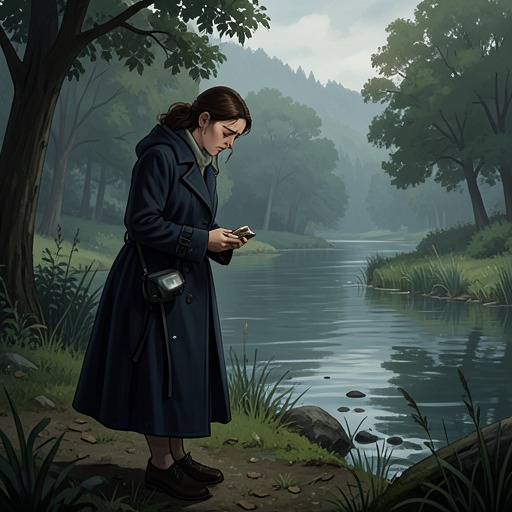
At Dead Stick Pond, V. I. Warshawski is attacked and left in grave danger. She struggles to get out of the water and toward the road, but exhaustion and disorientation leave her vulnerable to another assailant. The episode is a decisive breach in her confidence that determination alone will suffice: she survives, but not because she can simply will herself clear of every threat. Kappelman eventually gets her to help; after reaching a hospital, she wakes on Thursday morning with the memory of the pond returning and relief that her hands still have feeling. Her recovery is a physical fact and a change in perspective, not a victory without cost.
Change and Narrative Role
Afterward, V. I. Warshawski returns to the prospect of further danger at her home. Rather than going back to Racine without precautions, she asks to call the police and wants them to check the place first. Lotty Herschel responds with surprise at this newfound caution. V. I. Warshawski dislikes handing her problems over to someone else, but recognizes that refusing help merely to preserve her self-image would be foolish. The decision does not make her passive; it shows her adapting her methods to the risks she has actually encountered.
That adjustment culminates in her confrontation with Steve Dresberg at the Xerxes plant. From concealment, she calls out that he should never have tried to kill her in the same way he killed Nancy. Dresberg answers by pointing a gun at Louisa Djiak, treating V. I. Warshawski as too insignificant to address directly. She keeps speaking, tells him she has heard his conversation with Art Jurshak, and insists that he deal with her before turning on Louisa. Her taunts are not evidence of fearlessness so much as a way of refusing his chosen terms and drawing his attention to the immediate danger.
Across these episodes, V. I. Warshawski’s old athletic identity, legal training, and investigative persistence work together, but none guarantees safety or certainty. She is willing to follow a clue, acknowledge when it remains inconclusive, and ask for institutional help when acting alone would be reckless. The return to the high-school corridor begins with an involuntary memory of where to turn; the larger journey requires her to revise what strength means. It remains active and confrontational, but it no longer depends on believing that she must solve every danger by herself.