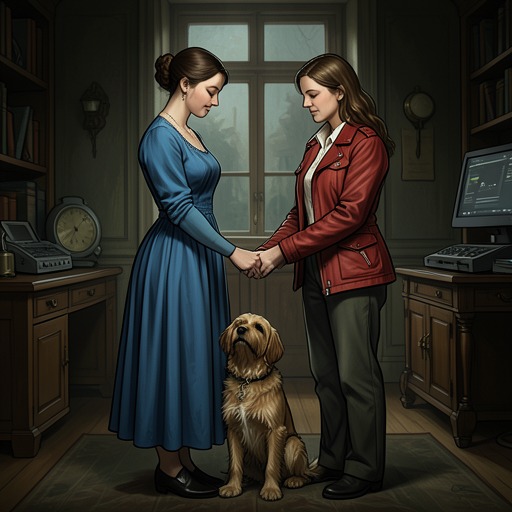
V. I. Warshawski's Apartment
Blood ShotV. I. Warshawski's Apartment is a home on Racine whose everyday rooms become an important part of the novel’s pattern of refuge and danger. A place of improvised meals, old belongings, and care from the neighbor downstairs, it is also the setting for intimidation and an attempted break-in. Its domestic details matter because they show how Warshawski lives—and how the protections she has installed are put to the test.
Setting and Domestic Life
The apartment’s rooms register the unevenness of Warshawski’s routines. After washing her hair, she wraps herself in a terry-cloth robe and searches the kitchen for something to eat. The pickings are slim: she takes peanut butter and Black Label whiskey into the living room, where she is eating them when a tentative knock interrupts her. Another evening, she is carefully polishing her black shoes while speaking on the telephone. These small, practical tasks place the apartment inside the work of investigation: even at home, she is thinking ahead to whom she must call and where she must go.
The rooms also hold traces of an earlier life. A phone book has disappeared beneath music stacked on the piano; in a hall closet, shoe polish is buried under a sleeping bag. Later, Warshawski searches a back closet among old notebooks and school papers and finds a worn checker set that her father and Bobby Mallory used to play over. The game gives her something familiar to do after a threatening call has left her unwilling to be alone. The apartment is not presented as an orderly retreat: its objects are accumulated, tucked away, and recovered when a practical or emotional need brings them back into view.
Neighborly Care and Companionship
Mr. Contreras, who lives downstairs, repeatedly crosses the threshold with food and concern. Finding Warshawski home, he brings barbecue chicken and salad on a loaded TV tray, notices that she has been trying to get by on whiskey and peanut butter, and offers to shop for her. He makes clear that she can ask him to leave, but his attention is not merely a single act of hospitality. After a later scare, he offers her grappa; she declines, but his presence helps her avoid being alone. They play several games of checkers while Peppy settles near the piano with her bone.
That companionship is attentive but not without friction. Warshawski resists being hovered over, yet Mr. Contreras accepts that she must handle things her own way and tells Peppy that she takes after him. When Warshawski returns from the hospital, he is waiting at her apartment door with Peppy, whose auburn coat he has groomed and whose neck he has decorated with a large red ribbon. He ushers Warshawski into an armchair, removes her boots, tucks a blanket around her legs, and sets out fruit, cheese, and tea. He leaves Peppy with her and makes sure she has his telephone number, asking her to let someone know before she goes looking for trouble. The apartment is thus a site of care that Warshawski accepts even when it makes her feel watched.
Threats at the Threshold
The boundary between home and danger is repeatedly disturbed. A cold-voiced caller tells Warshawski to stay out of South Chicago and invokes her ability to swim before warning that no swimmer can make it through a swamp. The threat arrives by telephone, reaching her inside the apartment; it turns the familiar rooms into a place where she has to consider whether she is safe. She reassures Mr. Contreras and Peppy that no one is going to shoot her that night, but the call has made her wary rather than carefree. She retrieves the checker set, choosing company instead of another drink.
The apartment’s entryways become especially significant when danger takes physical form. After returning home, Warshawski checks the apartment before settling down with her mail. No one has got past the reinforced steel at the front door or the sliding bars at the back. Those defenses do not erase her apprehension: she has been watching her back, and she goes out carefully to buy food rather than spend another evening drinking and eating peanut butter. The security measures are part of her daily calculation, not a guarantee that the threats have ended.
The Failed Break-In
The strongest test comes when Warshawski returns to the building after an absence and finds that the expected police activity has vanished. She enters the lobby cautiously, keeps close to the walls, and climbs the stairs sideways with her back against the wall. Mr. Contreras’s door opens; Peppy bounds out ahead of him. His tears and alarm reveal that police have been there, taken men away, and refused to tell him where Warshawski was or what had happened. He believes the men came gunning for her and says that a trick had been used to get him out of the way.
At the apartment, Warshawski learns that someone tried to break in. The steel-lined front door, installed after an earlier home invasion, held; the intruders could neither cut through it nor get past the third dead bolt. Even with Mr. Contreras and Peppy beside her, she searches the premises thoroughly before he will leave. He waits until he hears the final bolt slide home, then takes Peppy downstairs. The scene gives the door and locks a concrete consequence: the apartment has been attacked, but its reinforced defenses have kept the intruders out. The failed entry does not restore ordinary security; it leaves Warshawski and her neighbor to establish safety through a joint inspection and the final sound of the bolt.
A Refuge Under Strain
The apartment’s role is defined by this double function. Its kitchen and living room sustain makeshift domestic routines; its closets keep objects tied to earlier relationships; its threshold admits food, companionship, and urgent visitors. The lobby and upper hallway are not sealed off from the surrounding danger, while the reinforced door and locks mark the limits Warshawski has tried to impose on it. Caroline Djiak arrives after the threatening call, calling from the entry and asking to be let in; Warshawski releases the lobby door and waits in the upper hallway, with Peppy alert beside her. Home can offer a meeting place and human support, but it cannot keep the larger conflict outside.
That tension becomes particularly clear after Warshawski’s hospitalization. The apartment receives her back into familiar rooms, but her return is not a solitary restoration: Mr. Contreras prepares the chair and food, and Peppy stays as company. His request that she tell him before going into danger makes explicit what the apartment’s repeated episodes have shown. It is a refuge sustained by attention and practical care, not by walls alone, and its security remains something its occupants must continually test.