V. I. Warshawski—Nancy Cleghorn friendship
Blood ShotThe friendship between V. I. Warshawski and Nancy Cleghorn began in school and was shaped by basketball: Nancy drew V. I. into the game, and the sport gave them a shared language that endured into adulthood. Their bond is revealed both through V. I.’s recollections of playing together and through Nancy’s account of their closeness to others. After Nancy is killed, the old friendship becomes an intimate measure of the loss and a source of practical memory as V. I. tries to understand what happened.
A friendship formed on the court
Nancy persuaded V. I. to try out for the junior high basketball team. V. I. had been good at sports, but softball had been her game; joining the team with Nancy marked the beginning of a different sporting partnership. When V. I. made the team, her father fixed a hoop to the side of the house and played with the girls. He came to their high-school games, making basketball part of a family routine as well as a friendship.
The two learned and repeated the same moves together: fading, faking a pass, turning, and dunking. Their closeness is conveyed through this practiced cooperation rather than through a general description of affection. V. I. remembers their last college game, against Lake Forest, as a culmination of that shared play. In its final seconds she used the fake and dunk they had worked on, winning the game. The memory preserves Nancy as a partner in the action even though V. I. was the one who made the decisive basket.
Time apart and renewed contact
By the time V. I. speaks with people at Nancy’s funeral, their school and college years lie far behind them. V. I. calls herself Nancy’s old friend and reflects on how quickly the years since her thirtieth birthday seem to have passed. The distance in time had not erased the friendship: Nancy had spoken about V. I. to Ron Kappelman, who knew that V. I. had helped her through the strains of high school.
Their connection had also resurfaced shortly before Nancy’s death. V. I. recalls that the two had come together for a basketball reunion about a week earlier, and Nancy had attended a meeting with her afterward. The reunion makes their renewed contact concrete: the sport that first brought them together again furnished the occasion for seeing one another after a long interval. It also gives V. I.’s recollection of the friendship a recent endpoint, not merely a distant history.
Nancy’s death and the force of memory
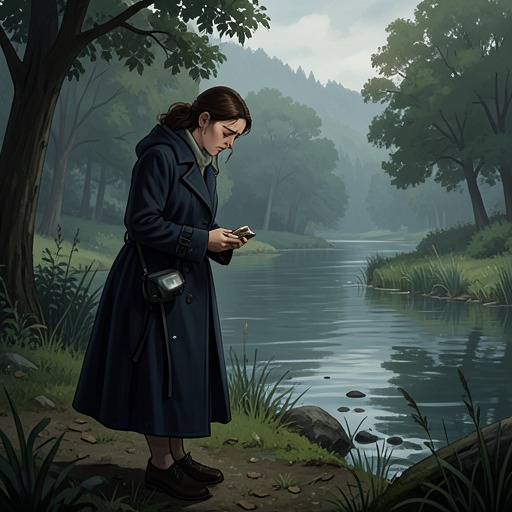
Nancy’s murder turns the friendship from a shared past into an immediate bereavement. V. I. tells a visitor about Nancy’s death and her own trek to Dead Stick Pond, where Nancy had been found. Using a city map, she traces Houston Street, where she grew up, and the route south to the Cal Industrial District and the wetlands. The account joins personal loss to the geography of the investigation: V. I. explains where Nancy’s body was found while also showing how unfamiliar that part of the city is to her visitor.
On the morning of Nancy’s funeral, V. I. cannot bring herself to put on the navy suit she associates with friends’ funerals. She delays dressing because wearing it seems to make Nancy’s death final. Her paralysis extends beyond the clothes: she cannot concentrate on organizing her papers or on planning how to get ahead of the police in finding Nancy’s killer. The funeral ritual makes the relationship’s absence tangible, while V. I.’s unfinished investigative work shows that grief and the need to act are pressing on her at once.
A shared game carried into the investigation
The friendship remains active in V. I.’s thinking after Nancy can no longer answer her. As she considers what Nancy may have known about a document and why Art Jurshak Jr. seems nervous, V. I.’s thoughts turn to their childhood and then to their years on the court. The remembered fake-and-dunk move gives her a model for what to do next: she has no proof, but decides to let Art believe that she does. She then takes Nancy’s most recent diary, where Nancy had written down three phone numbers for him, and goes to call.
This is not simply nostalgia interrupting the case. The recollection of how Nancy once taught V. I. to enter a game becomes a resource for approaching a difficult lead: shared practice helps V. I. shape a bluff. The friendship’s lasting significance lies in that combination of personal attachment and accumulated knowledge. Nancy is mourned as an old friend, remembered as a teammate, and still present in the habits of thought through which V. I. pursues the truth.