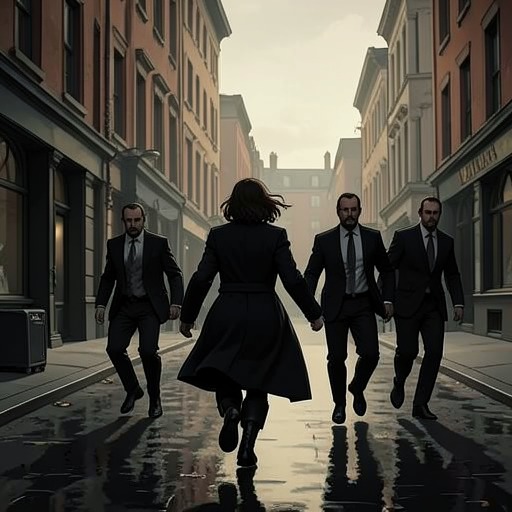
Vicki’s Smith & Wesson pistol
Blood ShotV. I. Warshawski’s Smith & Wesson pistol moves through the novel from concealed preparation to open threat and, finally, decisive use. Its recurring presence makes physical danger tangible: the weapon is not merely carried but handled, checked, and positioned as V. I. Warshawski navigates encounters in which she expects violence.
Carrying and Display as Protection
Before going to a police lineup, V. I. Warshawski sticks the pistol into her jeans and locks her apartment behind her. Later, preparing to take young Art to his father, she puts her driver’s license and money in her pocket so she will not be hampered by a purse, then draws the weapon and checks its clip. Young Art’s alarm at seeing it prompts her to explain that his father’s associates have been trying to shoot her all week. The pistol thus gives physical form to a danger that Art had not understood, while her practical preparation shows how thoroughly that danger shapes her movements.
At the winter meeting with Art Jurshak in Grant Park, the pistol is again kept close: V. I. Warshawski sits near Buckingham Fountain with it in her jacket pocket and her thumb resting on the safety. When Art looks toward his limousine, she warns him off any attempt to use it against her. She also makes clear that a reporter knows of the meeting, so the weapon’s deterrent effect is reinforced by the risk that an attack would become public. Here the pistol is both a means of defense and part of a calculated effort to keep the confrontation from turning violent.
From Readiness to Use
At the Xerxes plant, the pistol’s handling becomes part of a carefully timed approach. After rowing with Florence Chigwell for twelve minutes across roughly half a mile, V. I. Warshawski draws the Smith & Wesson and releases its safety before climbing a steel ladder to the plant’s river-facing loading platform. She leaves her right hand bare so she can feel the trigger, and raises her head only far enough to look over the bank. The loading-bay doors are shut and padlocked; two spotlights cut through the haze, but she sees no sign that anyone expects an approach from the river. She climbs onto the platform with the gun in front of her, lies still for sixty seconds, and waits for Florence to join her. The weapon is thus integrated into both the physical risks of entry and the pair’s signals: if Warshawski cries out, Florence is to row back to the car and raise an alarm.
Inside the plant, concealed readiness gives way to lethal action. Steve Dresberg points a large gun at Louisa Djiak and threatens her, while Warshawski tries to redirect his attention toward herself. When Dresberg swings and fires, his first shot goes wide. Florence throws her keys at his face to distract him; he fires at her movement, and she falls. Warshawski gets behind him and fires. Her first shot misses, but she shoots him twice in the chest when he turns toward her; he manages two more rounds before collapsing. As Warshawski runs to seize his gun arm, Art Jurshak moves in, apparently trying to wrest the revolver away before she can reach it. She shoots Jurshak in the chest. The pistol has shifted from a warning held close to the body into the instrument by which she stops two armed men, but the exchange leaves Florence wounded and exposes how quickly a plan built around caution becomes a close-range struggle.
A Weapon, Not a Guarantee
The final exchange denies the pistol any simple aura of mastery. Warshawski’s first shot at Steve Dresberg misses; the two shots that hit him do not stop him from firing twice more before he collapses. Her chance to shoot comes only after Florence Chigwell throws her keys to distract him, and the struggle continues as Art Jurshak moves toward the revolver. The Smith & Wesson is decisive, but it does not act alone or make its bearer invulnerable: its effect depends on timing, another person’s intervention, and Warshawski’s willingness to keep acting amid immediate danger.
Physical Handling and Vulnerability
The pistol also alters how V. I. Warshawski meets the winter cold. At the meeting in Grant Park, she keeps her thumb on its safety but wears no gloves so she can handle it readily; after sitting in intermittent drizzle, her fingers are so numb that she doubts she could have fired. The weapon’s presence therefore signals readiness without guaranteeing control: keeping it usable requires a bodily compromise that may itself undermine its use. That uncertainty contrasts with the deliberate care of checking the clip, releasing the safety, and keeping a bare hand on the trigger at the Xerxes plant. Across these scenes, the Smith & Wesson is a practical tool whose force depends on touch, timing, and a vulnerable body, not an assurance of mastery.