Wisconsin Steel
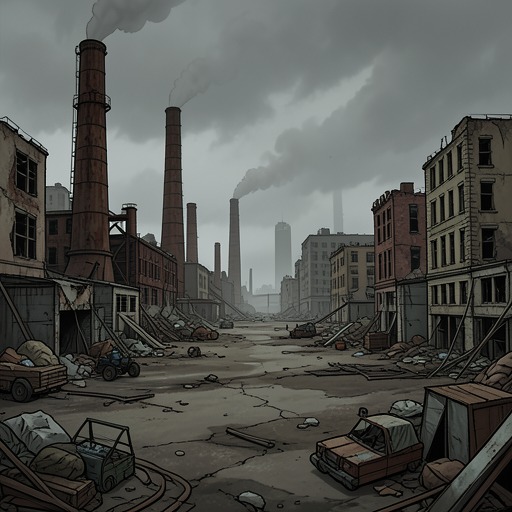
Blood ShotWisconsin Steel is remembered as a major South Chicago workplace whose decline marks the difference between the neighborhood’s industrial heyday and its diminished present. The novel places the steelworks within a dense local manufacturing economy and then sets that remembered world against shuttered plants, pollution, and deteriorating surroundings.
Place in South Chicago’s Industrial Economy
In V. I. Warshawski’s recollection, Wisconsin Steel was one of several factories that drew workers from the tidy homes nearby. She remembers eighteen thousand men pouring each day into the South Works, Wisconsin Steel, the Ford assembly plant, or the Xerxes solvent factory. The figure describes the scale of the industrial workforce across these employers, not the number employed by Wisconsin Steel alone.
That recollection gives the plant a social presence beyond its gates: factory work shaped the daily rhythm of the surrounding neighborhood. Freshly painted house trim and the autumn appearance of new Buicks and Oldsmobiles belong to the same remembered cycle of industrial employment and household prosperity. Warshawski presents that cycle as a past life for both herself and South Chicago.
Closure and a Changed Landscape
On her return, Warshawski sees Wisconsin Steel padlocked and rusting away. Its condition is part of a wider industrial contraction: the South Works is on strike, while the road south passes from the lakefront’s high-rises to landfill and worn-out factories. The contrast makes the closed steelworks legible not as an isolated abandoned site but as one feature of a landscape whose economic and physical deterioration has become hard to separate.
The contrast is also personal. Warshawski recalls the neighborhood before its factories and households fell into decline, but her return brings her into contact with the changed surroundings rather than restoring the past. Wisconsin Steel’s rust and locked gates stand against the remembered movement of workers entering local plants every day.
Relation to the Novel’s Industrial Conflicts
Wisconsin Steel belongs to the industrial background against which the novel investigates workplace hazards, insurance, and community power. The investigation’s specific insurance evidence concerns Humboldt Chemical’s Xerxes plant, not Wisconsin Steel: a 1963 letter identifies Jurshak & Parma as fiduciaries for that plant and accompanies an actuarial study of its losses. Keeping that distinction clear, the Wisconsin Steel reference helps establish how many industries and workplaces form the neighborhood’s history, while the Xerxes documents supply the investigation’s direct insurance trail.
The plant’s brief but pointed appearance thus connects the investigation’s present-day concerns to a broader history of industrial employment and decline. It is not presented as the site of the Xerxes insurance dispute; rather, its locked, rusting condition helps define the South Chicago in which that dispute unfolds.