
Diamond’s Return to Confidence
BloodhoundsThis flow traces Peter Diamond’s movement from boredom and self-doubt through mistaken theories toward renewed confidence in collaborative, concrete detective work.
increasing Bearing strength in each event
 decreasing
Bearing strength in each eventdecreasingA Detective Without a Challenge

A Detective Without a Challenge
Work feels small
Diamond has recently returned to leading the murder squad and complains that Bath offers little more than routine. The Saltford killing appears solved before he can investigate it.
Frustration turns outward
At meetings he mocks paperwork, technology, and the lack of serious crime. He measures professional worth by the challenge a case presents.
The attitude establishes both his appetite and his vulnerability. When a genuinely difficult case arrives, he may value ingenuity so much that a plausible puzzle can distract him from ordinary evidence.
A Squad Leader Under Pressure

A Squad Leader Under Pressure
Responsibility contested
Wigfull leads the stamp operation and recruits Diamond’s detectives. Diamond resents losing Julie and reacts sharply at briefings.
An anxiety admitted
Julie tells him that his domineering manner prevents the team from contributing. Diamond acknowledges that he feels insecure leading a room after time away from the squad.
The admission marks a change in his self-understanding. His authority is not effortless, and his best work depends partly on people willing to challenge him.
The Locked Room Defeats Him

The Locked Room Defeats Him
A genre he distrusts
Diamond resents the storybook quality of riddles, closed circles, and a body in a locked boat. He doubts that fictional puzzle methods have much to offer real police work.
A crisis of confidence
When Wigfull produces a convincing lock-substitution theory, Diamond considers giving him the murder inquiry. The explanation seems to solve the most difficult part of the case.
The moment is a low point because Diamond believes another investigator is better suited to his own responsibility. His doubts are intensified by a case that appears to reward theatrical deduction over his familiar methods.
A Practical Breakthrough
A Practical Breakthrough
Physical facts return
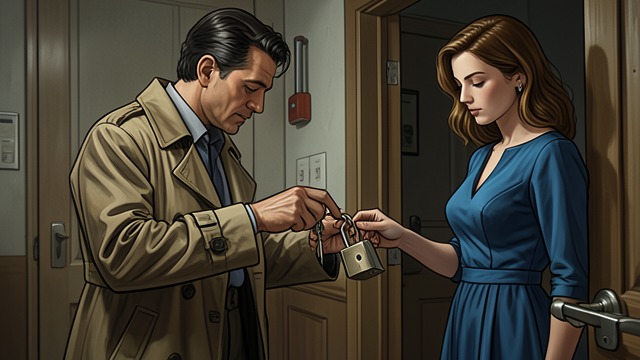
Diamond tests the recovered keys against the padlock and establishes that Wigfull’s substitution theory is impossible. He returns to the lock’s ordinary use rather than searching for a secret mechanism.
The right question
Julie’s earlier question about what the killer was doing at the boat helps Diamond imagine the culprit changing locks while Milo was inside. The open-shackle trick resolves the mystery.
Diamond’s recovery depends on combining physical testing with collaboration. His insight is his own, but it grows from Julie’s questions and the evidence provided by the divers.
A Detective Reclaimed

A Detective Reclaimed
Solving beyond the puzzle
Diamond brings together the riddle campaign, the paper bag, the lock mechanism, the graffiti, and the motive of Jones’s old grievance. He recognizes that the crimes form a single escalation.
Confidence through teamwork
Julie’s observations and courage prove essential, while Diamond’s willingness to revise theories turns scattered clues into a coherent account. He returns to leadership without pretending he was right from the start.
The resolution is not a triumph of infallibility. Diamond’s authority becomes more credible because he has been wrong, listened, and changed course before the investigation’s final danger becomes irreversible.
The opening week in Bath
When the Penny Black inquiry begins
After Sid’s murder is discovered
After the divers recover Milo’s keys
Near the ending, after Gilbert Jones is captured
