
The Bloodhounds’ Closed Circle
BloodhoundsThis flow traces a reading group’s shifting intimacy as shared books become shared evidence and every member becomes a possible suspect.
increasing Bearing strength in each event
 decreasing
Bearing strength in each eventdecreasingA Club with Fault Lines
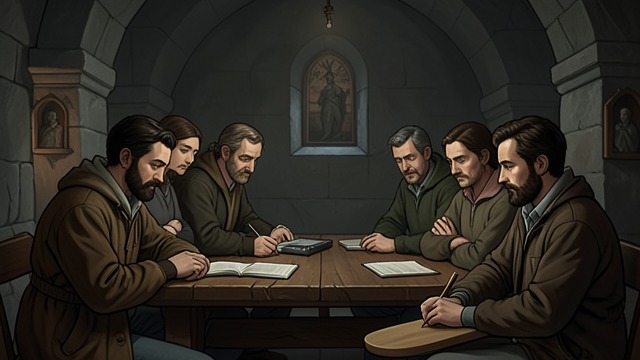
A Club with Fault Lines
A literary community
The Bloodhounds meet in a church crypt to discuss crime fiction. Their interests range from classic puzzles to modern, violent stories, and their conversations repeatedly divide along those lines.
Personality becomes structure
Polly organizes the group, Milo champions puzzles, Rupert provokes, Miss Chilmark asserts status, Jessica mediates, and Sid stays quiet. Shirley-Ann learns the group by watching how they disagree.
The club’s arguments are not merely decoration. They establish grudges, alliances, and patterns of attention that later make its members a plausible closed circle of suspects.
The Real Crime Proposal

The Real Crime Proposal
Fiction meets the headlines
Miss Chilmark proposes that members use their experience with detective stories to discuss the real Penny Black theft. The suggestion meets resistance from Polly, who distinguishes reading fiction from investigating actual crime.
The group turns detective
Members speculate about collectors, ransoms, and the riddles. Their discussion begins to blur the boundary between literary play and the police case unfolding outside the crypt.
The meeting gives the crime a social setting and creates the conditions for the stamp’s spectacular appearance. The group’s knowledge is precisely what the thief intends to challenge.
The Club Becomes Evidence

The Club Becomes Evidence
A discovery before witnesses
Milo finds the stolen envelope while the members are gathered around him. Every reaction and every opportunity at the meeting becomes relevant to police.
Solidarity divides
Some members are willing to keep quiet; Polly and Miss Chilmark insist that Milo should go to police. The group’s discussion of loyalty becomes an immediate decision about public responsibility.
The Bloodhounds cease to be only a reading circle. Their private disagreements shape the official case, and each member’s account of the evening can protect or implicate another.
Mutual Suspicion
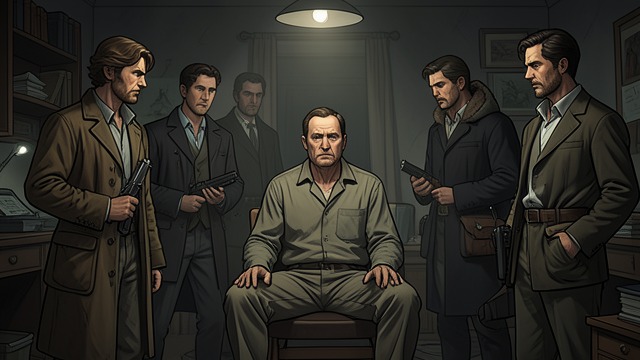
Mutual Suspicion
A meeting revisited
The members learn that Sid was murdered after leaving the crypt. They recognize that whoever killed him may have known Milo would be at the police station.
Trust thins
Shirley-Ann and Polly reason that one of the Bloodhounds may have known Milo’s plans. Police interviews bring old tensions into sharper focus, and members begin interpreting one another’s behavior as evidence.
The circle closes emotionally before it closes procedurally. Familiarity provides useful information, but it also makes the club’s members vulnerable to rumor and misreading.
A Club’s Reputation Broken
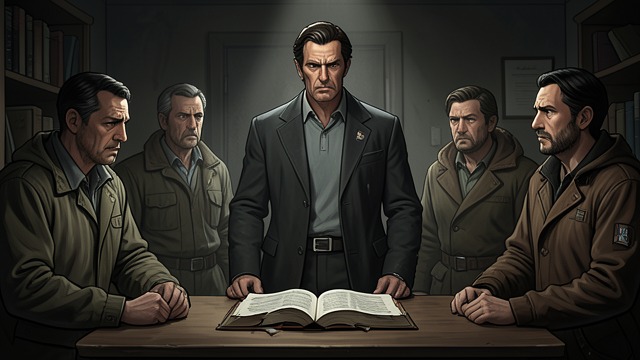
A Club’s Reputation Broken
A member’s old grievance revealed
Jones explains that the Bloodhounds’ dismissal of his reading wounded him deeply. He designed the theft as revenge against the people who had treated him as intellectually inferior.
Community becomes target
The club’s rituals, books, and divisions were used as elements in his scheme. Members who had once argued about fictional crimes now discover that their own group was selected as the setting for actual violence.
The Bloodhounds’ closed circle was useful to investigators but not protective. Its intimacy supplied both the information Jones exploited and the emotional injuries that made his challenge meaningful to him.
At Shirley-Ann’s first meeting
At the second meeting, before Milo reads
The moment the Penny Black appears in Milo’s book
The days after Sid’s body is found
Near the ending, after Jones confesses
