
Visibility and Misrecognition
BloodhoundsThis flow traces the novel’s repeated contrast between what characters notice, what they assume, and what remains hidden in plain sight.
increasing Bearing strength in each event
 decreasing
Bearing strength in each eventdecreasingThe Invisible Sid
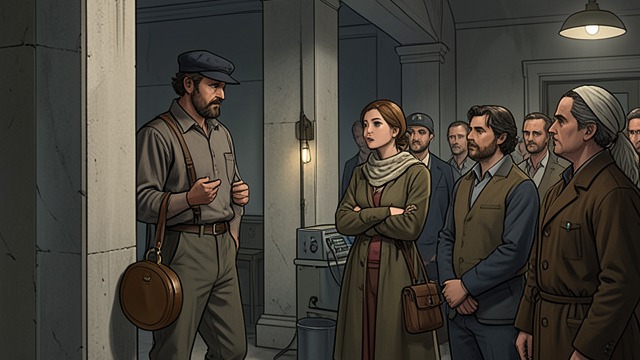
The Invisible Sid
A practiced disappearance
Sid stands behind a pillar and later sits with his cap in his hands, avoiding attention. Shirley-Ann notices that his silence seems deliberate and socially protective.
Others overlook ability
The group’s members treat Sid as a shy nonparticipant, even though he reads extensively and understands locked-room fiction. His apparent insignificance becomes part of how the crime can be misread.
Visibility is not the same as importance. The novel asks whether a person can be ignored so thoroughly that others invent an explanation for him only after he is dead.
A Target Hidden by a Warning
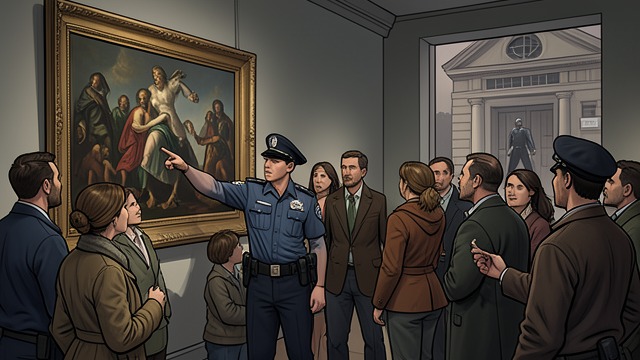
A Target Hidden by a Warning
Attention drawn to Turner
The riddle names initials and Victoria, so the police focus on Turner’s painting at the gallery. A visible security operation grows around the wrong object.
The stamp goes unseen
While police attention is concentrated on the gallery, the thief reaches the Postal Museum. The real target is present in the city but absent from the authorities’ working picture.
The crime depends on directing vision rather than hiding every action. What the police can see is shaped by what the warning teaches them to look for.
The Unremarkable Paper Bag

The Unremarkable Paper Bag
A practical wrapper
Sid’s brown paper bag is used briefly to help Miss Chilmark recover. Nobody treats it as special, and Jessica later keeps it without recognizing its future evidentiary value.
Meaning arrives afterward
When lists of rhyming words are discovered on the bag, investigators read it as a clue to Sid’s authorship. The ordinary object becomes a story about the dead man’s secret plan.
The novel shows how attention can transform an object without necessarily clarifying it. A thing becomes conspicuous only when it seems to confirm a theory, and that very fit may be engineered.
A Familiar Face in a False Story
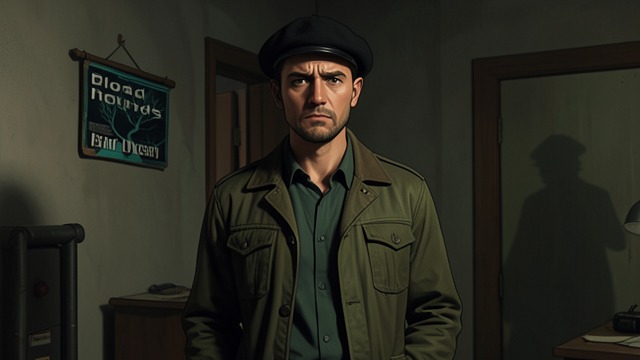
A Familiar Face in a False Story
Appearance seems decisive
Rupert’s beret, social history, and public behavior make him look like a plausible criminal. The paint and the hanging appear to complete a case against him.
Diamond sees the staging
The detective recognizes that these clues may have been arranged to point toward Rupert. Jones selected a stranger whose visible habits could be turned into evidence.
The frame succeeds because it uses what everyone already sees. Rupert’s image as a disruptive outsider becomes a surface onto which the killer can project guilt.
The Quiet Motive Revealed

The Quiet Motive Revealed
A respectable routine
Bert Jones appears to be a sports administrator with a private life and a partner who trusts him. His professional identity conceals his earlier connection to the Bloodhounds.
Resentment brought into view
In questioning, Jones explains that the club’s dismissal of his reading wounded him. The long-hidden grievance, rather than a visible criminal identity, explains why he designed the scheme.
The revelation reframes earlier scenes. The person who seemed least connected to the club had been receiving information through Shirley-Ann and watching for the chance to return unseen.
At Shirley-Ann’s first Bloodhounds meeting
Friday morning, when police respond to the first riddle
At the meeting when Miss Chilmark becomes distressed
After Rupert’s body is found
During Jones’s final interrogation
