
The Three Riddles
BloodhoundsThis flow follows how a sequence of rhymes directs attention, disguises targets, and finally predicts the staged ending.
increasing Bearing strength in each event
 decreasing
Bearing strength in each eventdecreasingA Poem on the Radio
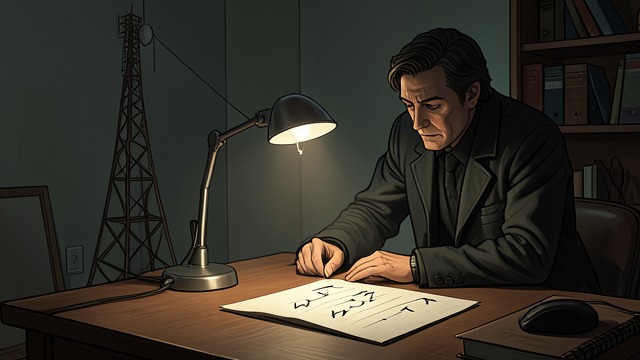
A Poem on the Radio
A baffling broadcast
Breakfast radio presents a four-line message containing the initials J.M.W.T. and a challenge to Victoria. Diamond copies it down while everyone else wonders whether it is a stunt or a genuine warning.
A threat interpreted narrowly
The police connect the initials to Turner and the reference to Victoria to the gallery. Diamond senses that the wording could point elsewhere but initially lets Wigfull pursue the gallery interpretation.
The riddle makes a real warning look like a different warning. Its ambiguity is not an accidental flaw but the mechanism that lets the thief choose the police response in advance.
The Locked Room Clue
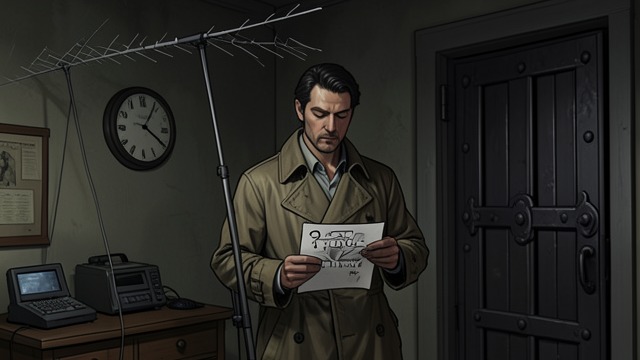
The Locked Room Clue
A second verse arrives
BBC Radio Bristol receives another poem asking where Victoria has gone, invoking a locked room and the number seventeen. Police and Bloodhounds alike begin searching for meanings.
A clue without a key
The number later connects to chapter seventeen of Milo’s book, where the stolen Penny Black appears. The clue is legible only after the setting has been supplied by events.
The poem gives the police a form of participation but not a usable lead. Its solution depends on knowing that Milo would read the relevant chapter, which makes the apparent invitation to solve it a calculated tease.
Sid Takes the Blame
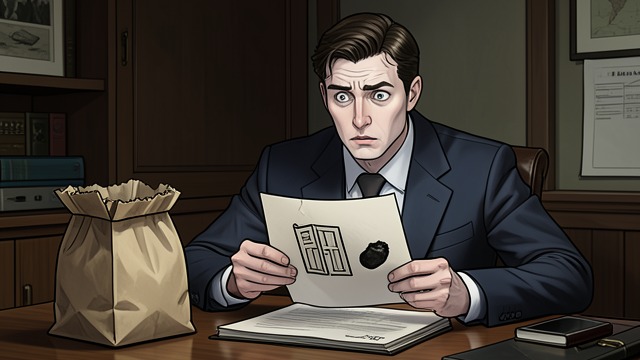
Sid Takes the Blame
An attractive deduction
Investigators discover rhyming word lists on a paper bag associated with Sid. Some words seem to relate to the Penny Black, Milo, and the locked room.
A dead man’s authorship
The lists encourage police to believe Sid wrote the riddles and stole the stamp. His expertise in security and detective fiction makes the theory seem natural.
The apparent evidence is not secure enough to bear the conclusion. The bag passed through Jessica’s hands, and the lists were deliberately left available to mislead investigators into giving Sid the role of criminal mastermind.
The Suspense Riddle
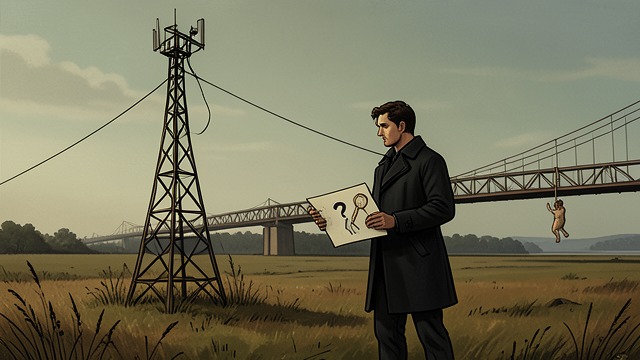
The Suspense Riddle
A new message
A third poem tells the police to end the suspense and find a way from Sid to Sydney. Its form and distribution echo the earlier riddles.
The wrong Sydney
Wigfull interprets the clue as a warning about Sydney Gardens and positions officers near the Holburne Museum. The riddle actually points toward the bridge where Rupert is found hanging.
The wording contains a double meaning: suspense is both uncertainty and the condition of a body suspended from a rope. Once again, the message appears to offer direction while encouraging a literal misreading.
Riddles as Cover
Riddles as Cover
A challenge with an author
Gilbert Jones admits that he composed the riddles as part of his plan to humiliate the Bloodhounds and outwit the police. The poems helped advertise the crime while directing attention away from its true target.
Performance becomes concealment
The third riddle did not reveal the whole plan; it helped make Rupert’s death look like a foreseen suicide. The same verbal play that invited admiration also concealed a murder.
The riddle campaign finally resolves as more than a puzzle sequence. It is Jones’s method of controlling interpretation, exploiting the expectation that an elegant clue must have an elegant, harmless solution.
Friday morning, before the Postal Museum theft becomes public
Friday afternoon, after the first riddle is solved retrospectively
The week after the stamp appears in Milo’s book
The afternoon Rupert’s body is discovered
At Gilbert Jones’s final interrogation
