
The Paper Bag’s Changing Meaning
BloodhoundsThis flow follows the paper bag from an improvised aid to a misleading piece of evidence whose authorship and custody reshape the investigation.
increasing Bearing strength in each event
 decreasing
Bearing strength in each eventdecreasingA Book Wrapped in Paper
A Book Wrapped in Paper
Sid’s quiet preparation
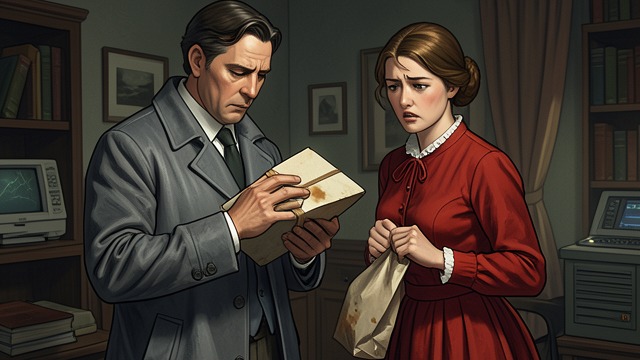
Sid Towers arrives with a secondhand book wrapped in a brown paper bag. He has little to say, and the object attracts no special attention until Miss Chilmark becomes distressed.
A useful object
When Jessica asks for a bag to help Miss Chilmark’s hyperventilation, Sid removes the book and hands over its wrapper. The mundane paper becomes part of a brief medical response.
The moment places an object from Sid’s private reading in public view. It will later carry apparent clues, but at this point nobody treats it as evidence or asks what is written on it.
The Emergency Remedy
The Emergency Remedy
Jessica acts decisively
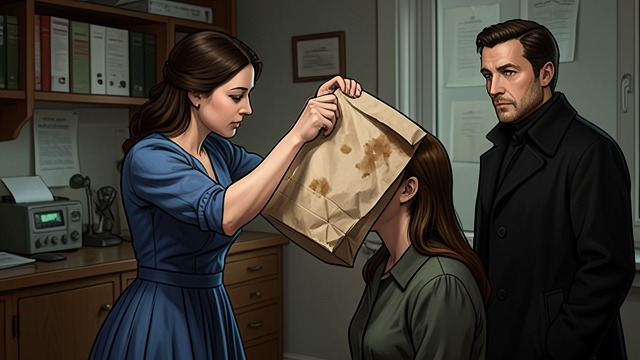
After Marlowe frightens Miss Chilmark, Jessica recognizes hyperventilation and holds a paper bag over her face. Sid has supplied the bag, and Jessica’s intervention helps the meeting regain order.
The object changes hands
Jessica keeps the bag nearby in case Miss Chilmark’s symptoms return. As the gathering later breaks up in confusion, she may place it in her own handbag.
The transfer matters because it complicates the later assumption that anything written on the bag must have been written by Sid. The club remembers the bag’s practical use but not every step in its custody.
Words Among the Evidence
Words Among the Evidence
A missing wrapper
Diamond notices that the brown paper bag is absent from the possessions recovered with Sid. He asks Julie Hargreaves to consider whether Jessica might still have it.
Lists that look incriminating
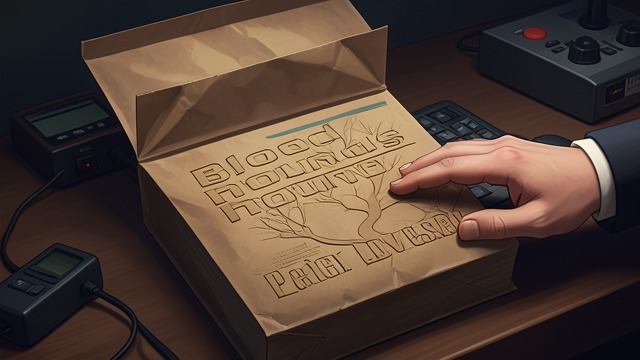
Jessica finds the bag in her handbag and gives it to Diamond. Three rows of rhyming words appear to echo Penny Black, Milo Motion, and the locked room.
The discovery seems to connect Sid to the riddles. Diamond sees that the evidence is not self-explanatory: the bag may have passed through more hands than the first interpretation allows.
A False Attribution
A False Attribution
The dead man blamed
The lists persuade investigators that Sid was preparing another riddle and may have authored the earlier ones. His expertise in locked-room puzzles strengthens the theory.
Diamond traces custody
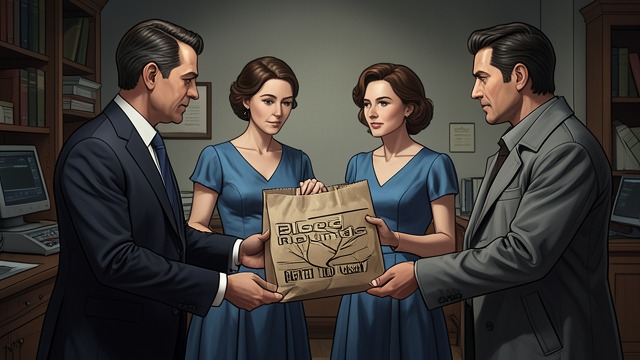
Diamond returns to the paper bag’s path: it belonged to Sid, was used by Jessica, remained with her after the meeting, and was later handed to police. The chain does not prove who wrote the lists.
The object’s apparent clarity becomes its danger. A plausible document can misdirect an investigation when its custody is treated as equivalent to authorship.
A Deliberate Diversion
A Deliberate Diversion
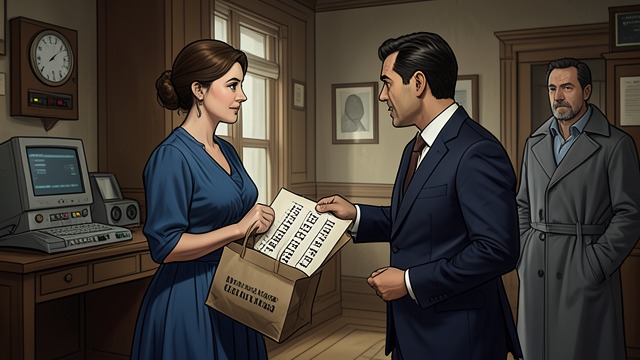
Diamond challenges Jessica
Diamond tells Jessica that the lists were likely written by her rather than Sid. She has let him discover them and draw the conclusion that supports the wrong theory.
Evidence used as misdirection
Jessica’s silence and the bag’s journey suggest that the lists were planted or preserved to frame Sid as the riddle writer. The bag helped shield the person responsible for the larger scheme.
The paper wrapper’s full significance lies in its double role: it records possible preparation, yet it was also positioned to control what the police believed. Its ordinary appearance conceals a deliberate intervention in the investigation.
Early in the second Bloodhounds meeting
During Marlowe’s disturbance at the meeting
Several days after Sid’s murder
After Wigfull’s padlock theory temporarily gains acceptance
Near the ending, during Jessica Shaw’s questioning
