Edgartown
Bones & AllEdgartown is the Pennsylvania town Maren reaches while searching for her mother and maternal grandparents, and the setting of a failed reunion that turns her journey elsewhere. Its domestic streets and public spaces offer her glimpses of family, kindness, and a possible future, but never the return she hopes to find: Maren leaves believing she will never see her mother again.
Family History and the Journey to Edgartown
Edgartown first enters Maren’s story as a detail on her birth certificate: her mother, Janelle Shields, is listed as having been born there. Maren’s own birthplace is given as General Hospital of Friendship, Wisconsin, so Edgartown is not where she was born. Instead, it becomes bound to the family history she is trying to piece together. When she discovers that Francis Yearly is named as her father, she begins to understand the money her mother has given her as a direction toward Sandhorn, Minnesota, where he might be found. But Maren cannot bring herself to go to him. She chooses instead to follow the address of her grandparents, whom she has not seen since before Penny Wilson’s death and whom her mother would not take her to visit.
The address comes from a Christmas-card envelope Maren retrieves from the trash. She has already memorized it, but pastes it into her notebook all the same, turning a discarded envelope into a practical guide. With a hundred dollars from her mother, the money seems sufficient to get to the place where her mother has gone. Before leaving, Maren eats what remains in the refrigerator, showers, and packs her belongings into an old army rucksack marked with the names Shields and U.S. Army. She selects books carefully because the pack will grow heavier as she carries it. The trip to Edgartown is thus not an abstract search: she takes with her a small, chosen record of the life she is leaving.
Arrival and the House Seen from Outside
Maren reaches Edgartown near dark and asks for directions at the counter of McDonald’s. Her grandparents’ neighborhood is made up of 1950s split-level houses, each hemmed in on three sides by similar homes and yards. The familiar-looking sameness does not make the place welcoming. In the driveway she recognizes the car she associates with her mother, parked behind a dark blue Cadillac that she takes to be her grandfather’s. Rather than approach the front door, she waits for darkness, circles the block, and climbs the back neighbor’s fence. She would rather risk being caught by someone who does not know her than by the family she has come to find.
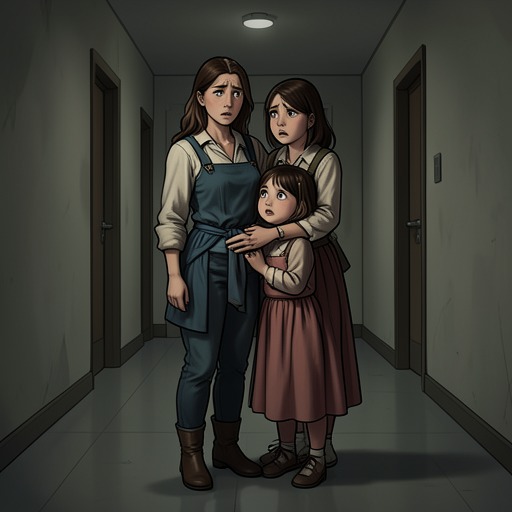
From the fence, Maren works out that the kitchen is at the back of the house and watches through its large window. The illuminated room makes the people at dinner appear like a scene on a screen: visible, close, and separated from her by glass and darkness. The picture window is more than a view into a house. It gives Maren access to the image of family life while keeping her outside it. She has come to seek her grandparents and, ultimately, her mother, but the evidence of their presence—the driveway, the Cadillac, the lit kitchen—does not become an encounter or a welcome. Edgartown’s most consequential domestic scene is therefore one Maren watches from concealment.
Public Encounters and the Library
Edgartown also contains spaces where Maren meets people who do not belong to the family she is pursuing. At a grocery store she introduces herself to Lydia Harmon. After they go outside, the two wait at a bus stop beside a mother with several children. The children laugh, hit one another, and kick stones while their mother smokes and stares down at the pavement. Lydia, by contrast, smiles at Maren and asks whether she is hungry. When the bus arrives, Lydia pays Maren’s fare. The small, concrete offer of help contrasts with the family life Maren has just watched from outside: a stranger notices her need and acts, while the relatives she has traveled to find remain beyond reach.
As the bus pulls away, Maren sees an old brick building with the words Edgartown Public Library carved above its entrance. A boy, perhaps nine or ten, holds the door for an older woman. The brief image has no conversation and no immediate consequence, yet it gives the town a second kind of threshold. At the grandparents’ house, a window lets Maren look in without joining; at the library, she sees one person hold open a door for another. The contrast is carried by ordinary gestures rather than explanation. Edgartown is not only the site of rejection or absence: it is also where Maren first notices a public place organized around entry, and where Lydia’s practical kindness interrupts her isolation.
Departure and Narrative Significance
A message on Lydia’s answering machine later mentions a plan to drive to Edgartown for shopping and lunch, extending the town’s connection to Lydia and her family. Maren’s own time there, however, ends with a decisive turn away. After breakfast she takes Lydia’s cream-and-pink enamel locket, knowing it belongs to Lydia’s niece but wanting something to remember her by. A few minutes later she boards a local bus in the direction opposite the Shieldses’ house. She understands this as a final departure from her mother, not simply a change of route: she believes she will never see Janelle again, not even through a picture window.
At the Greyhound station, Maren asks for the next bus to Minnesota and names Sandhorn as her destination. Edgartown has not resolved the questions that brought her there. It has instead sharpened the difference between biological or family connection and care as an action: the grandparents’ home offers only a view from the dark, while Lydia pays the fare and leaves Maren with a keepsake. The town’s recurring thresholds—the fence, the window, the bus, and the library door—give visible form to this difference. Maren arrives hoping to recover a place within her family; she leaves carrying an object from a stranger’s home and turning toward the father she had initially refused to seek.