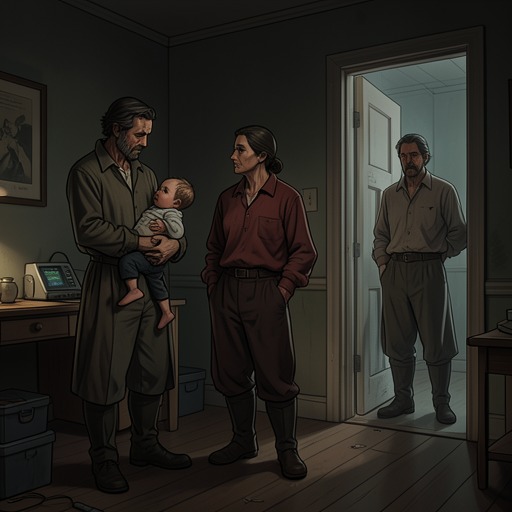
Frank leaves pregnant Janelle
Bones & AllFrank’s departure from Janelle while she was eight months pregnant is a rupture shaped by love and fear rather than by the absence of either. In Frank’s notebook to his child, he remembers their argument about where the baby should grow up, the fear he saw in Janelle, and the night he finally left. He also admits that he could not be certain he would never hurt her or their child. The separation becomes both his attempted safeguard against that uncertainty and a lasting abandonment: he does not write to Janelle because he fears she will not answer, and later understands that the silence has cost him the chance to see her again.
Background to the Separation
The account places the final departure in a period of growing strain. After Janelle came home early from work and learned what Frank had done, he could still feel her love, but also her fear. He insists that he had told her he would never hurt her, even if they fought; nevertheless, he cannot know whether she believed him. The narrative marks that night as a turning point in their life together: from then until the night he left, affection and fear coexisted, and Frank was relieved that he would never have to discover which feeling had kept Janelle with him. His relief is not certainty. It is an admission that the answer is inaccessible, and perhaps that he would rather not test his own hopeful interpretation.
A separate but related pressure surfaces in the argument Frank recalls from when Janelle was eight months pregnant. Janelle wanted to return to Pennsylvania, while Frank wanted their child to grow up loving the woods, hills, and rivers that mattered to them. He understood the disagreement as more than a dispute over where to live: he believed Janelle wanted to be near her parents because she was afraid. When he said so, she raised her voice and moved away from him. Frank saw terror in her eyes. He left the cabin to think things over, describing Janelle as no longer laughing and himself as knowing why. The scene makes their conflict intimate and practical at once: the question of a home becomes inseparable from whether she feels safe with him.
The Departure
The notebook distinguishes Frank’s leaving the cabin after the argument from the later, more consequential night when he left Janelle. The first is presented as a pause to think; the latter becomes a lasting separation. Frank says he did not want to leave his child, but believed he had to. His stated reason is not that he expected to hurt Janelle or the baby. Rather, even though he believed he would never do so, he could not be completely sure. He treats that uncertainty as a danger he cannot responsibly dismiss. In his account, leaving is an attempt to prevent possible harm, but it also means withdrawing from the family before the child is born.
That reasoning does not make the departure emotionally clean. Frank’s account repeatedly places his love beside what it cannot repair. He describes Janelle as the person who had made him feel that he could live honestly and have a good life, even after she learned what he had done. His decision to leave therefore separates him from the very person whose faith had helped him imagine another kind of future. The notebook does not resolve the contradiction: he presents himself as protecting his family while acknowledging that he is the one who chooses to disappear from it.
Silence and Its Cost
Frank’s departure continues after he leaves the cabin, in his failure to write to Janelle. He explains that fear stopped him: he worried that she would not write back. The silence is thus not evidence that he had stopped loving her; by his own account, it follows from anticipating rejection. But the reason also reveals how his effort to avoid one painful answer produces another consequence. He does not give Janelle the chance to respond, and he later calls this a mistake made too late to correct.
His grief gives the separation its final measure. Frank calls Janelle his sunshine and describes never seeing her again as the worst pain of his life. The account does not claim that leaving protected her, repaired their relationship, or gave him peace. It shows instead the lasting cost of his decision: the feared possibility of harm governs his departure, while fear of refusal governs his silence afterward. The loved ones he means not to hurt are also the people from whom he removes himself.
Narrative Form and Significance
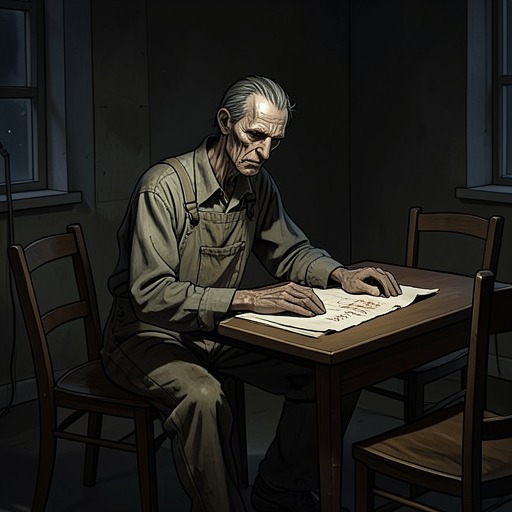
The event reaches the reader through Frank’s notebook to his child, not through an outside account of the separation. That form makes the departure retrospective: Frank can explain what he believed and feared, but his account cannot establish what Janelle truly thought or what would have happened had he stayed or written. He explicitly leaves her response uncertain, acknowledging that he cannot know whether fear was what kept her with him. The confession therefore gives access to his motives without turning them into an objective verdict on the decision.
The notebook also places the separation within a larger inheritance of secrecy. Frank writes to a child he has left, trying to make his absence intelligible while admitting that he did not contact the child’s mother. His explanation is both an act of care and a record of what care failed to overcome. The decisive pattern is not simply that a father leaves before his child is born, but that fear of becoming dangerous, fear of rejection, and love for Janelle all contribute to the same separation. His words preserve the relationship that his actions have made impossible to continue in person.