Frank's notebook to his child
Bones & AllFrank's notebook to his child is a worn composition book Frank leaves for his child to read during a visit. It begins as a careful attempt to address a person he has never met and explain the truth about himself; its changing handwriting and final pages turn that intended message into a record of how much he can no longer communicate.
Appearance and Discovery
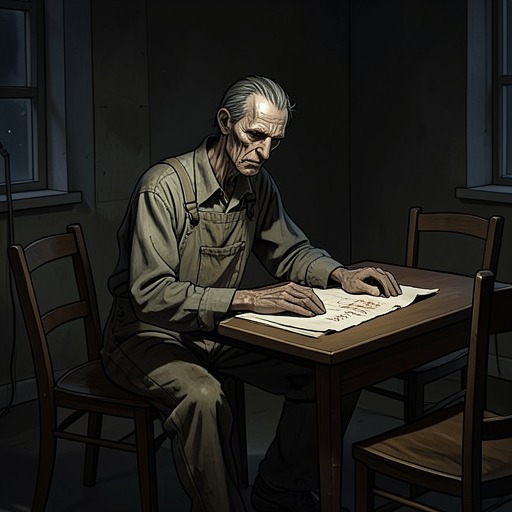
Travis retrieves the notebook and lays it on the table in front of Maren. Its marbled black-and-white cover has yellowed with age, and old spills have crinkled the pages. For a moment, Maren mistakes it for her own journal: the book is horribly familiar, though older. The resemblance makes the object more than a container for Frank's account; it brings his writing into immediate, unsettling proximity with his daughter's private record.
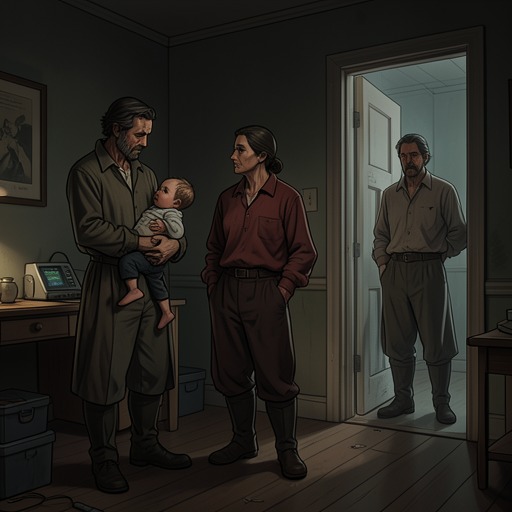
Travis stands by the door as Maren considers whether to open it. He explains that Frank wants her to read it and wrote it for her. The notebook is therefore both an intended communication and an artifact delivered through the people caring for Frank. Its arrival gives Maren access to words her father may no longer be able to say directly.
A Message to an Unknown Child
The opening addresses a child only as a Yearly. Frank does not know the child's name or gender, and cannot know whether the reader will encounter the book as a boy, a girl, a man, or a woman. He hopes the child will come, but fears being hated; he also recognizes that the child's mother might never tell them about him. He writes anyway, anticipating that by the time the child arrives he may not be able to answer questions. The notebook's purpose is shaped from the outset by uncertainty: Frank writes toward a reader whose existence he wants but cannot take for granted.
A later section turns to Janelle. Frank recounts that, at twenty-two, he worked as a forest ranger at Laskin National Park, where Janelle took entrance fees at the gate shack. Their first conversation began with laughter over an inflatable woman in a red wig in a single man's car. He presents that ordinary, comic encounter as the beginning of a lasting love, and describes the freedom of their park jobs to swim, hike, or slip away from work. These details make the notebook a personal account of a relationship as well as a confession: Frank wants his child to know the mother he loved, not only the secret he is about to disclose.
Confession and the Child's Place in Time
After blank pages, Frank says that he cannot be good for the child but can be honest, and begins to tell everything. His earliest remembered experience is beside a long bus at a gas station. A man leads him by the hand into a restroom behind the pumps and tries to make him do something bad; Frank's account says that, while still a very small boy, he ate the man. He distinguishes this from people who eat human flesh as ordinary food: he does not understand his own act as that kind of appetite. He recalls grinding the man's bones with his milk teeth and becoming hungrier as he ate. The notebook thus gives its intended reader a childhood memory that Frank frames as both an explanation and a source of pain and shock.
The book also tries to give the absent child a place in the calendar. On the ward, monthly birthday celebrations include vanilla sheet cake and bingo. Frank never knew his own birthday, so the Yearlys made it January 1. He says that, if he knew the child's birthday, he would ask Travis to remind him so he could imagine the celebration. Travis has told him the child was born on April 1, 1991; Frank concludes that the child is almost nine, but still cannot picture them without knowing whether they are a girl or a boy. The exact date offers a small point of connection, while the unknown details emphasize how little of the child's life he can share.
Handwriting, Repetition, and What Remains
The notebook's physical form registers changes in Frank's ability to write. The first page is covered in cramped, masculine handwriting that is only just legible. Later, after blank pages, the writing becomes much larger and more childlike. Near the end, Maren reaches a passage that alludes to Frank having ruined his hand; when she asks Travis what this means, Frank draws his left hand into his lap to shield the right. The notebook does not offer a clear explanation in the surviving excerpt, but its altered script and Frank's gesture make the damage visible in the present scene.
The final pages abandon sentences altogether. Page after page repeats Janelle's name in every color of the Crayola box. The name that first appeared in a remembered meeting and a story of love becomes the notebook's last remaining message. Frank had written to an unknown child so he could explain himself; what remains at the end is a repeated name, legible as attachment but no longer organized as an explanation. When Travis quietly asks where the child's mother is, the notebook's unanswered address meets the immediate question of her absence.