Janelle Shields
Bones & AllJanelle Shields is Maren’s mother and Frank Yearly’s wife, a figure whose tenderness and absence shape two generations of the Yearly family. Her story joins intimate acts of care—a shared life with Frank and a daughter she loved—to the abrupt note that Maren finds after waking to an empty apartment.
Identity and Early Traces
Maren’s birth certificate names her mother as Janelle Shields and records Edgartown, Pennsylvania, as Janelle’s birthplace. For Maren, the document makes her father’s name, Francis Yearly, tangible too: the faded entry confirms that she has a father whose identity she had never known. The paper thus gives Maren a fragment of Janelle’s past while opening a question about why that past had been kept from her.
A memory Janelle shares with Maren concerns a young babysitter: she recalls the woman’s long blond hair, usually worn loose, her quietness, and the impression that she had few friends. Janelle remembers that the woman’s face brightened when asked to watch Maren. Recounting it brings Janelle to tears and anger; she argues that dwelling on the past cannot change what happened. The memory shows both her capacity to notice another person’s loneliness and the pain she associates with revisiting that day.
Marriage and Life with Frank
Frank recalls that he and Janelle married in the spring, with her parents attending. They tried to be kind to him, but he sensed their unease at having had no chance to know him before Janelle agreed to marry him. He feared that Janelle’s mother suspected he was hiding something. Janelle herself knew before the wedding that he kept a secret, but she continued to love him without requiring him to disclose it.
After the summer, Janelle and Frank stayed in a caretaker’s cabin on Plover Lake, earning money by sweeping porches and preventing pipes from freezing. They made friends among the rangers, who visited for Thursday-night drinks and poker. Frank remembers Janelle serving grilled cheese and hot cocoa after a risky drive onto the frozen lake. The domestic details make their life together concrete: work, company, a woodstove, and a meal that stayed with him because she had prepared it.
Frank’s secret was that, as a small boy, he had eaten a man who was trying to assault him. He says Janelle did not know this before they married; later, even after she learned what he had done, she helped him feel that he could live honestly and be good. In his account, her love did not erase the act or make the secret harmless, but it gave him a way to imagine a life beyond being a monster.
Family History and Inheritance
The family surrounding Janelle is marked by adoption, loss, and withheld knowledge. Barbara Yearly confirms that she and Tom Yearly adopted Frank after Tom, their son, died, and admits that they had accepted the mysterious circumstances of Frank’s arrival too readily. Frank remembers a home in which he received meals and a warm bed but was repeatedly measured against Tom, sometimes even addressed as though he were the dead boy. This history complicates the family identity into which Janelle’s marriage brought Frank: belonging was offered, but it came entangled with grief and substitution.
Frank’s confession also gives Janelle’s marriage a place in the book’s account of inherited cannibalism. Frank had committed his first act as a child, before he met her, and he later concealed it from her until after their wedding. The evidence does not establish what Janelle knew about the wider family history, but it does show that she learned the truth about Frank’s act and continued to love him. Her role in that history is therefore neither the origin of the secret nor its simple solution; it is the relationship through which Frank briefly believed he might live differently.
Departure and Its Consequences
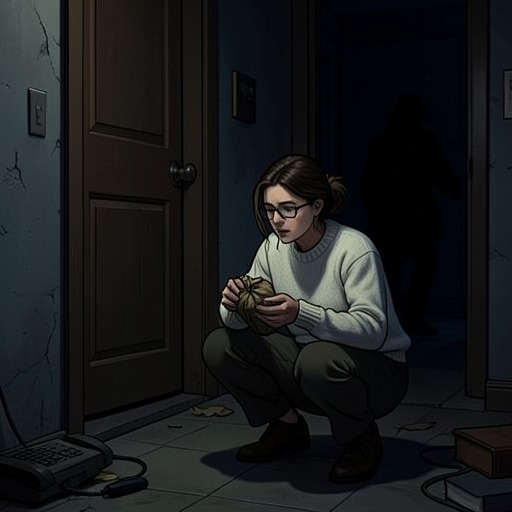
Maren’s last ordinary evening with Janelle ends with the promise of leftovers and a new book the next morning. When Maren wakes, the apartment is unnaturally still and there is no smell of coffee. On the kitchen table she finds a note in which Janelle says that she loves her daughter but cannot continue. Maren’s response is physical and disorienting: she turns her hands over as if they do not belong to her, then feels estranged from the chair, table, window, and even her mother.
Maren later connects the hundred dollars Janelle had given her with the name on the birth certificate. She concludes that Janelle expected her to travel by bus to Sandhorn, Minnesota, find Francis Yearly, and forget her mother. That is Maren’s interpretation of the money and the departure, rather than an explanation Janelle gives directly. The discovery does not immediately send Maren to her father: she first longs to make things right with her mother, then decides to go where she believes Janelle has gone, using the address of her grandparents that she had saved in her notebook.
Narrative Significance
Janelle is presented through unequal kinds of evidence: a birth record, a remembered scene, Frank’s retrospective account, and the brief note left behind. Together they make her both a person who offered sustained affection and the absent center of Maren’s search for family. Her love gives Frank a reason to imagine himself as more than his worst act; her departure leaves Maren with documents, money, and competing guesses where an explanation might have been. The contrast makes the family’s bonds feel real but not secure: care can shape a life, yet it does not guarantee that the people who depend on one another will remain together.