Lydia Harmon
Bones & AllLydia Harmon is an elderly woman whose ordinary kindness briefly gives homeless Maren a warm meal, a place to sleep, and the sense that someone trusts her. That fragile refuge ends with Lydia’s death: Maren finds her body, then discovers an old man feeding on it. The scene makes Lydia’s home a place where care and horror collide, and forces Maren to confront the likeness between the old man’s calm violence and her own.
Identity and First Encounter
Lydia first meets Maren in an Acme grocery store, after Maren has hurried out of a diner in embarrassment and is wandering with her rucksack. A can rolls away along the white linoleum; Maren picks it up, and Lydia asks her to read the label because her glasses are no longer useful. The can contains pear halves in white grape juice, the kind Lydia wants. Her precise, modest errand establishes the everyday setting in which their connection begins.
Lydia is presented through careful details of dress and manner: pale green jacket, red silk rose pinned to the lapel, gray tweed skirt, leather oxford shoes, and pearly-pink cat-eye reading glasses. She treats grocery shopping as a proper outing and responds to Maren with warmth rather than suspicion. When she asks Maren’s name, her hand is cold but her grip firm; she repeats the name appreciatively and introduces herself. The exchange gives Maren a moment of uncomplicated recognition at a time when she has no secure home.
Hospitality and a Brief Refuge
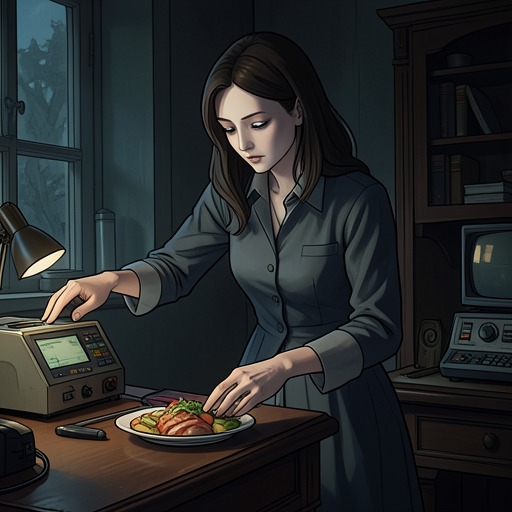
After paying for her groceries, Lydia goes with Maren to the bus stop and pays Maren’s fare when the bus arrives. Her kindness is material as well as conversational: she helps Maren continue her journey and asks if she is hungry. At Lydia’s home, that concern becomes food and shelter. Lydia prepares breakfast, and Maren regards it as the best meal she has ever tasted. A warm, honest meal eases her hopelessness, while Lydia’s company briefly lets her forget that she has nowhere to return to.
The emotional importance of the visit crystallizes when Maren realizes that Lydia trusts her. Maren takes their plates to the sink and washes them, including the frying pan. Lydia then lies on the sofa beneath a red-and-blue afghan, while her white cat settles on her stomach. The scene’s domestic details—shared breakfast, washed dishes, a familiar cat—give Maren a short experience of being accepted into someone else’s ordinary life.
Lydia’s home also contains the small routines and limitations of an older person’s life. She finds the ticking clock reassuring, even though her niece says it is too loud, and describes the passage of time as the one certainty in the world. A white wicker basket holds yarn in raspberry, peach, and baby-blue shades, but Lydia says arthritis prevents her from doing much needlework. Her hospitality is not presented as grand or heroic: it takes place amid a clock, a sofa, a cat, and unfinished wool, in a home shaped by both comfort and physical constraint.
Death and the Rupture of Safety
After sleeping in Lydia’s house, Maren wakes and finds it still. She goes to the living room, kneels beside the sofa, and calls Lydia’s name; touching her hand is enough to make Maren understand that Lydia is dead. Maren has never seen a dead person before, and the realization unsettles her so deeply that the floor seems to fall away. The white cat, curled on its cushioned stool, lifts its head and then settles again, registering no visible change. Its composure sharpens the contrast between the home’s familiar quiet and Maren’s shock.
Later, a sound wakes Maren again. She hears someone still living in the house, then smells blood and the sourness of a meal. In the dark hallway she sees the old man she had noticed from the bus, kneeling over Lydia’s body. Her head is gone; torn blouse lies on the carpet, and silver hair remains across the sofa arm. The man eats calmly and methodically. Maren cannot scream, because the act is familiar to her. She wonders whether she makes the same horrible noises when she feeds.
Narrative Significance
Lydia’s death reverses the meaning of the refuge she provided. The same home that offered Maren a warm breakfast and a trusted place to rest becomes the setting for a scene that exposes the danger surrounding her and the violence she recognizes within herself. Lydia herself does not learn Maren’s secret in the evidence presented here; instead, her ordinary generosity becomes the measure of what is lost when her body is consumed.
A later revelation identifies the old man as Sullivan and establishes that he is Maren’s father’s father. In retrospect, the attack on Lydia is not only an encounter with another eater but an early, horrifying point of contact with Maren’s own family history. Lydia’s brief appearance thus links intimate care to the book’s larger questions about inherited identity and chosen family: Sullivan argues elsewhere that people like them must make their own family, while Lydia’s kindness shows the immediate, concrete form that care can take. Her death leaves that kindness vivid precisely because it is not enough to protect her.